


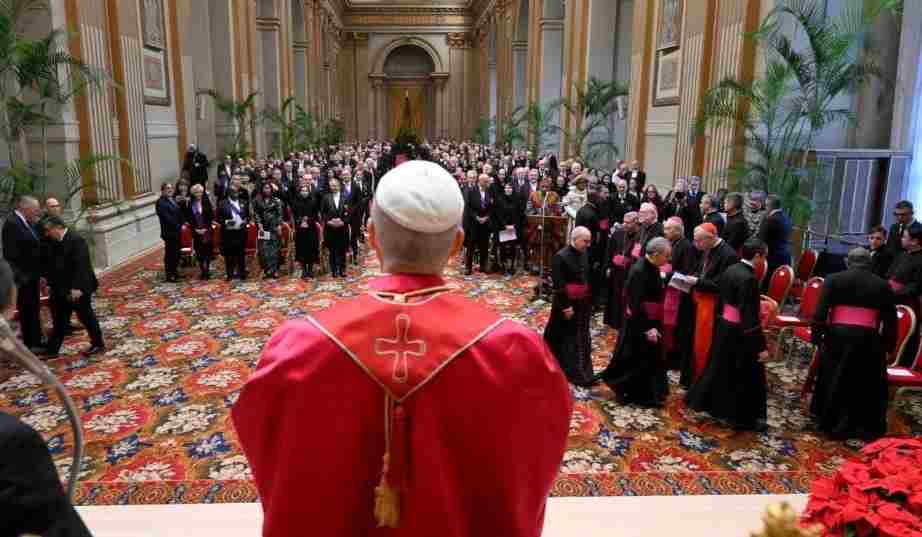
MEETING members of the Diplomatic Corps, Pope Leo XIV warns that human rights and freedoms are under strain as diplomacy gives way to the logic of power and war.
Warning that “war is back in vogue” and that peace is increasingly sought through force rather than justice, Pope Leo XIV issued a strong appeal for humility, dialogue, and a renewed commitment to multilateralism in his address to the Diplomatic Corps accredited to the Holy See.
Speaking on Friday, 9 January, during the traditional exchange of New Year greetings, the Pope cautioned that the foundations of international coexistence are being steadily undermined, as diplomacy based on dialogue gives way to the logic of power and deterrence.

“The principle established after the Second World War, which prohibited nations from using force to violate the borders of others, has been completely undermined,” he said, warning that such a mindset gravely threatens the rule of law itself.
The annual meeting between the Pope and Ambassadors accredited to the Holy See is considered one of the most significant moments in the Vatican’s diplomatic calendar.
RELATED STORY: Pope Leo Decries ‘Diplomacy Based On Force’ In Speech To Vatican Envoys
Often dubbed the “State of the World” Address, the Pope’s discourses in these occasions tend to offer a moral reading of international life – an appeal not to interests, but to conscience – offered at the beginning of a new year as a call to responsibility, restraint, and renewal.
For Pope Leo XIV, who said the occasion is “a new experience,” having been called only months ago to “shepherd Christ’s flock,” the address also served to articulate the moral horizon within which the Holy See understands diplomacy: a patient work of encounter, a defence of the vulnerable, and a commitment to peace rooted in truth.
Pope Leo XIV lamented the weakening of the principle established after the Second World War, by which nations pledged not to use force to violate the borders of others.
“The principle… has been completely undermined,” he said, warning that peace is increasingly sought “through weapons as a condition for asserting one’s own dominion,” a mentality that “gravely threatens the rule of law, which is the foundation of all peaceful civil coexistence.”
The Pope turned repeatedly to Saint Augustine to support his points, especially to De Civitate Dei (The City of God), in which Augustine reflects on pride, power, and the illusion of security.
Even those who wage war, the Pope recalled, ultimately desire peace – yet not peace as a shared good, but peace as possession. Citing Augustine, he said: “They do not, therefore, wish to have no peace, but only the peace that they desire.”
It was precisely this distortion, the Pope implied, that led humanity into catastrophe in the twentieth century. From that tragedy, he noted, the United Nations emerged, established eighty years ago as a centre of multilateral cooperation “for safeguarding peace, defending fundamental human rights and promoting sustainable development.”
From the principles of law, Pope Leo XIV moved to the concrete cost of war – especially when civilians become targets, and when essential infrastructure is destroyed.
“I would like to draw particular attention to the importance of international humanitarian law,” he said. Compliance cannot depend on “mere circumstances and military or strategic interests.”
Rather, he said, humanitarian law “is a commitment that States have made,” and “must always prevail over the ambitions of belligerents.”
He underscored that attacks on “hospitals, energy infrastructure, homes and places essential to daily life” constitute serious violations, and reiterated the Holy See’s condemnation of “any form of involvement of civilians in military operations.”
The moral measure, he insisted, is not advantage but dignity: “the protection of the principle of the inviolability of human dignity and the sanctity of life always counts for more than any mere national interest.”
The Pope then applied this moral framework to specific crises across the world. He spoke of the “ongoing war in Ukraine” and the suffering of civilians, reiterating “the pressing need for an immediate ceasefire,” and calling for dialogue “motivated by a sincere search for ways leading to peace.”
He appealed to the international community not to waver, and reiterated the Holy See’s willingness “to support any initiative that promotes peace and harmony.”
In the Holy Land, he noted that despite a truce announced in October, civilians continue to endure “a serious humanitarian crisis.” He reaffirmed attention to initiatives aimed at guaranteeing Palestinians in Gaza “a future of lasting peace and justice,” and reiterated that the two-State solution remains the institutional perspective for meeting the aspirations of both Palestinians and Israelis.
He also lamented increased violence in the West Bank against Palestinian civilians, who have “the right to live in peace in [their] own land.”
Pope Leo XIV also expressed concern about “escalating tensions in the Caribbean Sea and along the American Pacific coast,” renewing an appeal for peaceful political solutions.
He also addressed the crisis in Venezuela “in light of recent developments,” calling for respect for the will of the people and for the safeguarding of human and civil rights.
He invoked the witness of two Venezuelan saints canonised last October – José Gregorio Hernández and Sister Carmen Rendiles – as inspirations for building a society founded on “justice, truth, freedom, and fraternity.”
He spoke too of the violence and instability in Haiti, calling for concrete international support. Likewise, he pointed to the Great Lakes region of Africa; Sudan and South Sudan; tensions in East Asia; and Myanmar’s humanitarian crisis, worsened by last March’s earthquake, and called for “peace and inclusive dialogue” and access to humanitarian aid.
At the root of many of these crises, Pope Leo XIV said, lies the persistent belief that peace is possible only through force and deterrence. Yet peace, he warned, requires continuous construction and vigilance – especially among those with the greatest capacity for destruction.
He pointed to the urgency of nuclear arms control, noting the impending expiry of the New START Treaty in February, and warned of a return to an arms race with increasingly sophisticated weapons, including those shaped by artificial intelligence.
AI, he said, “requires appropriate and ethical management,” together with regulatory frameworks that protect freedom and human responsibility.
The Pope’s defence of dignity extended to migrants and prisoners – two groups often treated as problems rather than persons.
“Every migrant is a person,” he said, and therefore has “inalienable rights that must be respected in every situation.” Not all migration is chosen. He explained that many flee “violence, persecution, conflict, and even the effects of climate change.”
Marking the seventy-fifth anniversary of the International Organisation for Migration (IOM), the Pope warned that efforts against crime and trafficking must not become a pretext “for undermining the dignity of migrants and refugees.”
He also spoke of prisoners, insisting they “can never be reduced to the crimes they have committed.” He thanked governments that responded to Pope Francis’ Jubilee appeal for gestures of clemency, and expressed hope that the Jubilee spirit would inspire justice systems “permanently and structurally,” ensuring humane conditions and proportionate penalties.
Above all, he stressed, this includes abolishing the death penalty, which the Pope called a measure that “destroys all hope of forgiveness and renewal.” He did not forget “prisoners held for political reasons in many countries.”
Another theme of the Pope’s address was the warning about language itself: its weakening, its manipulation, and its conversion into an instrument of harm.
“Rediscovering the meaning of words is perhaps one of the primary challenges of our time,” he said, because when words lose their connection to reality, reality itself becomes “debatable and ultimately incommunicable.”
He recalled how Saint Augustine describes two people forced to remain together without a shared language: “dumb animals… understand each other more easily than these two individuals,” Augustine writes; indeed, “a man would more readily converse with his dog than with a foreigner!”
Yet, the Pope warned, semantic ambiguity today is not merely accidental. “Language is becoming more and more a weapon with which to deceive, or to strike and offend opponents,” he said, calling for words “to express distinct and clear realities unequivocally,” so that authentic dialogue can resume – in families, in politics, in the media, on social media, and in international relations.
He noted a paradox: this weakening of language is often defended “in the name of freedom of expression,” yet, “on closer inspection, the opposite is true,” because freedom is protected precisely when language is anchored in truth.
“It is painful to see how, especially in the West, the space for genuine freedom of expression is rapidly shrinking,” he said, warning of “a new Orwellian-style language” which, while seeking to be inclusive, “ends up excluding those who do not conform.”
From language, the Pope moved to rights increasingly threatened in contemporary societies: freedom of conscience and religious freedom.
He defended conscientious objection as a safeguard for dignity, noting that “Conscientious objection is not rebellion, but an act of fidelity to oneself.” It reflects the truth that a free society “does not impose uniformity but protects the diversity of consciences,” preventing authoritarian tendencies and fostering ethical dialogue.
Religious freedom, the Pope said, is also at risk. Quoting Pope Benedict XVI, he recalled it as “the first of all human rights.” He noted that violations are rising worldwide, with “sixty-four percent of the world’s population” suffering serious violations of this right.
The Holy See, he said, asks full respect for Christians, and “the same for all other religious communities.” On the sixtieth anniversary of Nostra Aetate, he reiterated the “categorical rejection of all forms of antisemitism,” and stressed the importance of Jewish-Christian dialogue and deeper common roots.
At the same time, he said, the persecution of Christians remains among the most widespread human rights crises today, affecting “over 380 million believers worldwide,” with high or extreme levels of discrimination and violence.
He recalled victims of violence in Bangladesh, the Sahel, and Nigeria, and those killed in the terrorist attack last June on the parish of Saint Elias in Damascus, as well as victims of jihadist violence in Cabo Delgado, Mozambique.
He also pointed to subtler discrimination against Christians even in majority-Christian societies, including in Europe and the Americas, where Christians may be restricted from proclaiming the Gospel – especially when they defend “the dignity of the weakest, the unborn, refugees and migrants, or promote the family.”
Pope Leo XIV reaffirmed that the right to life is the foundation of every other right and warned that the contemporary human rights framework risks losing its vitality when rights become detached from reality and truth.
“In the current context, we are seeing an actual ‘short circuit’ of human rights,” he said, as fundamental freedoms – speech, conscience, religion, even life – are restricted “in the name of other so-called new rights,” creating space for force and oppression.
The Pope spoke about the family as the privileged place where human beings learn to love and to serve life.
He described two urgent challenges: the tendency to marginalise the family’s role in the international system, and the painful reality of fragile families afflicted by hardship and domestic violence.
He reiterated the Church’s categorical rejection of practices that “deny or exploit the origin of life” as well as projects that assist people in doing so. Public resources, he said, should support mothers and families rather than “suppress life.”
Despite the gravity of his diagnosis, Pope Leo XIV insisted that peace remains “a difficult yet realistic good.” Quoting Augustine, he called peace “the aim of our good,” a foretaste of the City of God even within the earthly city.
Peacemaking, he said, requires “humility and courage: the humility to live truthfully and the courage to forgive.” These virtues, he added, are revealed at Christmas – when Truth becomes humble flesh – and at Easter, when the condemned Righteous One forgives and grants life as the Risen One.
Bringing his discourse to a close, Pope Leo pointed to signs of hope: the Dayton Accords that ended the war in Bosnia and Herzegovina thirty years ago; the Joint Declaration of Peace between Armenia and Azerbaijan signed last August; and efforts by Vietnamese authorities to improve relations with the Holy See. These are “seeds of peace,” he said, that must be cultivated.
Looking ahead to October’s eighth centenary of the death of Saint Francis of Assisi, “a man of peace and dialogue,” the Pope concluded by invoking the saint’s witness of humility and truth, and wishing “a humble and peace-loving heart” for all at the beginning of the new year. (Vatican News)
