



By National Record
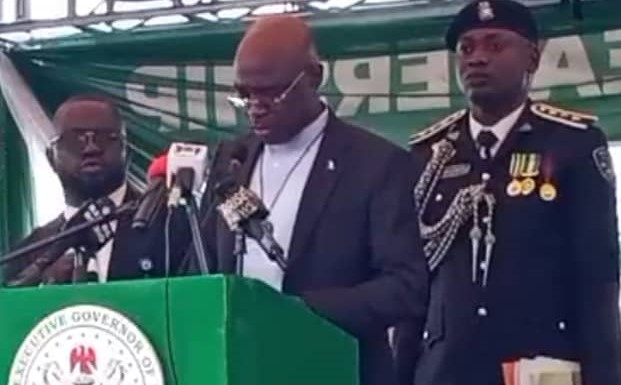
BENUE State Governor, Rev. Fr Hyacinth Alia, marked his second year in office on Thursday with a grand Democracy Day event in Makurdi — a spectacle heavy on self-praise but light on substantive accountability.
While the governor boasted of transformative achievements, glaring gaps and broken promises cast a shadow over the festivities.
At the IBB Square, Rev. Fr. Alia recited a now-familiar list of accomplishments: a ₦75,000 minimum wage, road projects, 100 buses for Benue Links, and reforms across education and healthcare.
Yet, these claims demand scrutiny. The much-touted minimum wage, while commendable, remains inaccessible to many workers, particularly casual staff who continue to languish without regularization — despite a state policy limiting such employment to five years.
Some have endured over a decade in precarious positions, yet Alia’s administration has done little to address their plight.
In addition to this uncertain situation for casual workers, the governor continues to renege on his campaign promise to clear arrears of salaries and pension within hundred days in office, a promise upon which he got elected on a massive scale, and despite a burgeoning revenue accruable from the removal of subsidy on petroleum products.
As a result of this, many civil servants, while being paid the new minimum wage, still remain unsettled, while pensioners, especially retired teachers, die in droves from common age-related ailments they are incapable of treating.
The governor proudly declared completing projects across all 23 LGAs “without taking loans,” attributing this to phantom savings from civil service reforms. But where is the transparency? Where are the detailed financial records to prove these savings?
Meanwhile, the Makurdi underpass — promised for inauguration on his second anniversary — remains un-commissioned, another in a string of delayed projects.
Although Alia got the APC’s endorsement of for a second term at the anniversary, but it seems premature and reeks of political maneuvering rather than genuine performance assessment in the context of crisis in the party amidst increasing insecurity statewide.
Similarly, the rushed motion to adopt President Tinubu as the party’s 2027 presidential candidate in the state further exposes the event as a staged loyalty parade rather than a meaningful review of governance.
While traditional rulers and party elites lavished praise, workers and civil society groups rightly question the administration’s priorities.
A ₦20 billion cancer center is laudable, but what of the basic welfare of civil servants? What of the schools still in disrepair despite claims of renovation?
Alia’s speech was heavy on rhetoric about a “digital age” and “infrastructure revolution,” but Benue’s people deserve more than slogans — they deserve tangible results, transparency, and accountability.
Two years in, the governor’s record remains a mix of modest gains and unfulfilled promises. The real test is whether the next two years will deliver substance — or just more ceremonies.
