


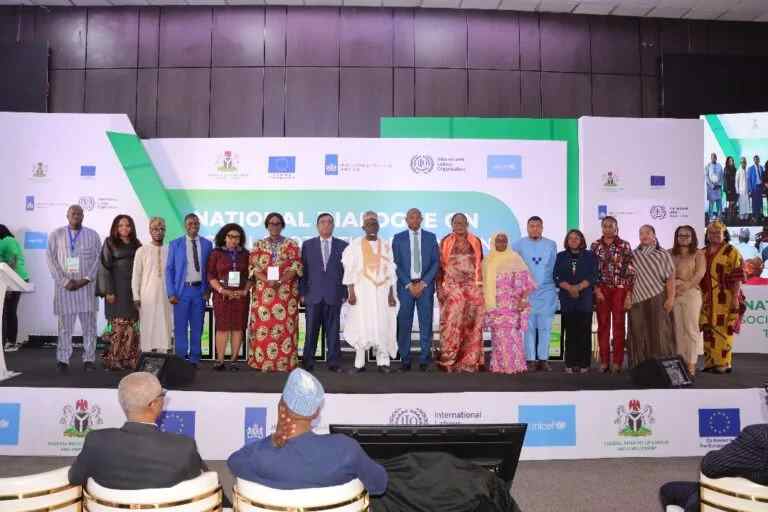
THE FEDERAL Government has revealed plans to provide social protections to over 60 million Nigerians working in the informal sector.
The Minister of Labour and Employment, Dr Muhammad Dingyadi, disclosed this on Tuesday in Abuja, at the National Dialogue on Extending Social Protection Coverage to Informal Economy Workers.
The dialogue was organised by the Ministry in collaboration with the International Labour Organisation (ILO).
Dingyadi said the government is partnering key social protection agencies to deploy mobile health insurance and micro-pension schemes targeting millions of workers in the informal sector.
According to the minister, no fewer than 60 million Nigerians in markets, farms, transport clusters and workshops lacked basic protection.
He restated the government commitment to closing the gap through technology-enabled systems.
“Our goal is to extend social protection to all Nigerians, especially the most excluded,” he stressed..
He listed ongoing initiatives to include the expansion of the National Health Insurance Authority and the Nigeria Social Insurance Trust Fund to cover informal workers through mobile platforms designed for easy and flexible access.
The minister added that the micro pension plan driven by PENCOM and the National Bureau of Statistics would deepen pension inclusion.
According to him, pilot projects of the plan with the ILO, UNICEF, and the World Bank are testing scalable community insurance models.
He urged participants to produce a national implementation framework.
He urged that the dialogue must not end with communiqués that gather dust, but with clear targets, financing pathways and full stakeholder commitment.
Dr Vanessa Phala, the ILO Country Director for Nigeria, Ghana, Liberia and Sierra Leone, , said social protection remained a human right and an economic necessity.
Phala, represented by Mr Shailendra Kumar, Special Technical Advisor to the ILO, said it reduced poverty, exclusion and inequality while enhancing social cohesion.
She noted that many informal workers were among the 85.2 per cent of Nigerians without adequate protection, adding that a comprehensive strategy was needed to overcome barriers to social security coverage.
“The ILO will continue supporting Nigeria’s efforts.
“Extending legal coverage and strengthening financing mechanisms are crucial for building a universal social protection system,” she said.
The Minister of Humanitarian Affairs and Poverty Reduction, Dr Bernard Doro, said informal workers faced income instability, lack of insurance and exposure to economic shocks.
The minister, represented by Mr Peter Audu, Deputy Director in the ministry, said the dialogue provided a platform to design practical solutions to the challenge.
He said the ministry remained committed to the Renewed Hope Agenda, which prioritised poverty reduction and social inclusion.
Doro assured that ongoing collaboration with states, development partners and civil society would strengthen coordination.
He added that the dialogue would shape reforms towards a shock-responsive and inclusive protection system.
The Director-General of the Nigeria Employers’ Consultative Association (NECA), Mr Adewale-Smatt Oyerinde, described the dialogue as timely and critical for extending protection to the nation’s vast informal workforce.
Oyerinde, represented by Mr Thompson Akpabio of NECA’s Abuja Liaison Office, said NECA was ready to support the initiative.
He added that working through existing associations could help extend safety nets without compromising standards or the quality of products targeted at informal workers. (NAN)
