


By Our Reporter, With Vatican News Report
POPE Leo XIV has urged academics at Oriel College, University of Oxford, to pursue truth courageously, uphold human dignity and promote an approach to education that recognises the whole person.
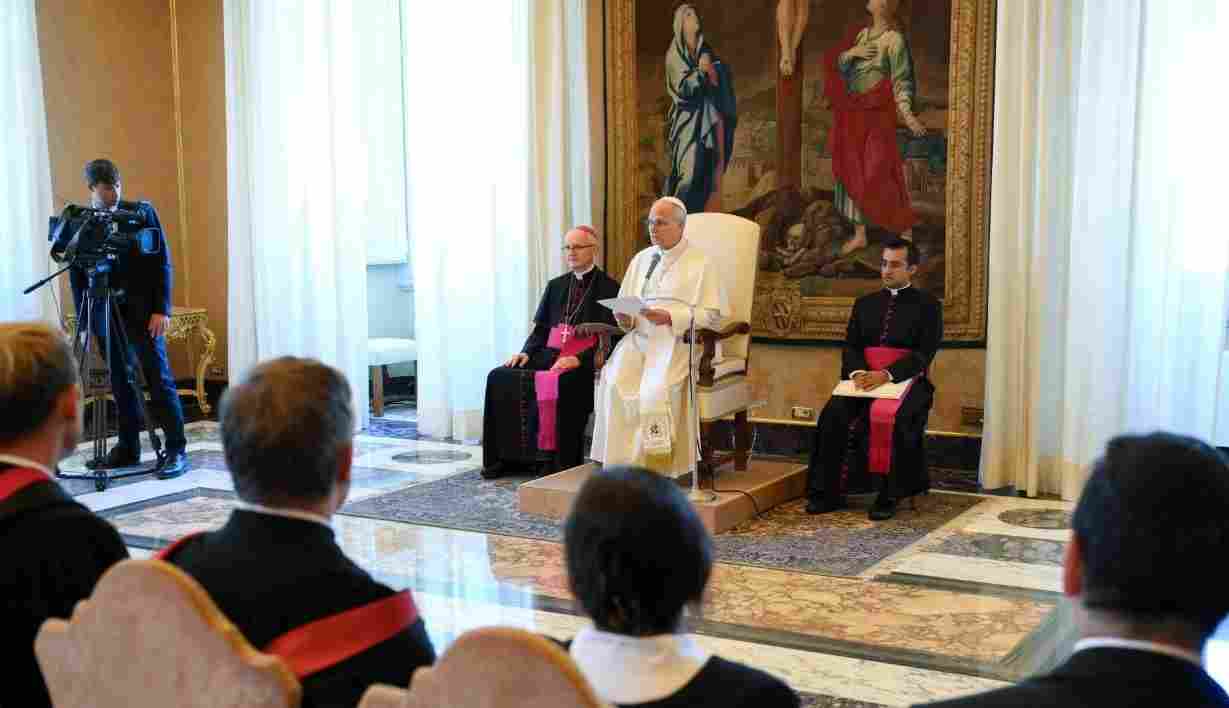
The Pope made the call on Friday when he received the Provost, Fellows and members of Oriel College at the Vatican, as the historic Oxford institution marks its 700th anniversary.

Founded in 1326 under the patronage of King Edward II, Oriel College is formally known as “the House of the Blessed Mary the Virgin in Oxford.” The institution has maintained a Christian identity throughout its long history and counts St. John Henry Newman and two Nobel laureates among its distinguished alumni.
In his address, Pope Leo praised the college for preserving its Christian character despite centuries of social, cultural and academic change.
He described this identity as central to Oriel’s ability to remain more than an academic institution, saying it could continue to be “a true community of faith and scholarship in its deepest meaning.”
Newman as a Model for Faith and Reason
A major focus of the Pope’s address was the legacy of St. John Henry Newman, the English cardinal, theologian and former member of Oriel College.
Pope Leo described Newman as a “shining example” of a scholar who demonstrated the inseparability of faith and reason not only through his writings but also through the way he lived.
Newman was canonised by Pope Francis in October 2019. Pope Leo XIV proclaimed him a Doctor of the Church in 2025 and named him, together with St. Thomas Aquinas, co-patron of Catholic education.
According to Pope Leo, Newman’s ideas were marked by a strong practical dimension. His religious convictions, he said, were rooted in a personal relationship with God, while his academic work combined intellectual excellence with practical relevance.
The Pope’s emphasis on Newman comes at a time when universities and other institutions of higher learning are facing questions about the purpose of education, the place of religion in public life and the responsibility of scholarship to society.
Education Beyond Academic Achievement
Pope Leo encouraged Oriel College to draw from Newman’s understanding of Christian education, which he said should embrace the entire human person.
He said the value of education should not be measured solely by academic achievement or professional advancement, but also by its contribution to human dignity, justice and the common good.
The Pope argued that this understanding of education remains particularly relevant in the modern world, where societies face complex challenges requiring not only technical expertise but also sound ethical judgement and concern for others.
His message has implications beyond Oxford, particularly for Catholic and other faith-based educational institutions that seek to balance academic excellence with moral and spiritual formation.
For countries such as Nigeria, where faith-based schools and universities remain significant parts of the education system, the Pope’s emphasis on education as formation of the whole person also resonates with ongoing discussions about character formation, social responsibility and the role of education in national development.
Call for a Renewed Vision of Humanity
Pope Leo concluded his address by challenging Oriel’s scholars to “seek the truth courageously” and promote what he called an “integral anthropological vision”.
The concept places the human person at the centre of educational and social reflection, recognising intellectual, moral, spiritual and social dimensions rather than reducing people to their economic, professional or academic usefulness.
The Pope said such an approach could help scholars facilitate a “heart to heart” encounter with others and, ultimately, with Jesus Christ, whom Christian faith recognises as “the way, the truth, and the life.”
His meeting with Oriel College therefore combined a celebration of the institution’s seven centuries of history with a broader appeal about the future of education.
For Pope Leo XIV, the university should remain a place where the pursuit of knowledge is connected with the pursuit of truth, where reason can engage constructively with faith, and where scholarship ultimately serves human dignity and the common good.
