


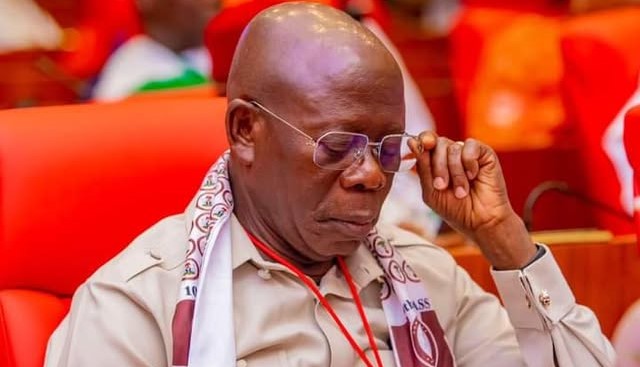
A DRAMATIC confrontation is engulfing the Nigerian Senate as former Edo State Governor and serving senator, Adams Oshiomhole, demanded the resignation of Senate President Godswill Akpabio on Thursday, accusing him of orchestrating a morally bankrupt amendment to the chamber’s standing rules to extend his political lifespan.
The call for Akpabio to vacate his office came after the upper legislative chamber passed controversial amendments to its standing orders, introducing a stringent requirement that only senators who have served at least two consecutive terms (eight years) are eligible to contest for the position of Senate President.
Speaking with journalists in Abuja following a heated plenary session, Oshiomhole did not mince words, describing the new rules as “serious moral crisis” and arguing that Akpabio himself would fail the very eligibility test he is trying to impose on the 11th Assembly.

“The Senate President became Minority Leader on his fourth day in office, on his first term. He is now the one presiding and asking us to change these rules such that even somebody who did a first term cannot contest,” Oshiomhole declared, his voice laced with incredulity.
He pointedly noted that Akpabio has not yet spent a cumulative eight years in the Red Chamber.
“Even if you count the previous one, plus the current one, it is not yet up to eight years,” Oshiomhole stated, adding: “So, if we pass the rule that you must do eight consecutive years before you can be Senate President, it means he has to lead by example by vacating because he is presiding without acquiring the appropriate qualification” .
The crisis stems from a contentious amendment to the Senate Standing Orders, initially passed via a voice vote that critics claim was designed to limit competition ahead of the 2027 leadership tussle.
Under the new framework, the pool of eligible candidates for principal offices has been drastically narrowed to exclude fresh and even some returning legislators.
Following an immediate backlash, the leadership partially reversed some amendments related to oath-taking procedures, though the core eligibility requirements linked to tenure reportedly remain in force.
Oshiomhole, a fierce labour leader turned politician known for his rhetorical firepower, drew a sharp contrast between the current leadership and that of former Senate President David Mark.
He argued that rules should not be “played with” to entrench a single individual.
“Senator David Mark had the honour and privilege of serving as Senate President for eight years, not by playing with the rules,” Oshiomhole said. “Those rules that enabled David Mark to preside for eight years, what is wrong with them? Those rules that enabled this Senate President to contest for Senate Presidency, what is wrong with them? Why changing it now?”.
Oshiomhole alleged that the amendment is a direct reaction to shifting political dynamics. “You think that next time, because last time, this rule of one-term ranking is what you require, and he turned out to be the only one from the South-South where it was zoned to,” he explained. “Now you hear that more senators will be eligible, which will broaden the competition base, and now he wants to change it”.
The Edo North senator, who belongs to the same All Progressives Congress (APC) as Akpabio, insisted he was unafraid of political reprisals for his dissent.
“If other people are afraid, I am not afraid. I am only afraid of my creator,” Oshiomhole declared, adding a philosophical warning about mortality: “I’ve seen whether you tell the lie or tell the truth, the date of death, you can’t adjust it”.
The tension has fractured the Senate, with other lawmakers, including Senator Abdul Ningi (Bauchi Central), echoing Oshiomhole’s sentiments. Ningi described the amendment as “self-serving and self-centred,” accusing the leadership of tailoring laws to specific ambitions rather than national interest.
As of press time, the office of the Senate President had not issued an official rebuttal to the resignation calls.
However, the development marks one of the most aggressive public challenges to Akpabio’s authority since he assumed the leadership of the 10th National Assembly, signalling a potentially brutal legislative war ahead of the 2027 political season.
