



BY MAX AMUCHIE
THE WORLD is entering a new geopolitical era. The concentration of global power that characterised much of the post-Cold War international order is giving way to an increasingly multipolar configuration. New centres of economic, military, technological and diplomatic influence are emerging, challenging established hierarchies and creating new possibilities for international cooperation and competition.
The rise of China, the renewed international influence of Russia, the expanding ambitions of BRICS and the continuing influence of traditional Western powers all point towards an international system in transition.

Much of the conversation focuses on the redistribution of power between states. Who will lead the emerging international order? Which countries will shape its institutions? What does multipolarity mean for international cooperation?
ALSO READ: Marriage Breakup Drama In Courts, Podiums And Pulpits; By Hassan Gimba
These are important questions. But they leave another insufficiently examined: What happens when a state’s international standing remains intact, but its capacity to exercise legitimate authority across its constituent territories becomes increasingly uneven?
A country may enjoy diplomatic recognition, attract competing international partners and participate in influential geopolitical alliances while struggling to protect populations, control territories, regulate resources and sustain institutions in particular geographical spaces.
The redistribution of international power does not necessarily strengthen operational sovereignty within individual states. This distinction is central to understanding the emerging multipolar world. It is also where the Decoupling Sovereignty Index (DSI) offers an important analytical contribution.
The Sovereignty Question Beyond Geopolitics
Formal sovereignty and operational sovereignty are not always the same thing. A state can retain its internationally recognised borders and constitutional authority while alternative centres of power exercise considerable influence over economic activity, security arrangements and social organisation within particular territories.
Its national institutions may remain operational while their capacity to perform essential sovereign functions deteriorates in specific geographical spaces.
The resulting gap between formal sovereignty and its operational expression is central to the DSI.
An important methodological distinction follows: sovereignty deficits are not necessarily distributed uniformly across a country. Some territories may experience effective public authority, while others face compromised protection, resource capture, territorial contestation and the emergence of alternative systems of authority.
ALSO READ: The Big Three In Yalta-Like Summit To Calm Unsettled Waters; By Owei Lakemfa
National aggregates can conceal these differences by averaging conditions across entire countries.
The DSI therefore adopts the subnational geographical zone, not the country as a national aggregate, as its primary unit of analysis.
It investigates how sovereignty is exercised, weakened, displaced or sustained within defined geographical territories. This does not diminish the state’s status as the formal sovereign entity. Rather, it distinguishes juridical sovereignty from the geographical distribution of its operational expression.
Why the Multipolar World Needs a Different Instrument: Four Illustrations of Decoupled Zones
The analytical distinction becomes clearer through specific geographical examples. Haiti, Colombia, Mexico and Nigeria offer different political and institutional environments in which the geographical distribution of sovereign authority raises important questions.
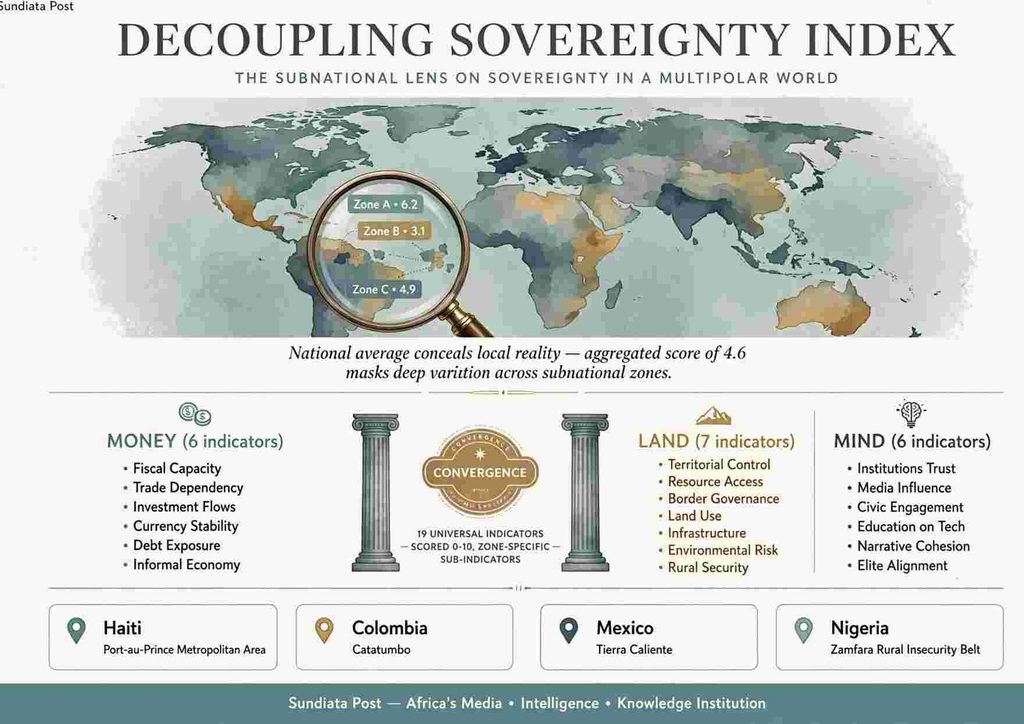
These are illustrative candidate zones for DSI investigation, not completed assessments or officially validated DSI classifications.
Haiti: Port-au-Prince Metropolitan Area
The metropolitan area of Port-au-Prince presents a striking illustration of the fragmentation of public authority. Armed gangs have established extensive territorial influence across parts of the capital, including Cité Soleil, while exercising influence over transport routes, economic corridors and access points.
ALSO READ: Tinubu And The Ancient Idoma Tale Of Oyíbíbí; By Iduh Onah
Their activities extend beyond violence to economic disruption, coercive taxation, restrictions on movement and compromised access to public services. The crisis has also spread into departments including Artibonite and Centre.
A DSI investigation would examine these conditions through its three vectors. Money would assess coercive revenue extraction and economic capture; Land would examine territorial control, protection and freedom of movement; Mind would investigate institutional legitimacy, public confidence and the displacement of public authority by alternative systems.
Haiti’s formal sovereignty remains intact, but its operational expression is severely compromised in particular geographical spaces.
Colombia: Catatumbo
The Catatumbo region of Norte de Santander provides another important candidate. Municipalities including Tibú, El Tarra, Teorama and San Calixto have experienced prolonged armed conflict involving the National Liberation Army (ELN), FARC dissident organisations and other armed actors competing for territorial influence and illicit economic activities.
The January 2025 escalation demonstrated the consequences of this competition. Human Rights Watch documented the displacement of more than 64,000 people following the ELN offensive.
A DSI investigation would examine how illicit economies interact with territorial authority and institutional legitimacy. Money would investigate the economic foundations of competing power structures; Land would assess territorial control, population protection and institutional presence; Mind would examine public allegiance, institutional confidence and alternative systems of authority.
ALSO READ: As AI Interference In Election Discourse Takes Centerstage; Zainab Suleiman Okino
Catatumbo illustrates how a functioning national state can coexist with substantially compromised operational sovereignty in particular territories.
Mexico: Tierra Caliente
In Mexico, the Tierra Caliente region of Michoacán offers a different illustration. Municipalities such as Apatzingán, Buenavista and Parácuaro are relevant to examining the relationship between organised criminal power, territorial influence and economic resource capture.
The region’s agricultural economy, particularly lime and avocado production, has become an arena of criminal competition and coercive economic extraction. Armed organisations have sought to influence supply chains, impose extortion payments and control revenue-generating activities.
A DSI investigation would examine how criminal organisations capture economic value and influence legitimate commercial activity under Money; how they exercise territorial influence and coercive authority under Land; and how persistent intimidation affects institutional legitimacy and public confidence under Mind.
Tierra Caliente demonstrates how economic control can become a mechanism through which alternative systems of authority acquire influence over geographical territories.
Nigeria: Zamfara’s Rural Insecurity Belt
Nigeria provides an especially important illustration because its insecurity challenges are geographically differentiated.
Rural areas around Maru, Shinkafi, Zurmi and Bukkuyum in Zamfara State offer potential zones for examining the relationship between banditry, economic coercion, territorial insecurity and institutional vulnerability.
ALSO READ: Tinubu And The Politics Of Royal Hypocrisy: When The Palace Becomes A Campaign Office; By Abadom Lawrence Amechi
The European Union Agency for Asylum’s January 2026 assessment reported that more than 273 people were killed by bandits in Zamfara between May 2023 and May 2025. It also cited reports of 725 villages across 13 local government areas being controlled by bandit and criminal groups.
These conditions raise questions beyond the conventional classification of Zamfara as an insecurity-affected state.
Money would investigate coercive taxation and the economic foundations of bandit power. Land would examine territorial control, protection and the geographical reach of legitimate state authority. Mind would investigate institutional trust, public confidence and the consequences of prolonged insecurity for the relationship between citizens and the state.
Zamfara demonstrates how sovereignty deficits can become concentrated in rural territories even while formal state institutions continue to operate elsewhere.
What These Illustrations Demonstrate
The four examples reveal different configurations of sovereignty decoupling. Haiti illustrates armed territorial control and the displacement of public authority. Catatumbo demonstrates the interaction of illicit economies and competing armed organisations. Tierra Caliente reveals the relationship between criminal power and economic resource capture. Zamfara illustrates coercive taxation, insecurity and weakened institutional presence.
These are not identical manifestations of sovereignty decay, nor should they be assigned equivalent DSI scores without systematic investigation.
ALSO READ: The Atiku Dilemma: The Courts, ADC And The Battle For Nigeria’s 2027 Presidency; By Lanre Ogundipe
Their significance is that the same analytical framework can investigate different configurations of sovereign decoupling across distinct political and geographical environments.
A DSI application would identify a defined zone, establish the relevant evidence, assess the 19 indicators under Money, Land and Mind, and investigate the convergence of the conditions identified. Its findings would describe the operational sovereignty conditions of that zone, not automatically those of the entire country.
The same country may contain zones with substantially different configurations of operational sovereignty. Equally, zones in different countries may exhibit comparable patterns despite different political and historical circumstances.
This is why the zone is fundamental to the DSI.
Universality Without Uniformity
A universal analytical framework does not require uniform application. Countries have different constitutional arrangements, political histories, economic structures and territorial configurations. Sovereignty deficits in a resource-dependent economy may manifest differently from those in an industrialised economy.
The DSI’s Money, Land and Mind architecture provides a common analytical grammar for examining these differences.
Its measurement architecture comprises 19 universal indicators: six under Money, seven under Land and six under Mind. These indicators provide the basis for structured assessment within a defined geographical zone rather than averaging conditions across an entire country.
The framework also incorporates a Convergence Indicator and a Recovery Sequencing Score.
The Convergence Indicator examines how conditions across the three vectors reinforce or compound one another within a zone. It recognises that economic, territorial and institutional vulnerabilities cannot always be understood independently.
The Recovery Sequencing Score addresses the order in which conditions necessary for restoring sovereign capacity should be addressed.
The framework is therefore concerned with diagnosis as well as the analytical foundations of recovery.
Its international application will require transparent indicator definitions, context-sensitive evidence, consistent assessment procedures and independent methodological scrutiny. Universality must be demonstrated through application, not merely asserted through ambition.
The Multipolar World and the Measurement of Sovereign Reality
The emergence of a multipolar international order does not automatically expand the operational sovereignty of individual states. A government may have more international partners while remaining unable to protect populations in particular territories. It may attract competing investments while losing effective control over strategic resources in specific geographical spaces.
The central challenge is therefore not simply to understand how power is redistributed between states, but also how sovereign authority is distributed, exercised, weakened or displaced within them.
This is the intellectual space the DSI seeks to occupy.
Its proposition is that sovereignty must be examined not only as a legal status or diplomatic entitlement but also as an operational reality whose expression varies across geographical territories.
The DSI moves the measurement of sovereignty beyond national aggregates to the subnational zone, where the realities of authority, protection, resource control and institutional legitimacy can be investigated.
Its framework originates in Africa, but its analytical ambition extends beyond Africa. It seeks to contribute to a global conversation in which sovereign reality can be examined across different political systems without geographical or intellectual exceptionalism.
The emerging multipolar world needs more than new geopolitical alignments and competing centres of influence. It needs better ways of understanding not only the states that constitute the international system, but also the geographical spaces within which their sovereignty is expected to operate.
The redistribution of global power cannot guarantee the restoration of sovereign reality within states. Nor can national averages necessarily reveal where that reality is most severely compromised.
That is the distinction the Decoupling Sovereignty Index brings into focus.
Completing an Intellectual Series
The DSI began as an attempt to understand the changing character of insecurity and the erosion of sovereignty. It has evolved into a framework for examining the geographical distribution of operational sovereign authority. Its next test is application, scrutiny and the demonstration of its value across different territorial and institutional contexts.
And it is why an African-originated analytical framework, developed through a media institution that understands journalism as a foundation for enduring knowledge, deserves to be part of the conversation about the future of the multipolar world.
Since 7 June 2026 when it was unveiled what began as an intellectual proposition has since developed into an analytical framework with an increasingly defined methodology and global ambition.
Over the eight weeks of this series, we have examined different dimensions of sovereignty decoupling. We began with the disturbing possibility of how an individual can disappear as a nobody within a decoupled zone. We explored the fieldcraft principle underpinning the DSI, its 19 indicators, the mechanisms through which decoupling reinforces itself, the Recovery Sequencing Score and the place of the DSI within a lineage of newsroom-developed indices.
Each instalment has added another layer to the framework’s intellectual and methodological architecture.
Today, we take the final step: examining the DSI as a potential universal analytical tool for a multipolar world.
With this instalment, the eight-part series concludes. But the questions it raises, and the work of developing and applying the index continue.
Dr Amuchie is the developer of the Decoupling Sovereignty Index and the CEO of Sundiata Post Media Ltd. He is the Founder and Curator of the Sundiata Post Research Repositories (Harvard Dataverse and Zenodo).
