


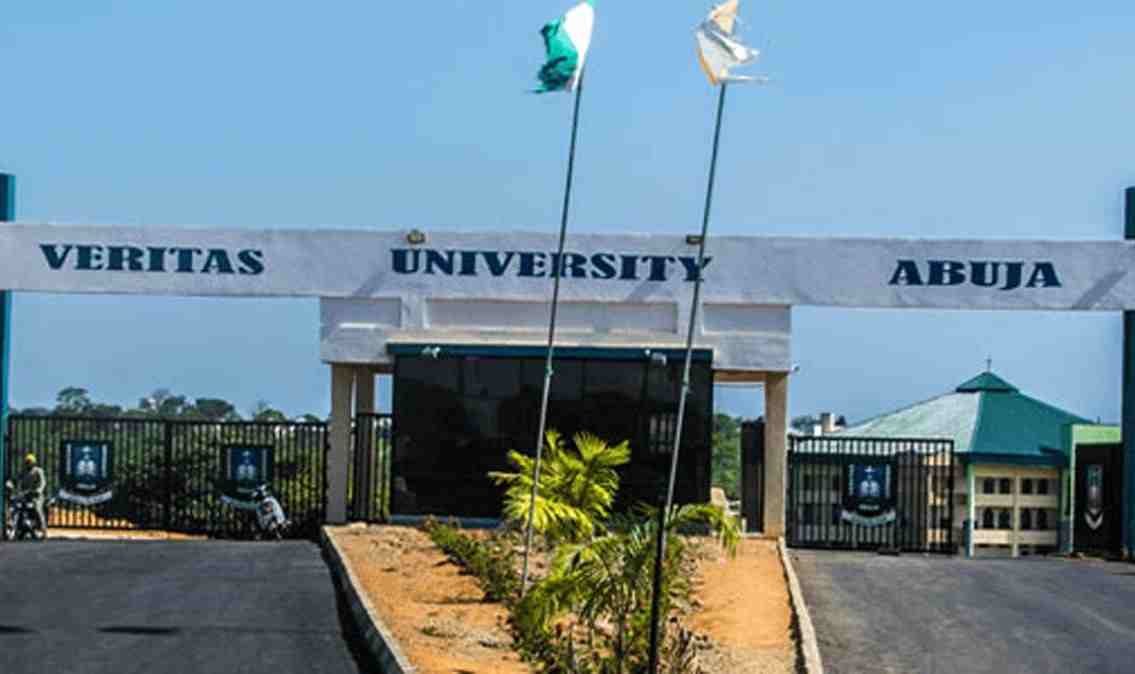
VERITAS University, Bwari, Abuja, has commenced a three-day staff retreat aimed at developing strategies to transform the institution into a world-class Nigerian university through technology, collaboration and staff development.
Declaring the retreat open on Wednesday, the Vice-Chancellor of the university, Prof. Hyacinth Ichoku, said the event was an opportunity for reflection, strategic thinking, renewal and recommitment to the vision and mission of the institution.
The retreat, themed “Building a World-Class Nigerian University:Strategies, Challenges and Opportunities, ” is being facilitated by Emeritus Prof. Peter Okebukola, former Executive Secretary of the National Universities Commission (NUC).

Ichoku said the university could only achieve its aspiration of becoming world-class through the collective efforts of its management, academic and non-academic staff.
According to him, the strength of a university lies in the quality of relationships among its members and the ability of its various organs to collaborate rather than operate in silos.
“No university becomes a world-class university through the efforts of one department, faculty, staff member, management or vice-chancellor.
“A university is a community, and its strength lies in the quality of relationships among its members.
“We are one Veritas University,” he said.
The Vice-Chancellor said technology, especially Artificial Intelligence (AI), was rapidly transforming teaching, learning, research, administration and virtually every aspect of university operations.
He said the university would intensify training programmes to ensure that every member of staff acquired the requisite skills to use AI and other emerging technologies effectively.
He said management was also investing in technological infrastructure, including the importation of 350 computers and 60 smart boards, in addition to the 18 smart boards already available.
He explained that the investment was aimed at ensuring that major classrooms in the university were equipped with smart boards and that lecturers were adequately trained to use them.
The vice-chancellor said the university was committed to providing the tools and environment required for staff to perform at world-class standards.
He urged staff to embrace technology, noting that they were teaching a generation whose learning patterns and expectations were changing rapidly.
On his part, Okebukola urged the university to make needs assessment the starting point for planning retreats, training and other capacity-building programmes.
He said the approach would enable institutions to identify the specific challenges and priorities of their staff and tailor programmes toward addressing them.
Okebukola said a needs assessment conducted ahead of the retreat showed that AI was the highest-ranked area staff wanted the programme to address.
“I did not come here with Artificial Intelligence in mind. I did not come because I am a practitioner or because I had already decided that this was what we would discuss.
“You said that this was what you wanted, and that is the beauty of it. That is why we are focusing on Artificial Intelligence,” he said.
The former NUC boss warned that individuals and institutions that failed to embrace AI risked being left behind in the coming years.
“Anybody in this hall, or anywhere in the world, among the 8.2 billion people, who runs away from Artificial Intelligence is going to be in big trouble in the next five years,” he said.
He said the retreat would feature a practical, hands-on session to enable participants to understand AI beyond the use of popular tools such as ChatGPT and Claude.
Okebukola said participants would also examine the limits of AI, the role of humans in an increasingly automated world and potential risks associated with increasingly intelligent machines.
On the university’s Catholic identity, Okebukola urged the institution not to lose sight of its spirituality while pursuing academic excellence and global recognition.
He said the university must aspire to attain the standards of leading Catholic universities globally, stressing that spirituality should remain a primary component of its identity.
He cited institutions such as Université Catholique de Louvain in Belgium, Pontificia Universidad Católica del Perú, Fordham University, Loyola University Chicago and Pontificia Universidad Católica de Chile as examples of highly ranked Catholic universities.
Okebukola said Veritas University needed to invest in research, teaching, facilities and other areas that could improve its ranking while ensuring that its Catholic identity remained central.
He also noted that the Federal Government had directed Nigerian universities, including federal, state and private institutions, to participate in university ranking.
He said the development made the retreat particularly important as the university developed strategies to improve its academic and institutional standing.
Okebukola said the ultimate goal should be to produce graduates who were academically competent, professionally capable, morally grounded and committed to the common good.
He said such graduates should combine expertise in their chosen professions with the values and spirituality expected of students at a Catholic university. (NAN)
