


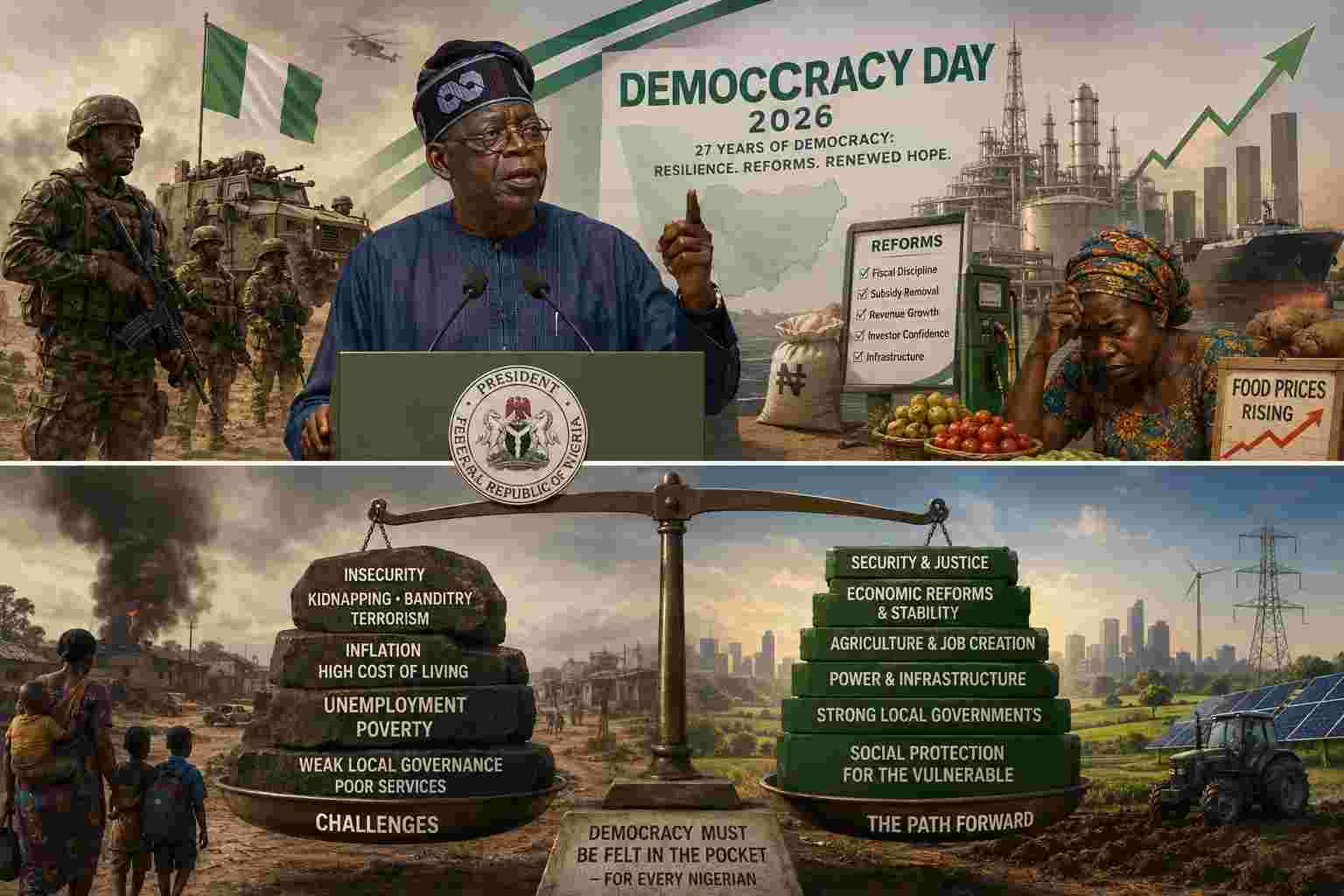
This News Analysis examines President Bola Ahmed Tinubu’s 2026 Democracy Day address which sought to project confidence in Nigeria’s democratic resilience and defend the far-reaching economic and security reforms his administration has pursued since 2023. It explores the gap between the administration’s claims and the realities being experienced by citizens, evaluates the prospects of Tinubu’s reform agenda, and assesses whether the government’s current policy trajectory is likely to deliver the prosperity and stability it promises or deepen public discontent in the years ahead.
PRESIDENT Bola Ahmed Tinubu’s 2026 Democracy Day address was both a celebration of Nigeria’s democratic journey and a defence of the economic and security policies that have defined his administration since 2023. Unlike previous speeches that often focused solely on achievements, this address contained notable acknowledgements of persistent hardship, insecurity and governance failures. Yet, beyond the rhetoric of hope and resilience, the speech invites a critical assessment of whether the government’s claims align with the realities confronting Nigerians and where current policies are likely to lead the country.
At its core, the address sought to frame Nigeria’s 27 years of uninterrupted civilian rule as a democratic success story. On that score, the President’s argument is difficult to dispute. Since 1999, power has changed hands through elections and constitutional processes rather than military coups. Despite persistent electoral controversies, Nigeria has maintained a democratic order longer than at any previous period in its history. Tinubu’s appeal to institutions – the judiciary, media, civil society and legislature – as “guardrails” of democracy reflects an understanding that democratic endurance depends on more than elections alone.

Perhaps the most politically significant admission came in Tinubu’s remarks on local government administration. By stating that insecurity is partly linked to the collapse of grassroots governance, he implicitly acknowledged a structural failure within Nigeria’s political system. His push for financial autonomy for local governments reflects an understanding that governance deficits at the local level contribute directly to insecurity, poor service delivery and citizen alienation.
However, the address also revealed a contradiction. While democratic institutions have survived, public confidence in them has weakened. Electoral disputes remain commonplace, judicial rulings are frequently politicised, and opposition parties continue to complain about uneven political competition. Thus, while democracy has endured procedurally, many Nigerians remain unconvinced that it consistently delivers accountability or responsive governance.
The President’s treatment of insecurity was among the strongest sections of the address. He acknowledged that the Democracy Day mood was overshadowed by the abduction of children in Oyo and Borno states and admitted that “democracy without security is not solid enough.” This was a significant admission because it recognised that democratic legitimacy is ultimately measured by citizens’ safety.
Tinubu highlighted increased defence spending, expanded recruitment into the police and armed forces, and military successes against terrorist groups. The claim that terrorist-related deaths have declined and that thousands of insurgents have surrendered suggests measurable gains in the North-East. Indeed, there is evidence that military operations have weakened some insurgent formations and disrupted terrorist command structures.
Yet, the broader security picture remains mixed. While terrorism may have receded in some areas, kidnapping, banditry and communal violence continue to spread across large parts of the country.
The President’s insistence that “crime has no ethnicity” was a welcome attempt to depoliticise insecurity and discourage ethnic profiling. Nevertheless, many communities still experience insecurity as an everyday reality, regardless of national statistics. For ordinary citizens, perceptions of safety are shaped less by military briefings than by whether they can travel highways, farm their land, or send children to school without fear.
On the economy, Tinubu presented the most comprehensive defence yet of his reform programme. He argued that his administration inherited severe fiscal stress, weak investor confidence and unsustainable public finances. Few economists would dispute this diagnosis. The fuel subsidy regime had become fiscally burdensome, foreign exchange distortions discouraged investment, and government revenues lagged behind expenditure needs.
The President’s claim that reforms have improved fiscal transparency and increased revenues for states and local governments is largely accurate. The removal of fuel subsidies and exchange-rate liberalisation have expanded government revenues and strengthened public finances. Domestic refining capacity has also improved, reducing total dependence on imported fuel.
If, in the short-term, inflation moderates, electricity supply improves, agricultural productivity rises and security improves, the administration may eventually vindicate its reform agenda. However, if economic pain persists without visible improvements in living standards, public frustration could intensify. Democratic legitimacy, as Tinubu himself noted, must be felt “in the pocket.” Citizens are unlikely to remain patient indefinitely if promised benefits remain elusive.
Yet the social consequences of these reforms remain profound. Inflation, particularly food inflation, has severely eroded household purchasing power. Real incomes have fallen, poverty levels have increased, and millions of Nigerians continue to struggle with the rising cost of transportation, housing and basic necessities. Tinubu himself acknowledged this reality when he admitted that “many Nigerians still face economic hardship.”
This admission may prove to be one of the most important aspects of the speech. Rather than claiming that reforms have already delivered widespread prosperity, the President effectively conceded that the pain remains real and widespread. Such candour contrasts with earlier official narratives that sometimes appeared disconnected from public sentiment.
The question, however, is whether the benefits promised by the reforms will materialise quickly enough. Tinubu argued that Nigeria is moving “from uncertainty to stability” and that the next phase will focus on growth. Economic indicators do suggest improving macroeconomic stability. Foreign reserves have strengthened, investor interest has increased, and government revenues are healthier.
However, stability does not automatically translate into prosperity. Without rapid expansion in productive sectors such as agriculture, manufacturing and small-scale enterprise, the gains may remain concentrated among governments, corporations and investors rather than ordinary citizens. Nigerians are unlikely to judge economic reforms by fiscal metrics alone; they will judge them by food prices, employment opportunities and household incomes.
The President’s discussion of electricity highlighted another crucial challenge. His diagnosis of the sector’s problems was unusually frank. He described chronic generation shortfalls, transmission bottlenecks, metering deficits and legacy debts. These have indeed been longstanding obstacles to economic growth.
The Electricity Act and efforts to decentralise power generation could become one of the most consequential reforms of the Tinubu administration. Allowing states greater authority over electricity has the potential to unlock investment and improve supply. Yet implementation remains the key test. Nigerians have heard promises of power-sector transformation from successive governments for over two decades. Until households and businesses experience consistent electricity, public scepticism will remain justified.
Similarly, the President’s references to agricultural mechanisation, non-oil export growth and infrastructure development point towards a strategy centred on productive economic expansion rather than consumption-driven growth. If effectively executed, such policies could gradually diversify the economy and reduce dependence on oil revenues.
Perhaps the most politically significant admission came in Tinubu’s remarks on local government administration. By stating that insecurity is partly linked to the collapse of grassroots governance, he implicitly acknowledged a structural failure within Nigeria’s political system. His push for financial autonomy for local governments reflects an understanding that governance deficits at the local level contribute directly to insecurity, poor service delivery and citizen alienation.
If pursued consistently, this could become one of the administration’s most transformative reforms. Stronger local governments could improve accountability and bring governance closer to citizens. However, entrenched political interests at state level are likely to resist any redistribution of power and resources.
Looking ahead, the direction of Tinubu’s policies appears increasingly clear. The administration is unlikely to reverse its market-oriented economic reforms, which is at the heart of the hardship and social disruption being felt by ordinary Nigerians. This will probably deepen in the face of a well-coordinated social protection mechanism to cushion existing impacts through targeted interventions.
If, in the short-term, inflation moderates, electricity supply improves, agricultural productivity rises and security improves, the administration may eventually vindicate its reform agenda. However, if economic pain persists without visible improvements in living standards, public frustration could intensify. Democratic legitimacy, as Tinubu himself noted, must be felt “in the pocket.” Citizens are unlikely to remain patient indefinitely if promised benefits remain elusive.
Ultimately, the Democracy Day address reflected a President seeking to balance optimism with realism, perhaps a strategic choice in the face of an impending re-election bid in the context of increasing national discontent. In that regard, the address’ most compelling feature was not its catalogue of achievements but its frank acknowledgement that security remains fragile, local governance is weak, and economic suffering persists.
Those admissions lend some degree of credibility to the administration’s message despite its many shortcomings. They also establish a benchmark by which Nigerians will judge the government in the years ahead.
