


By Max Amuchie
IN THE last two weeks, Parts One and Two diagnosed a structural mutation in the Nigerian state: a dual sovereignty system in which the Institutional Mirage performs authority while the Shadow Order exercises it, sustained by The Insecurity Triad as a mechanism of mutual reproduction.
What remains is the hardest question in political theory: not what is happening, but whether it can be reversed.

The answer is yes—but not through reform.
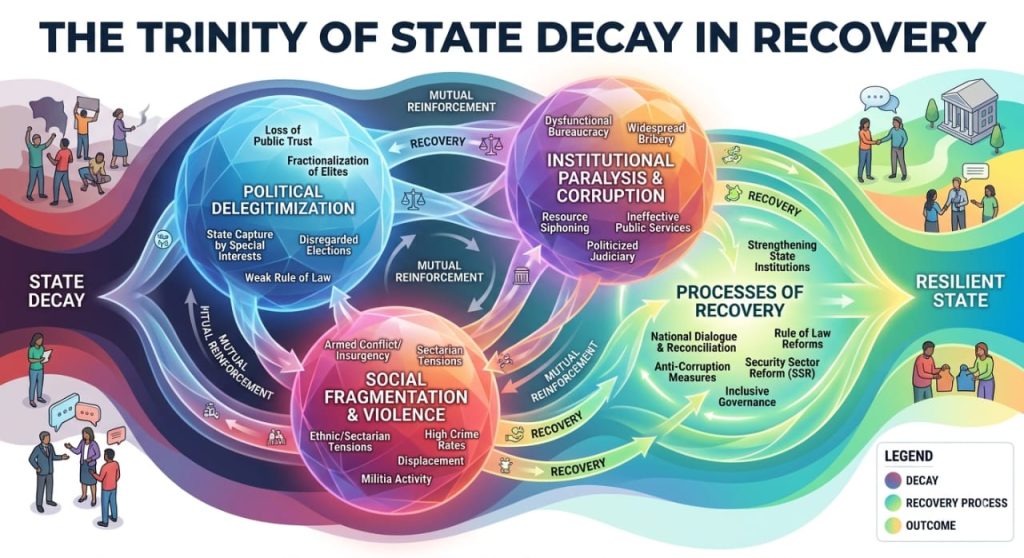
Systems that reproduce decay cannot be repaired within their own logic. They must be structurally interrupted.
The Trinity does not collapse. It is displaced.
From Ritual Governance to Peripheral Presence
The first reversal targets the geography of illusion.
The Institutional Mirage is concentrated in the symbolic centre—where governance is performed through summits, communiqués, and administrative ceremony—while dissolving at the periphery where authority is actually tested.
This produces a distorted state: visible in Abuja, absent in the borderlands.
ALSO READ: How I Returned From The Gate Of The Other World (2), By Hassan Gimba
To reverse the Trinity, the state must abandon Ritual Governance—the substitution of performance for presence—and return to the empirical occupation of territory.
This is not military occupation. It is administrative presence as sovereignty.
A state exists not when it speaks in the capital, but when:
a child attends a functioning school without paying a parallel tax of fear;
a farmer harvests without negotiating with non-state authority;
a dispute is resolved by a recognised court faster than an armed intermediary.
Governance is not restored by declaration. It is restored by continuity.
Where state presence becomes routine, the Shadow loses its monopoly on predictability.
From Pacification Bargaining to Sovereign Integrity
The second reversal confronts a deeper failure: negotiated sovereignty.
The state has increasingly drifted into a system of Negotiated Sovereignty sustained through what may be described as Pacification Bargaining—the purchase of temporary calm from rival authority structures through ransom logic, amnesty arrangements, protection payments, or informal accommodation.
ALSO READ: Africans Shouldn’t Join Our Xenophobic South African Brothers In Lunacy; By Owei Lakemfa
This is not strategy. It is dependency disguised as pragmatism.
Every bargain strengthens The Insecurity Triad by:
monetising abduction economies;
legitimising territorial extraction;
reinforcing the Shadow’s role as a negotiating sovereign.
The result is a system of self-financing violence in which each concession funds the next cycle of coercion.
Pacification Bargaining does not resolve insecurity. It institutionalises it.
Each transaction deepens the perception that coercion is profitable, territorial pressure is negotiable, and sovereign authority is conditional rather than absolute.
Sovereign recovery therefore requires rupture in this economy.
The state must reassert a non-negotiable monopoly over:
taxation;
adjudication;
legitimate force.
Integrity, in this context, is not moral posture. It is institutional refusal to participate in markets of coercion.
ALSO READ: Nigerian Electoral Politics: A View From Mars; By Jibrin Ibrahim
A state that bargains over its coercive authority is not managing insecurity—it is outsourcing sovereignty.
The Critical Break: Dismantling the Insecurity Triad
To dismantle The Insecurity Triad is to break the loop between performed sovereignty and enforced sovereignty.
This cannot be achieved through security operations alone, though coercive force remains an essential and non-negotiable instrument of restoring empirical sovereignty. It requires something deeper: the reconstruction of institutional credibility in the very spaces the Institutional Mirage has abandoned.
It requires the state to stop performing governance and start delivering it. To stop negotiating the terms of its own authority and start enforcing them.
To recover the map—not in abstraction, but in detail: name by name, community by community—that armed actors are actively redrawing through coercion, taxation, and enforced renaming.
Dismantling the Triad is therefore not only a security task. It is a reversal of political geography itself.
The Cartographic Re-occupation of the Republic
The Shadow Order does not only occupy land. It reorganises meaning.
Through what may be understood as Constitutional Erasure, it renames territories, restructures local identity, and replaces the symbolic map through which authority is recognised.
ALSO READ: What The Kano Political Violence Reveals About Nigeria’s Democracy; By Lawan Musa Danlami
Once this occurs, sovereignty is no longer contested physically alone—it is contested cognitively.
Cartographic Re-occupation is therefore not symbolic politics. It is structural restoration.
It requires three coordinated acts.
First, administrative re-anchoring: the immediate restoration of functioning institutions—schools, clinics, courts, and local administration—under continuous state presence.
Second, symbolic restoration: the reassertion of original geographic and civic identities through formal public renaming and constitutional recognition.
Third, cognitive consolidation: governance must cease to appear as intervention and become the default condition of life.
The state is not restored when it returns to territory. It is restored when territory returns to the state’s cognitive map.
Intellectual Closure: The State After Fragmentation
The deeper insight of this architecture is that sovereignty in Nigeria is no longer singular.
What has emerged is a fragmented order in which authority is distributed between competing logics of governance—one performed, one enforced, both partially functional, neither complete.
This is where African political thought clarifies the structure beneath the surface.
The logic of adaptive survival described by Jean-François Bayart explains why the state persists even as it weakens. Achille Mbembe explains how survival itself becomes managed rather than guaranteed.
Together, they clarify the central claim of the Trinity: this is not collapse. It is reorganisation.
Closing Movement
Nigeria does not face a singular collapse of authority. It faces a structured competition between performed sovereignty and functional sovereignty.
The Mirage still speaks in the language of the state.
The Shadow still governs in the language of necessity.
Between them, society survives by navigating two competing logics of order.
The question is no longer who governs.
It is whether governance itself can be reassembled into a single coherent structure.
The Reversal Condition: Sequential Sovereignty Restoration
The Trinity is reversible, but only in sequence.
Protection must be restored before compliance can shift.
Compliance must shift before territorial credibility stabilises.
Territorial credibility must stabilise before institutional authority can move from performance to function.
Any inversion of this order produces relapse.
The system is not resistant to reform. It is resistant to mis-sequencing.
The Trinity reverses only when sovereignty becomes empirically enforceable again through the sequential reconstitution of protection, compliance, and territorial credibility, thereby disrupting the mutual reproduction loop between the Institutional Mirage and the Shadow Order sustained by The Insecurity Triad.
ALSO READ: Nomadic Politicians And The Assault On Our Sensibilities; By Zainab Suleiman Okino
Where this sequence fails, the loop does not weaken. It adapts.
The Social Contract Is Not Broken — It Is Being Replaced
There can be no social contract in a state where the sovereign performs authority it does not possess, negotiates with rivals it cannot defeat, and watches—from the polished corridors of Abuja—as the names of its own communities are erased from the landscape it claims to govern.
The conventional framing of Nigeria’s crisis describes a broken social contract: the state has failed its obligations, and the people are paying the price.
That framing is not wrong. But it is insufficient.
A broken contract implies a single agreement that has lapsed—and the possibility, in principle, of renegotiation and restoration.
What the Trinity of State Decay reveals is something more structural.
The social contract is not merely broken. It is being replaced.
In the spaces where the Institutional Mirage does not reach—in the northwest, northeast, and Middle Belt, in renamed villages and abandoned farmlands—a rival contract is being written.
On rival terms. Under rival authority. With rival consequences for those who refuse to sign.
The Shadow Order does not offer freedom. It offers a different captivity—one organised around extraction, fear, and the brutal clarity of power that does not pretend to be something it is not.
Within its own logic, it is internally consistent and therefore predictable.
ALSO READ: From Colonial Batons To Modern Bullets: The Unfinished Reform Of Nigerian Police; By Abadom Lawrence Amechi
And in conditions where protection becomes uncertain and uneven, predictability itself begins to function as a substitute for legitimacy—not as consent, but as adaptation under constraint.
The Institutional Mirage, by contrast, sustains a different form of instability: the unpredictability of protection, the inconsistency of enforcement, and the performance of authority that does not reliably translate into outcomes.
It is this asymmetry—between predictable coercion and unpredictable protection—that accelerates the silent transfer of compliance from formal sovereignty to rival order.
Conventional state failure frameworks assume a linear erosion of capacity.
The Trinity departs from this by demonstrating a dual-state condition in which formal and rival sovereignties coexist, interact, and reinforce decay.
Nigeria is not a failed state.
It is a state in the grip of a Trinity.
The Definition
Drawing on the full architecture of the foregoing analysis, I now offer a formulation of the Trinity of State Decay theory:
The Trinity of State Decay is the decoupling of a state into rival sovereignties: the Institutional Mirage, which performs authority without fully possessing it, and the Shadow Order—or competing Shadow Orders—which exercises de facto authority in spaces the Mirage has vacated, both sustained by The Insecurity Triad as the mechanism of their mutual reproduction.
The Trinity intensifies where the Mirage fragments into competing centres of performed authority, accelerating the transfer of empirical sovereignty to rival structures.
The Trinity reverses only when sovereignty becomes empirically enforceable again as a stable condition of governance.
This condition is not defined by the mere presence of the state, but by the alignment of three realities: protection must be enforceable, compliance must orient toward the state, and territorial authority must remain continuous.
Where these diverge, sovereignty fragments.
Where they converge, sovereignty reconstitutes.
Recovery is not repair or return. It is the production of a new equilibrium in which the Mirage collapses into function, the Shadow is displaced, and The Insecurity Triad loses its organising role.
This condition is produced through sequence: protection must precede compliance, compliance must precede territorial credibility, and territorial credibility must precede institutional function. Any inversion produces relapse; where the sequence holds, the loop breaks.
While derived from the Nigerian case, the Trinity offers a generalisable framework for analysing state decay in contexts where formal sovereignty persists alongside entrenched systems of rival governance.
Stay seasoned.
Concluded.
Dr. Max Amuchie is the CEO of Sundiata Post.
