


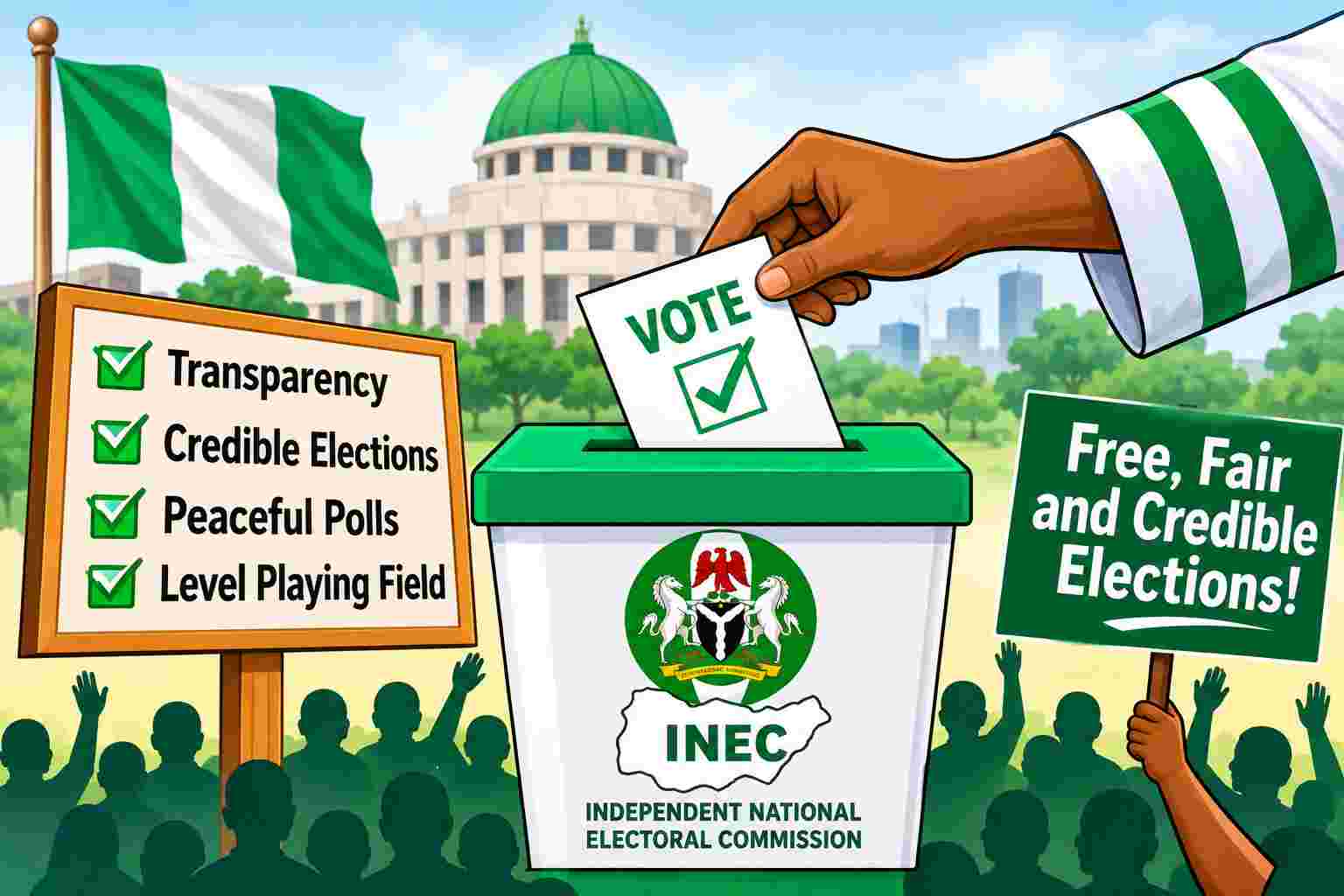
WITH 50 days to the 2027 General Election, a review of the electoral environment shows a series of challenges from key election stakeholders, including the Independent National Electoral Commission (INEC), the Federal and State Governments, political parties, the judiciary and others.
INEC in particular is causing sleepless nights for Nigerians hoping for free, fair, credible and violence-free elections. The Commission is undermining confidence in itself through opaque practices, while an upsurge in political violence and a wave of restrictions on civic space across the country are increasingly worrying. It is now apparent that the election’s credibility hinges on three interrelated factors: INEC’s operational conduct, including the management of the result process, voter register controversies and unclear preparedness for the election; an unsatisfactory legal framework and pre-election litigation; and political violence and a restricted civic space.
It is against this background that we, as concerned citizens, met to review these matters. We issue this statement to draw the attention of all relevant authorities and our fellow citizens to these issues, as a patriotic call to action. We urge that they be addressed urgently and transparently, to assure Nigerians of our collective commitment to free, fair and credible elections.

1. INEC’s Operational Readiness: Progress Marred by Opacity
INEC has introduced result management reforms, including safeguards on the INEC Result Viewing (IReV) portal and a new e-EC8A Form, aimed at making collation of results a “transparent formality.” However, we note that these reforms rest on unclear foundations.
a. Result Management
First, the purpose and operation of the e-EC8A Form have not been adequately explained. Requiring Presiding Officers to key-in figures manually into what is described as the “source of truth” for disputes (the e-EC8A) introduces human intervention into a supposedly automated process, and raises serious concerns. Second, Form EC40 G-PU, designed to prevent fake results from places where voting did not occur being infused into the results collation process, appears to have been dropped from the electoral regulations. No explanation has been given for this. These gaps feed suspicion that the rules are being changed without transparency.
b. Voter Register Controversies Deepen Mistrust
The preliminary voters’ register published in October 2026 became a flashpoint after AI-generated photographs and fictitious entries were discovered. INEC removed 1,608,660 invalid registrations and identified 54 personnel in 10 states as allegedly complicit, yet no arrests have been announced and no details published. IT experts also question INEC’s account, particularly the suggestion that ‘front-end’ officers with INEC Voter Enrolment Devices (IVEDs) could execute ‘back-end’ functions that require strict security protocols and access to servers.
INEC also appears to have breached Section 19 of the Electoral Act 2026: the physical display of the voters’ register ran from 9 to 15 October 2026, but the register was not published online by the 18 October deadline, denying citizens and parties the full opportunity to scrutinise it and file claims and objections.
Reports that INEC quietly added 453 polling units (PUs) and 29 Wards, raising the number of PUs from 176,846 to 177,299 and Wards from 8,809 to 8,838, deepen these concerns. INEC denies acting in secret, but the lack of consultation is a significant departure from the process that preceded the 2021 expansion of PUs.
c. State of Readiness for the Election
INEC reports that Permanent Voter Card (PVC) production is complete, that non-sensitive materials have been distributed to the six geopolitical zones, and that nine of the fourteen activities on the election timetable have been concluded. Yet weekly PVC collection figures remain unpublished; non-sensitive materials that were due at State offices six months ago have reportedly still not been deployed there; and 50 days after the INEC Chair’s press conference, there is no update on the procurement of 56,000 Bimodal Voter Accreditation System (BVAS) devices. The 28 November 2026 mock accreditation exercise also lacks detailed published guidelines on staff selection, equipment, training and security. This limits access for voters, political parties and election observers, as well as the exercise’s value as a test of readiness.
2. A Finalised Legal Framework and Unresolved Loopholes
The Senate has ruled out further amendments to the Electoral Act 2026 before the 2027 general elections. Yet the Act contains at least two significant ambiguities. First, Section 63(3) allows manual collation where there is a “communication failure”, a term the Act leaves undefined. Second, Section 63(2) empowers Presiding Officers to determine the authenticity of balloting instruments. With the law finalised, neither gap can now be addressed through legislation, which makes clear INEC Regulations and Guidelines all the more important. Left unaddressed, these gaps risk inconsistent decisions at polling units and collation centres, and claims that electronic results were bypassed.
3. Political Violence and Restricted Civic Space
The civic space has narrowed sharply since campaigning began in August 2026. Armed Conflict Location and Event Data (ACLED), an independent, non-profit organisation tracking political violence, has recorded over 30 attacks on campaigns, candidates, convoys and gatherings, with more than 10 deaths. The National Peace Committee has reported 60 election-related incidents in one month, and 131 incidents since the signing of the Peace Accord.
Restrictions on assembly and expression have also multiplied: five men were arrested in Borno for wearing “Tinubu Must Go” T-shirts, a Kano event was blocked by police, and a critical book launch was cancelled. Meanwhile, an INEC office in Ebonyi was burned, destroying 340 ballot boxes – the third such attack in under three weeks. These events raise serious concerns about the freedoms of association and expression and the right to canvass for political support, all critical elements of a democracy.
4. Calls to Action
We therefore call for the following actions:
INEC
● To explain and publish the purpose of, and set clear protocols on, the e-EC8A Form;
● To clarify the status of Form EC40 G-PU and whether it will be used in the 2027 General Election;
● To define what amounts to a “communication failure” and set out clear guidelines on what to do under this circumstance in its Regulations and Guidelines;
● To brief stakeholders on procedures for the clean-up, certification and publication of the final Register of Voters, and on polling unit and ward changes;
● To publish weekly PVC collection figures by state;
● To publish the findings of its investigation into the 54 personnel implicated in the voter register irregularities, and refer those found culpable for prosecution;
● To publish verifiable timetables for deploying BVAS and both sensitive and non-sensitive materials to all states, LGAs, RAs and PUs.
Governments
● To end the denial of access to campaign venues and the intimidation of opposition parties and leaders by the Federal and many State Governments – actions that are eroding the level playing field for the elections.
Security Agencies
● To coordinate closely, through the Inter-Agency Consultative Committee on Election Security (ICCES), the early and impartial deployment of security forces to protect campaign events, voters, candidates, electoral staff, INEC facilities, observers and the media, and to act against perpetrators of violence regardless of party affiliation.
The Judiciary
● To prioritise and urgently conclude all pending pre-election cases well before polling day;
● To commit to neutral and impartial adjudication that safeguards the broader right of citizens to choose their leaders, and to ensure that the judicial process is not abused to undermine the democratic process;
● To ensure that judicial officers who act improperly or corruptly are swiftly held accountable.
Political Parties
● To commit publicly to non-violence, refrain from inflammatory rhetoric such as “rig and die,” strengthen internal democracy and adhere to the Peace Accord.
Civil Society
● To deploy trained observers for independent monitoring of result recording, transmission and collation;
● To run early-warning systems to identify political and electoral violence;
● To educate voters on the results management process;
● To press INEC for clarity on the e-EC8A and EC40 G-PU Forms.
Voters
● To collect their PVCs and turn out to vote;
● To organise peacefully and lawfully at local and community levels to protect their votes and guard against all attempts at electoral fraud.
5. Conclusion
An election conducted amid mistrust, suspicion and violence, with weak state capacity to curb it, risks serious consequences: sharply lower turnout, weakened mandates, rejected results, prolonged litigation and legitimacy disputes, and deeper public cynicism about elections as a means of peaceful change. The time for transparency, accountability and restraint is now – before the first vote is cast.
ISSUED IN ABUJA, NIGERIA, on 27th November 2026 by a group of concerned Nigerians
1. Dr. Husseini Abdu
2. Dr. Kabiru Adamu
3. Amb. Fatima Balla OON
4. Dr. Yahaya Hashim
5. Prof. Ibrahim Gambari
6. Prof. Jibrin Ibrahim CON
7. Prof. Attahiru Muhammadu Jega OFR
8. Prof. Mohammad J. Kuna
9. Abubakar Balarabe Mahmoud, SAN, OON
10. Mal Kabiru Yusuf
