


By Amos Aar
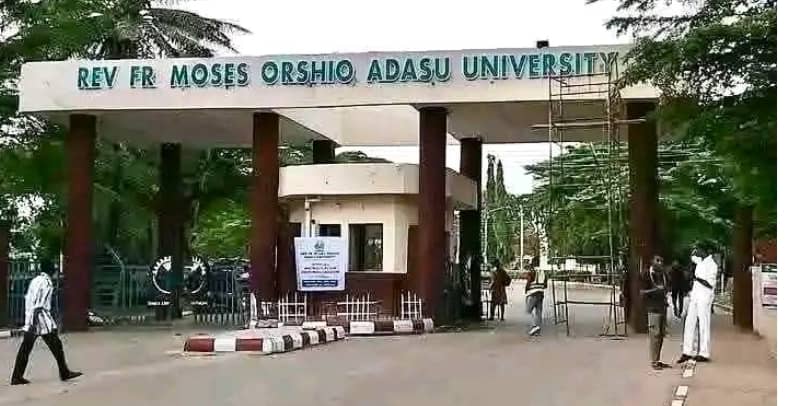
THE ACTING Vice Chancellor of Rev. Fr. Moses Orshio Adasu University, Makurdi (MOAUM), Prof. Simon Terver Ubwa, has expressed concern over inadequate funds to develop the institution, saying the challenge impacts negatively on operations despite efforts by the state government.

Speaking during an interaction with the forum of Journalists in his office on Friday, Prof. Ubwa described university education as a capital-intensive venture as he acknowledged government’s significant investment, noting however that the demands of the institution far outweigh available resources.

“Over time, the university has been complaining of poor funding, the governor is making extremely frantic efforts to support the university by paying the entitlements of staff, and I want to say that if you know how much the state government is committing to the university, you will truly appreciate the government, but university funding is capital intensive,” Prof Ubwa stated.
He added: “In as much as government is putting in so much finances, we still require more because this university has a student population getting close to ten thousand (10,000), while our staff strength, from the junior to academic personnel, is approaching three thousand (3,000). With over sixty (60) academic programmes, many of them indexed programmes, there is so much pressure on the system. The fees paid by both undergraduate and postgraduate students cannot meet the university’s needs, especially with added obligations like pensions, which the university must help the government to fulfil.”
He noted that the institution is doing its best to grow its internally generated revenue, but for now, the funding gap remains a major challenge.
Ubwa also identified poor student response and rising insecurity as other critical issues affecting MOAUM. He added that many parents are peasant farmers who can no longer access their farms due to security concerns and that the ugly development directly affects their ability to pay school fees for their children.
“A good part of our state is inaccessible due to herders crisis. It affects people’s income and consequently, every other thing related to education funding. A good number of our students are unable to pay their user charges. For example, two days before our matriculation ceremony, only about two thousand (2,000) out of nine thousand nine hundred and ninety-one (9,991) students paid and registered. This led to repeated postponements of the matriculation until we could no longer extend it,” the acting VC said.
According to him, “200 level students and above who are currently sitting for exams, only about five thousand (5,000) out of twenty thousand (20,000) registered. That means around fifteen thousand (15,000) did not. In our system, if you don’t register, you can’t attend the lectures or write exams, but due to these realities, we sometimes have to relax the rules.”
Prof. Ubwa recalled visiting an examination hall the previous day where a course expected to host about one hundred and fifty (150) students ended up with over one thousand (1,000) students.
He said: “These students had not paid or registered but showed up for the exam. Because of the rush, many were hastily registered but were not captured in preparation for the course. The course was not prepared for such a large number, and only two invigilators were assigned.
Ubwa noted that “some parents are genuinely trying. They give their children school fees, but the students sometimes divert the money to buy big phones. Despite all these, we are managing. The campus remains calm even though we face serious challenges.”
On whether the Benue State Government can cope adequately with funding needs of both MOAUM and the newly established University of Agricultural Sciences and Technology, Ihugh, Ubwa expressed optimism, saying “the government can fund both institutions. In fact, I contributed a bit to the structure of the new university. The appointed Vice Chancellor is well known to me. From the beginning, the governor charged them to be innovative and seek alternative ways of funding. Because of the nature of their programmes, they have already formed partnerships with foreign organisations that will support their funding.”
Prof. Ubwa noted also that while both institutions are state-owned, their funding needs differ due to the distinct nature of their academic programmes.
He clarified: “On our part, we are also planning to explore broader avenues to increase internally generated revenue. Their university is unique and can attract certain external funding. Our funding models will not be the same.”
