


By Our Reporter, With Agency Reports
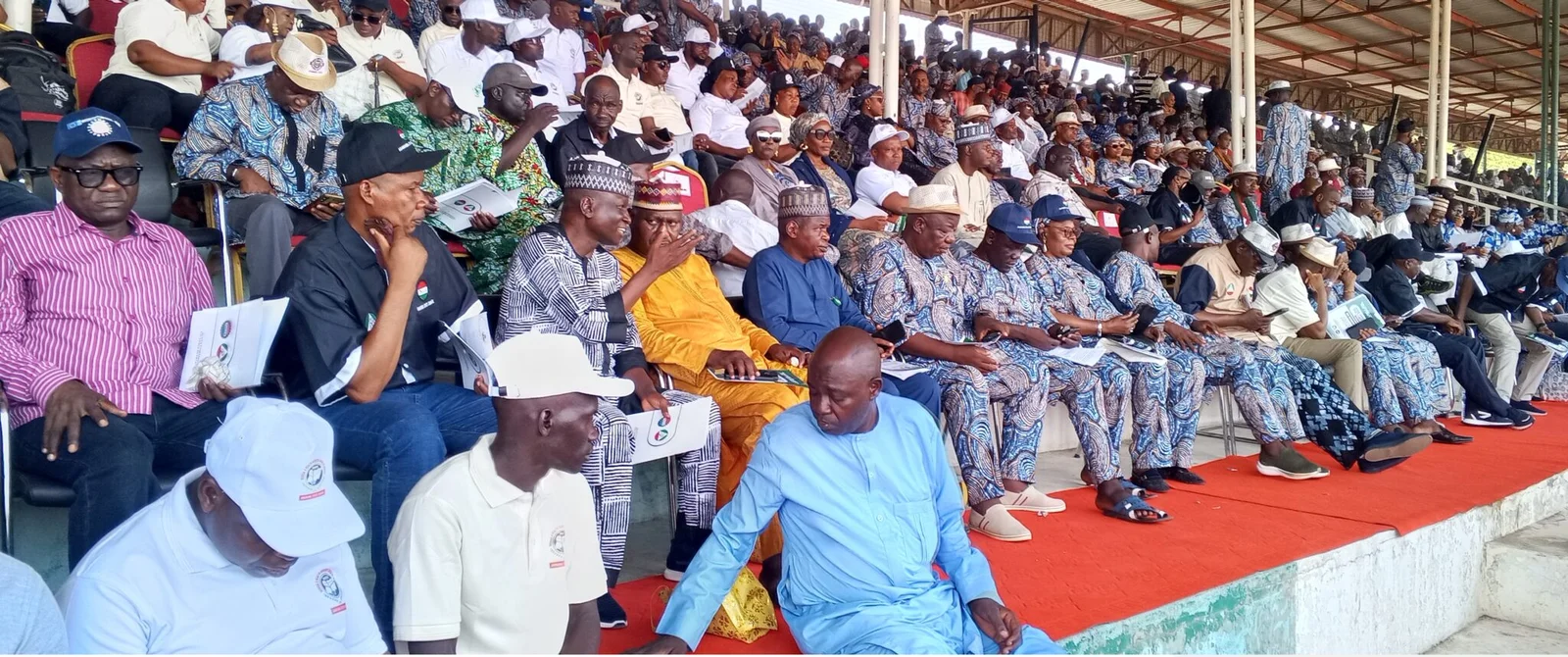
NIGERIAN workers marked the 2026 May Day celebration on Friday with a mix of solemn reflection and robust demands, as the Federal Government reaffirmed its commitment to tackling the twin crises of insecurity and poverty – themed: “Insecurity, Poverty: Bane of Decent Work” – while labour unions across the states pushed for wage reviews that reflect the harsh economic realities facing millions of Nigerians.
The national celebration in Abuja drew assurances from President Bola Tinubu’s administration, with labour minister, Dr Muhammad Dingyadi, describing Nigerian workers as “the backbone of national growth, productivity and sustainable development.”

President Tinubu, represented by Secretary to the Government of the Federation, Sen. George Akume, declared that insecurity and poverty have been treated as a “national emergency” since his administration assumed office on May 29, 2023, adding that “there cannot be decent work where workers fear for their lives, or where wages cannot feed a family.”
Yet beneath the official rhetoric, workers’ grievances rang loud and clear. From Lagos to Yobe, Adamawa to Kogi, labour leaders presented hard-hitting demands: the Lagos NLC sought a N225,000 minimum wage – up from the current N85,000 – citing 15.38 per cent inflation and soaring food and transport costs.
In Yobe, workers demanded restoration of annual leave grants and 100 per cent overhead costs. In Kogi, the NLC called for the reinstatement of 441 sacked workers, while Adamawa workers pressed for a “living wage” to match today’s economy.
Former NLC President Sen. Adams Oshiomhole, speaking in Abuja, reminded the crowd that May Day “did not emerge from goodwill but from sustained resistance against exploitation,” warning that some workers still earn as low as N40,000 monthly despite the new national minimum wage.
FG: Security, Job Creation as National Emergency
President Tinubu, through SGF Akume, outlined a raft of measures aimed at addressing the theme’s core challenges.
He announced that the Community Protection Guards Initiative, launched in partnership with states, has recruited and trained 45,000 youths to enhance community security while providing gainful employment.
On economic interventions, the administration said it has scaled up the National Social Investment Programme to reach 15 million vulnerable households through conditional cash transfers, which Tinubu said has lifted approximately 7.5 million Nigerians above the poverty line, citing recent National Bureau of Statistics data.
The President also highlighted major infrastructure projects – including the Lagos-Calabar Coastal Highway, Sokoto-Badagry Superhighway, and Ajaokuta-Kaduna-Kano Gas Pipeline – that have created over 600,000 jobs with social protection benefits such as pensions and health insurance. A N200 billion Micro, Small, and Medium Enterprises fund has supported over one million businesses, he added. The Presidential Compressed Natural Gas (CNG) initiative has reduced transportation costs by 40 per cent through the conversion of over 100,000 commercial vehicles, the government said.
On his part, Labour Minister Dingyadi assured workers that the recently implemented minimum wage “was only the beginning of broader wage reforms,” adding that the government is investing in agriculture, technology, and infrastructure to expand sustainable employment opportunities. He stressed that “decent work must never be compromised at any level” and that ongoing labour reforms include review of employment policies, labour laws, and occupational safety frameworks nationwide.
NASS: Akpabio Pledges Living Wage Legislation, Pension Reforms
Senate President Godswill Akpabio, in a personally signed May Day message, assured Nigerian workers that the 10th National Assembly recognises the challenges they face – from rising costs of living to workplace demands – and remains “unwavering in its commitment to legislating for a living wage, safer workplaces and pension reforms.”
He said the passage of the new National Minimum Wage Act and workers’ welfare packages testified to this commitment.
“You are the true heroes of our democracy and the engine of our economy,” Akpabio told teachers, farmers, doctors, artisans, civil servants, security personnel, and private sector employees.
He urged employers in both public and private sectors to prioritise workers’ welfare, noting that “a motivated workforce is the foundation of national productivity and prosperity.”
The Senate President commended organised labour for constructive engagements and pledged continued partnership with the Nigeria Labour Congress (NLC), Trade Union Congress (TUC), and all affiliates.
Lagos NLC Demands N225,000 Minimum Wage as Inflation Bites
In Lagos, the Nigeria Labour Congress State Council chairperson, Comrade Funmi Sessi, made a dramatic appeal to Governor Babajide Sanwo-Olu to review the minimum wage from N85,000 to N225,000, describing the upward review as “compelling due to rising inflation and the resultant high cost of living.”
While acknowledging that the approval of the current N85,000 was commendable, Sessi said prevailing economic realities had rendered the amount inadequate to meet workers’ basic needs.
“Given the current economic hardship and the high cost of living in Lagos, this amount is no longer sufficient,” Sessi said, warning that failure to adjust could threaten industrial harmony.
She also expressed concern over rising insecurity across the country, noting that workers in many parts face kidnapping and displacement, making workplaces increasingly unsafe.
She linked economic hardship to global developments, including the conflict between Iran and the US, which she said had negatively impacted petroleum prices.
Despite the grim assessment, Sessi praised the Lagos State Government for infrastructure development, including the Blue, Red and Yellow Rail Lines, the Opebi–Ojota Link Bridge, and road projects. Deputy Gov. Obafemi Hamzat represented Sanwo-Olu at the event.
Yobe Workers Demand Leave Grant, Overhead Cost Restoration
In Damaturu, Yobe NLC Chairman, Comrade Mukhtar Tarbutu, called on the state government to restore payment of annual leave grants to workers and 100 per cent overhead costs to ministries, departments and agencies (MDAs), saying the leave grant was suspended “without cogent reason” while overhead was arbitrarily slashed by 50 per cent.
Tarbutu also demanded a 100 per cent increase in furniture allowance “in line with existing economic realities.”
“The current increasing cost of goods and services requires an urgent upward review of allowances,” Tarbutu said.
He also called for an upward review of the Consolidated Health Salary Structure (CONHESS) and implementation of paramilitary salary structures for the state Fire Service and Road Traffic Agency.
He commended the government, however, for implementing the new national wage, massive recruitment into the state civil service, a 20 per cent subsidised motorcycle loan scheme, and capacity-building programmes for workers.
Adamawa NLC Seeks Living Wage, Fintiri Pledges Leadership
Adamawa State NLC Chairman, Comrade Emmanuel Fashe, advocated for a review of the minimum wage to a “living wage” in line with economic realities, noting that the theme “Insecurity, Poverty Bane of Decent Work” was “not chosen by accident but deliberately to suit contemporary situations.”
“With rising costs of food, transport, and housing, we request the re-convening of the State Minimum Wage Committee to negotiate a living wage that matches today’s economy,” Fashe said.
Governor Ahmadu Fintiri, represented by Deputy Gov. Prof. Kaletapwa Farauta, assured workers that “whenever the ‘living wage’ is nationally agreed upon, Adamawa would always lead the way in the implementation as usual.”
He noted that the state has so far employed over 7,000 workers into the core civil service and plans to release a list of over 5,000 newly recruited teachers, with local government recruitment also being concluded.
Kogi NLC Demands Reinstatement of 441 Sacked Workers
In Lokoja, Kogi State NLC Chairman, Comrade Gabriel Amari, urged Governor Ahmed Ododo to reinstate 441 civil servants who were sacked during former Governor Yahaya Bello’s administration but have since been screened and cleared by the State Civil Service Commission.
The commission had recommended their reinstatement, and Amari stressed “the need for immediate reinstatement” of the affected workers.
He also called on the state government to urgently address water and transportation challenges affecting workers.
Amari presented an 11-point demand, declaring that “human dignity at work is not negotiable.” He praised the governor’s security interventions – including surveillance drones, 49 security vehicles, and engagement of traditional rulers – as “investments in decent work.”
He also acknowledged prompt salary payments, cash backing for 2023 and 2024 promotions, and health insurance for vulnerable pensioners, declaring that “rest after labour has become sweet again in Kogi.”
Governor Ododo, represented by Deputy Governor Joel Salifu, reaffirmed his administration’s commitment to workers’ welfare and described himself as a “Chief Servant,” urging workers to embrace patriotism, diligence, and unity while rejecting indiscipline and inefficiency.
Oyo, Nasarawa, Osun Workers Present Diverse Demands
In Oyo State, Governor Seyi Makinde, represented by the Secretary to the State Government (SSG), Prof. Musbau Babatunde, said his administration’s policies were aimed at enhancing workers’ welfare, citing the strengthening of the Amotekun Security Network and improved inter-agency coordination.
He noted that regular salary and pension payments, implementation of the national minimum wage, clearing of promotion arrears, and a recent N10,000 monthly transport bonus were “testimonies of government commitment.”
Both TUC and NLC state chairmen urged the government to make the transport bonus permanent.
In Nasarawa State, organised labour appealed to Governor Abdullahi Sule to restore annual salary increments, with NLC chairman, Comrade Ismaila Okoh, arguing that civil servants had experienced stagnation due to the absence of step increments, a situation that “undermined the scheme of service.”
The labour leaders also called for implementation of a N20,000 upward review of monthly pensions for state retirees and adequate funding of the Pension Bureau to clear outstanding gratuities.
Governor Sule, represented by Head of Service, Barr. Abigail Waya, said his administration has employed over 8,000 teaching and non-teaching staff and more than 2,000 healthcare workers.
In Osun State, the Federation of Informal Workers’ Organisations of Nigeria (FIWON) called for increased government support and protection for informal sector workers, who make up a significant percentage of the workforce but face lack of social protection, limited access to credit, and unsafe working conditions.
State coordinator, Ibrahim Olayinka, urged governments to design inclusive policies recognising informal workers’ contributions.
Oshiomhole: Workers Must Defend Rights, Revive Local Industries
Former NLC President, Sen. Adams Oshiomhole, speaking at the Abuja celebration, delivered a fiery call to action, reminding workers that May Day “did not emerge from goodwill but as a product of struggle.”
He decried the poor welfare of workers earning as low as N40,000 or N45,000 monthly despite the rising cost of living, insisting that “laws on minimum wage were made to protect workers and must be fully enforced by both government and private sector employers.”
Oshiomhole pledged to join workers “rogatically, not symbolically” in lawful struggles to defend their rights, and stressed the need to revive local industries, particularly manufacturing, to create jobs and reduce poverty.
“Poverty cannot be defeated without job creation. Sustainable jobs can only come from productive sectors of the economy,” he said, and urged the government to prioritise policies that encourage local production and protect Nigerian industries.
ADC’s Mark Commends Workers, Pledges Living Wage Advocacy
Former Senate President and National Chairman of the African Democratic Congress (ADC), Sen. David Mark, commended Nigerian workers for their resilience, dignity and sacrifices, pledging sustained advocacy for improved welfare.
Mark said the party would champion policies guaranteeing living wages, pension reforms, job creation, productivity rewards, and strict punishment for corruption.
He described workers across classrooms, farms, hospitals, markets, factories and oil fields as “the enduring backbone sustaining the country,” warning that “any nation that failed to protect workers’ dignity could not genuinely claim progress.”
