


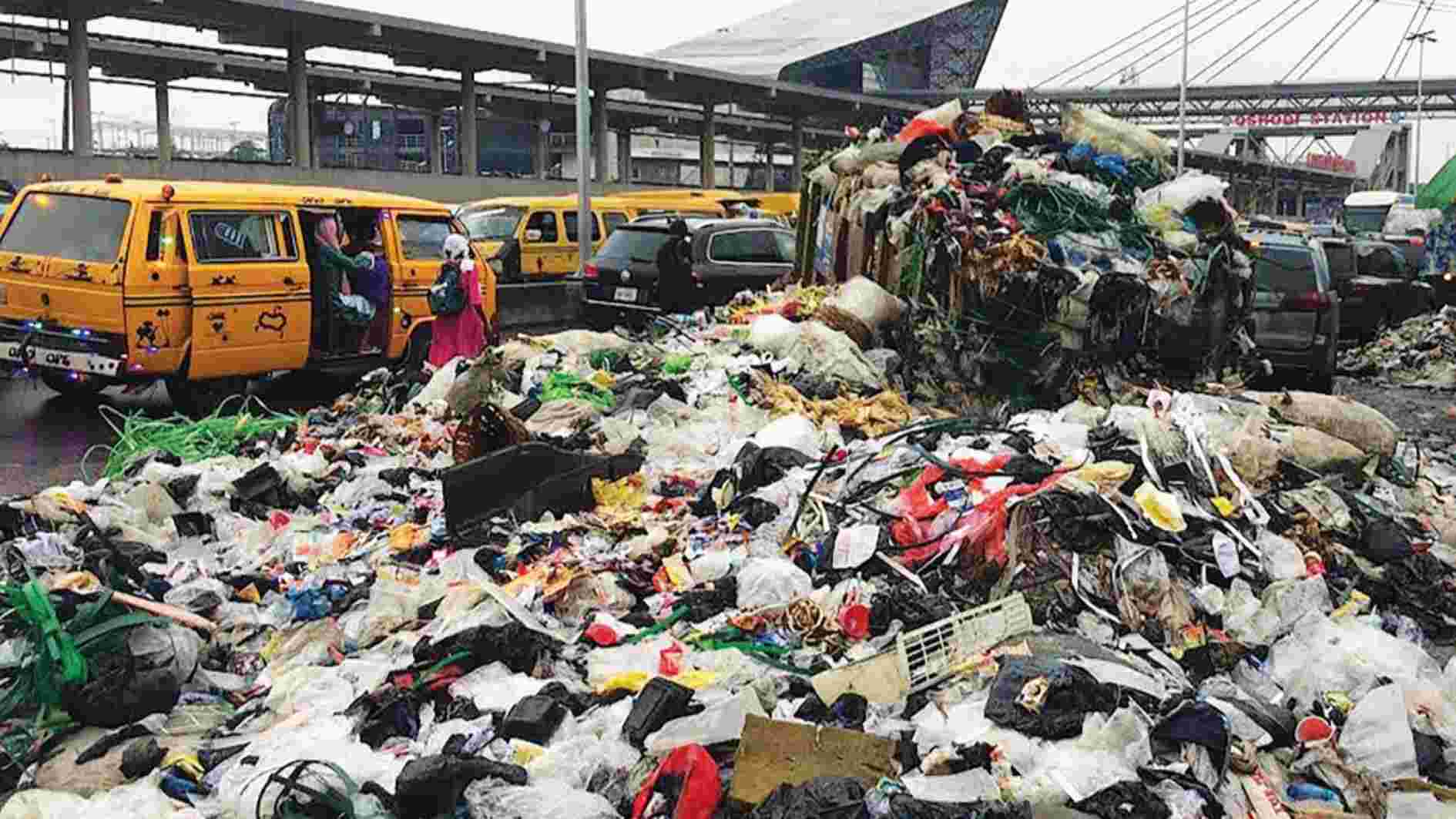
- Accuses LASG, LAWMA Of Turning Communities Into Dumpsites
THE LAGOS State Government and the Lagos State Waste Management Authority (LAWMA) have been accused of failing to effectively manage household waste across the state, with an activist group warning that prolonged accumulation of refuse could pose a serious threat to public health.

The National Publicity Secretary of the group, Comrade Chinedu Bosah, made the allegations in a statement in which he called on Lagos residents to mount pressure on the state government to urgently overhaul its waste management system.
Bosah described the situation in several parts of Lagos as “shocking,” alleging that communities and major roads had increasingly become refuse dumps as a result of irregular waste collection.

According to him, some households now experience waste collection only once in several months, while residents in other areas have been left to find ways of disposing of their refuse themselves.
He specifically cited Harmony Estate and surrounding communities in Aboru, Alimosho Local Government Area, where he alleged that Urban Care, a private sector participant responsible for waste collection in the area, sometimes goes more than 13 weeks without collecting household waste.
Bosah said the last collection in several parts of Aboru by the contractor was on May 28, 2026, claiming that the prolonged accumulation of waste had contributed to an increase in rodents and wild birds in the affected communities.
He also alleged that residents on Charity Road, Abulegba, and surrounding areas had experienced a similar situation involving another private waste contractor, Oye Balogun Enterprises.
According to the statement, the contractor last collected waste in April 2025 but continued to issue waste bills to some residents.
Bosah cited a property at No. 49 Charity Road as an example, alleging that the property had accumulated more than N250,000 in waste-related bills despite allegedly receiving no waste collection service.
He likened the practice to billing systems in the electricity sector where, according to him, customers sometimes receive bills despite inadequate service.
The activist also questioned the roles being played by local governments in waste management, citing Section 1(h) of the Fourth Schedule to the 1999 Constitution, as amended, which assigns refuse disposal among the functions of local government councils.
He accused local governments in Lagos of becoming largely preoccupied with revenue generation while failing to adequately discharge their responsibilities in waste disposal.
Bosah further criticised the public-private partnership model adopted by successive Lagos administrations for waste management, alleging that some private waste operators receive government support and subventions while simultaneously collecting fees from residents.
He called for greater transparency in the relationship between the state government and private waste contractors, particularly regarding government financial support to operators and the services expected in return.
The statement also took aim at comments attributed to Lagos State Deputy Governor Obafemi Hamzat during a recent interview on Nigeria Info 99.3 FM.
Bosah said Hamzat’s responses to questions about the state’s waste management challenges demonstrated what he described as poor planning and an unwillingness by the government to accept responsibility for the crisis.
According to Bosah, the deputy governor had attributed part of the problem to the level of organisation among Nigerians and the wider African population, while also explaining that the volume of waste generated in Lagos had exceeded earlier projections.
The statement quoted Hamzat as saying that Lagos was now dealing with approximately 17,000 tonnes of waste daily, compared with an original projection of about 13,000 tonnes.
Bosah said the deputy governor had also identified inadequate refuse trucks as a major factor and disclosed that 214 additional trucks had been ordered by the state government and local councils.
According to the statement, 114 of the trucks were ordered by the 57 local government areas and local council development areas, while the state government ordered another 100.
The trucks, Bosah said, were expected to arrive in Nigeria in September 2026.
He acknowledged that inadequate trucks were part of the problem but argued that increasing the number of trucks alone would not resolve Lagos’ broader waste management crisis.
He also referenced Hamzat’s admission that some of the approximately 840 trucks deployed by private waste operators were unusable or in poor condition.
Beyond the shortage of operational trucks, Bosah identified the state’s dumpsite infrastructure as another fundamental weakness in the current waste management system.
He argued that Lagos had failed to develop a sustainable waste disposal infrastructure capable of keeping pace with its rapidly growing population.
According to him, the continued reliance on major dumpsites located at Epe and Badagry creates logistical challenges because of the distances involved and the traffic conditions across Lagos.
He alleged that some waste trucks travel more than four hours to reach the dumpsites and may subsequently spend as much as two days waiting in queues before they can offload.
Bosah argued that such a system was inherently inefficient and that the arrival of 214 additional trucks would therefore provide only limited relief if the wider disposal and processing infrastructure remained unchanged.
He also warned that the current dumpsites could eventually face the same problems experienced at former waste disposal sites, including those at Igando, Ojota and Ile-Epo.
The statement advocated a broader approach involving waste sorting, recycling and waste-to-energy technology rather than continued dependence on conventional dumpsites.
Bosah cited Beijing as an example of a major city that, according to him, generates a significantly larger volume of waste but has developed systems for collecting and processing it.
He argued that Lagos should have planned for substantially higher waste volumes over the past 27 years and developed infrastructure capable of handling projected increases.
“Rising refuse generation” should not, he said, continue to serve as an excuse for inadequate waste management.
The activist accused successive administrations under the ruling All Progressives Congress (APC) of failing to adequately plan for the state’s population growth since the party assumed power in 1999.
He said the responsibility for keeping Lagos clean ultimately rested with government institutions rather than ordinary residents.
The group expressed particular concern about the public health implications of prolonged refuse accumulation.
Bosah warned that overflowing garbage could provide breeding and feeding grounds for rodents, flies and birds and increase environmental health risks.
He described the situation as a potential threat of an epidemic if the government failed to act urgently, while calling for sustained waste collection and proper processing and disposal.
The statement also criticised the state’s monthly environmental sanitation exercise, arguing that it was contradictory for government to enforce sanitation compliance among residents while allegedly failing to ensure regular waste collection.
Bosah called on Lagos residents to begin demanding greater accountability from government over waste management and urged them to organise peaceful mass actions to pressure the authorities to address the problem.
He concluded that any government unable to provide an effective waste management system should be held accountable by voters, while stressing that the criticism should not be interpreted as applying only to the APC or its candidates.
