


By Iduh Onah & Victor Itodo Abuh
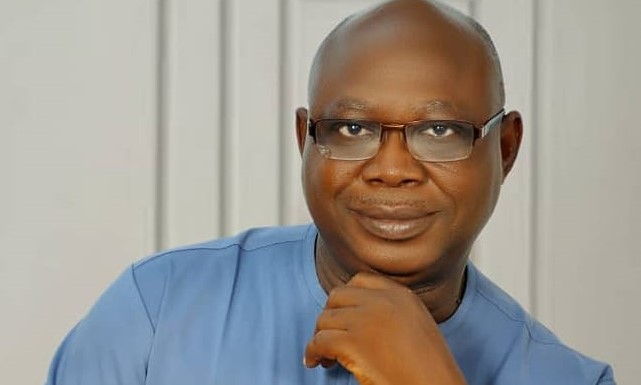
IN THE complex tapestry of Nigerian politics, where money often talks louder than ideas and where grassroots connection is frequently sacrificed at the altar of metropolitan sophistication, Dr Raphael Odoh Otobo is emerging as a fascinating anomaly.
This comes out neatly in his over an hour-long interview with National Record in Abuja, where the soft-spoken Dr Otobo espoused on his methodology of partisan politics, his dreams against contemporary realities, convictions and aspirations.

At 58, this educationist-turned-politician is charting an unfamiliar course, one that seeks to transplant the discipline of the classroom into the unpredictable arena of the National Assembly.
His journey from the dusty footpaths of Aidogodo Village in Okpoga, Okpokwu LGA of Benue State on the way to the corridors of political power is not merely a personal story of ambition; it is a narrative laden with implications for how we understand representation, service, and the very essence of governance in Nigeria.
Born on February 24, 1968, Otobo’s early life was steeped in the agrarian rhythms of rural Benue. His parents were farmers, and young Raphael knew the weight of the hoe long before he understood the weight of books.
“From the village I went to school, return for holidays,” he recalls, his voice carrying the resonance of someone who has not forgotten where he came from. “Whenever school was on break, I would go back to the village and join my family to farm. We literally did everything together.”
For a man who has achieved so much in the private sector – multiple schools, housing estates, and the quiet satisfaction of providing employment for nearly 450 workers – the question naturally arises: why politics? What would drive a successful educationist to abandon the relative peace of school administration for the treacherous waters of Nigerian partisan politics?
That upbringing, he insists, shaped him fundamentally – teaching him discipline, hard work, and the resilience that would later define both his educational empire and his political aspirations.
What makes Otobo’s trajectory particularly intriguing is the unanticipated nature of his entry into the education sector. Like many young Nigerians of his generation, he initially harboured ambitions of studying Medicine, drawn not by passion but by the commercial prospects that the profession promised.
“We felt that that was where people made success out of life,” he admits with a candid laugh. “Almost all the successful men read Medicine; those we see, or those who read Law.” But fate, as it often does, had other plans. After remedial studies at the University of Jos, he was offered admission to study Economics Education – a consolation prize that would ultimately become his life’s calling.
“I ended up in Economics Education coincidentally, and that’s what I am today; I became a teacher,” Otobo reflects. There is no regret in his voice, only the quiet satisfaction of someone who discovered his true purpose through what seemed like a detour. He would later pursue a Master’s degree in Educational Administration and Planning in 2004, and a PhD from Nasarawa State University in 2016.
But the real education, the one that would prepare him for the rough and tumble of Nigerian politics, was happening outside the classroom walls.
In the year 2000, newly arrived in Abuja after his youth service, Otobo began giving lessons to earn some money. With savings from part-time lecturing at the University of Jos and private lessons here and there, he built a modest two-bedroom flat. Looking at the space behind the building, an idea struck him – why not convert it into a school? A carpenter was summoned, the apartment was partitioned into six tiny classrooms, and Metro International School was born, almost as an afterthought.
“It started like a child’s play,” he says, still sounding slightly amazed at what that child’s play has become. “I was so surprised that within the first term we had over 100 children.” Today, Metro International School stands as one of the largest educational institutions in Kubwa, Abuja, with approximately 1,500 children and 250 staff members. The nursery that began in a partitioned flat has blossomed into an educational empire of sorts that includes Apa College of Education in his village and a community secondary school.
But the road was not without its potholes.
In 2004, when Nasir el-Rufai’s demolition exercise swept through Abuja, Metro International School was caught in the wreckage. At that time, Otobo was nurturing ambitious plans for a private polytechnic, with structures already in place. The demolition forced him to shelve those plans and focus on rebuilding Metro International School. Looking back, he sees divine providence at work. “When I got stabilised for the polytechnic, I decided to go and build a college of education in my village instead.”
That decision would prove pivotal, anchoring him more deeply to his roots and ultimately shaping his political consciousness.
For a man who has achieved so much in the private sector – multiple schools, housing estates, and the quiet satisfaction of providing employment for nearly 450 workers – the question naturally arises: why politics? What would drive a successful educationist to abandon the relative peace of school administration for the treacherous waters of Nigerian partisan politics?
The answer, Otobo insists, lies in the limitations of private enterprise. “Though I’ve done so much for my community – I singlehandedly brought electricity to my village, I built schools, I brought a lot of development initiatives – there are things I can’t do, or be allowed to do as a private citizen. I can’t tar or pave their roads.”
This frustration with the boundaries of private philanthropy, the invisible fence that prevents even the most generous individual from undertaking certain types of public infrastructure, became the catalyst for his political awakening.
His entry into partisan politics came through an unlikely door. In 2014, Chief Audu Ogbeh visited his school and was impressed by what he saw. “Please come, let us form APC at home,” Ogbeh appealed. At that time, Benue was predominantly PDP territory, but Otobo heeded the call.
Until Chief Ogbeh’s death, he remained a guiding influence, though Otobo is quick to note the limitations of even his mentor’s political approach. “He didn’t have much grip of the political dynamics at home. Not only him, so many Idoma politicians, they did not have that required grassroots cache. Many of them are too engaged in Abuja, perhaps too metropolitan in their political activities to have the requisite impact in their home base.”
This philosophy of accessible leadership is not merely sentimental; it is backed by concrete action. When youths from Edumoga recently approached him about the Ekeh-Ojigo-Ojapo road; a major artery that has defied development for decades; Otobo did not give them the usual political run-around. He listened, and he made a commitment. “When you win, please do that road,” they told him.
This critique of the absentee politician – the one who descends on his constituency only during elections or for occasional burials – forms the philosophical core of Otobo’s political project. He contrasts this approach with that of politicians like Senator Abba Moro, and Senator George Akume, the current Secretary to the Government of the Federation (SGF), whose grassroots connections he openly admires.
“Abba Moro is the only one from Idoma land that you can see at home every time. Burials today or tomorrow, Abba will always be there. During Christmas, Abba Moro will sit down with all the widows. If Abba doesn’t have money, he will look for money,” he hummed.
For Otobo, this is not mere politicking but a fundamental principle of representation. “I admire his connection with the people, and I think that has been his winning magic.”
The contrast with his own socio-political concept is instructive. For 25 years, Otobo and his family have spent Christmas in their ancestral home, never in Abuja. For 20 years, even before contemplating partisan politics, he has run a widow’s project that holds its ceremony every December 24th.
“It is what I feel from the depth of my heart,” he says simply. His house in the village remains unfenced, a deliberate choice to ensure that people have free access to him. “In our local communities, people should be able to see or have free access to their political elite.”
This philosophy of accessible leadership is not merely sentimental; it is backed by concrete action. When youths from Edumoga recently approached him about the Ekeh-Ojigo-Ojapo road; a major artery that has defied development for decades; Otobo did not give them the usual political run-around. He listened, and he made a commitment. “When you win, please do that road,” they told him.
His response reveals a different kind of political calculation. “Four years is enough for me to make a difference. If I can’t do what people want after four years, if the people want you to go back, they will be the one to even come and tell you; not this one that after four years, you want to go for another four years, and after that four years, you still discover that you want to go again because you have nothing to fall back on.”
This willingness to risk political capital on performance rather than longevity is rare in a system where incumbency is often treated as a birth-right.
But Otobo brings to politics the mindset of a businessman who understands opportunity cost. “Me even leaving my business for four years is a great risk for me. What do I need from National Assembly that I don’t have? The Hilux they will give me, I have a Hilux. The Prado they will give me, I have a Prado.”
The question is not rhetorical; it goes to the heart of what drives a man to seek public office when private comfort is already assured. His answer is both idealistic and pragmatic. “We have never enjoyed good governance in Nigeria. We don’t even know what good governance is. If we knew what good governance is, elected public officers couldn’t misbehave.”
He points to Morocco, where a four-hour journey from Casablanca to Marrakech is possible on smooth roads, compared to the two-day ordeal of traveling from Abuja to Lagos. He cites David Umahi’s transformation of Ebonyi State from the second poorest to the third fastest-growing state in the country. He mentions the recent renaissance in Abia State under a technocrat governor. These examples, for Otobo, demonstrate that the challenges of governance are not insurmountable; they simply require a different algorithm of leadership.
“My only heart’s desire is that before I die, if we can experience good governance for four years, three years,” he says, his voice taking on an almost evangelical fervour. “Once good governance comes, it will be difficult to turn it away. Just like bad governance, it’s difficult to remove. My desire is that my children will see good governance.”
This quasi-religious conviction about governance is rooted in something deeper – Otobo’s Christian faith. A pastor in the Catholic Charismatic Renewal, he has maintained his church membership for 30 years without change. His Christian background, he believes, has given him both boldness and humility.
“What do you have that’s not God that has given it to you?” he asks, framing a question that challenges the arrogance he sees in many politicians. “If it is God, why are you misbehaving? My greatest challenge with some politicians is arrogance. The level of arrogance of some of them is to an extreme. They look down on everybody.”
This faith manifests in practical ways. His house, though he has only three children, accommodates 16 to 17 people at any given time – other people’s children whom he sponsors through university. “That is my calling; that is to reach out to people, especially in education.”
For Otobo, the teacher’s passion is education, and he sees the neglect of education as the root cause of many of Nigeria’s problems, including insecurity. “When public institutions crumble like they have in Nigeria, you see children on the streets. As they grow, they recruit them. Check all the Boko Haram boys they are arresting; they are small, small boys who didn’t finish primary school.”
As he prepares for another shot at the House of Representatives – this time under the African Democratic Congress (ADC) platform, following a coalition that brought together multiple political factions in the Idoma axis – Otobo is under no illusions about the challenges ahead.
The 2023 election was decided by a mere 75 votes, a margin so slim that it could be overturned by a single ward’s shift in allegiance. The incumbent, Hon. Philip Agbese, Otobo says, reportedly spent about 2 billion naira to clinch the ticket in the last election – a sum that Otobo, with his private sector mindset, finds both staggering and telling. “When politicians have to borrow money, you can guess what they will do if elected.”
As he puts it, with the quiet confidence of a man who has built a business empire from partitioned rooms, “I have a different dimension to politics. The dimension of looking at the interest of the people and provide the basic necessities of life.” It is a simple message, but in the complexity of Nigerian politics, simplicity can be revolutionary.
But Otobo is not running a conventional campaign. He is not taking loans, not selling houses to fund his ambition. He is running on what he calls the three essentials of politics: courage, resources, and personal popularity.
The courage comes from his Christian faith, the resources from his business success, and the popularity from 25 years of Christmas visits to his village and two decades of supporting widows. It is a formula that may seem naive in a system dominated by money politics, but Otobo has seen enough to know that money alone does not guarantee victory.
“I saw so many of them who went with me; they didn’t get the vote I had and they are alleged to be cultists. It is the way they will tell us that this thing is not for Christians? Some of the things they told us was just to scare us.”
What Otobo represents, ultimately, is a challenge to the dominant political culture. He embodies the possibility of a different kind of politics – one rooted in genuine grassroots connection, driven by a service mentality rather than primitive accumulation, and animated by the belief that governance can actually improve people’s lives.
Whether this vision will translate into electoral victory remains to be seen. But in a political landscape increasingly dominated by transactional relationships and absentee representation, Dr Raphael Odoh Otobo offers something that has become precious in Nigerian politics: authenticity.
As he puts it, with the quiet confidence of a man who has built a business empire from partitioned rooms, “I have a different dimension to politics. The dimension of looking at the interest of the people and provide the basic necessities of life.”
It is a simple message, but in the complexity of Nigerian politics, simplicity can be revolutionary.
From the classroom to the National Assembly, Dr Otobo is betting that the lessons of the teacher can indeed reshape the character of the politician. For the sake of his constituents; and perhaps for the sake of Nigerian democracy itself, one hopes he is right.
Read the interview here.
