


By Amos Aar
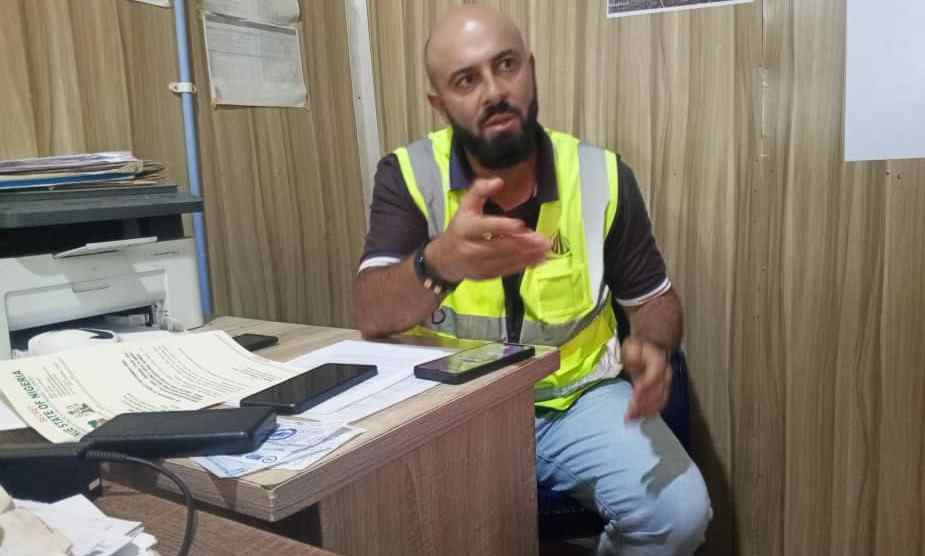
THE PROJECT Manager of Bauhaus Nigeria Limited, Engr. Charbel Al-Ammar, has reacted to allegations of labour exploitation and poor welfare practices at the company’s project sites across Benue State, offering explanations that, in several instances, align with findings published in a recent Premium Times investigation.
The October 11 report by Premium Times alleged that Bauhaus, a Lebanese-owned construction firm executing multi-billion-naira contracts for the Benue State Government, pays some workers as low as ₦30,000 monthly, a figure far below Nigeria’s current national minimum wage of ₦70,000.

It also accused the firm of denying workers formal employment letters, operating without an insurance scheme, and against unionisation of the workers.
Speaking with journalists in Makurdi, Al-Ammar dismissed suggestions of exploitation but, in doing so, inadvertently made several admissions that reinforce findings by Premium Times in its report.
“No one joins our payroll without signing an engagement form that contains details like salary, next of kin, and terms of service. The forms are kept in the office, but anyone who wants a copy can have it,” Engr. Al-Ammar stated, a comment that effectively confirms the absence of employment letters for most workers; one of the key complaints raised in the Premium Times investigation.
The project manager explained that engagement documents remain in company files and are issued only upon request, adding that some workers use them to register for pension.
This admission mirrors Premium Times’ revelation that many employees were not given written contracts and often relied on “verbal engagement.”
While Al-Ammar argued that such documents exist internally, he acknowledged that workers were not routinely issued copies unless they asked for them.
On workplace safety, the Premium Times report noted that Bauhaus lacked a formal insurance scheme and often failed to adequately compensate injured employees. While Al-Ammar did not outrightly deny the absence of an insurance policy, he however said the company supports injured staff through direct payments.
“I personally paid over ₦1.5 million for medical treatment of injured workers,” he stated. “Some stayed home for up to five months with full pay. That was our form of compensation.”
His remarks affirm that Bauhaus does not operate a structured staff insurance programme, relying instead on ad-hoc personal interventions — a practice that falls short of standard labour requirements.
I’m Their Union Chairman, Project Manager Says
Perhaps most revealing was his explanation concerning union representation. While denying that Bauhaus forbids union activities, Al-Ammar said he personally acted as “union chairman” for workers’ welfare.
“For a long time, I was the one representing them as union chairman because I protect them,” he said.
This assertion corresponds closely with the Premium Times finding that workers are discouraged from joining independent labour unions. Industrial experts note that an employer cannot simultaneously represent employees as a union leader, raising questions about Bauhaus’s compliance with Nigeria’s Trade Union Act and relevant labour laws and international labour conventions and instruments.
On other issues raised in the Premium Times report such as alleged underpayment and long work hours, Al-Ammar insisted that Bauhaus observes minimum wage regulations and pays overtime for work done on weekends or public holidays but this is yet to be confirmed.
“We can never allow a worker to do overtime without being paid. We pay weekly or biweekly, depending on the job,” he insisted
He also refuted claims of discrimination between Nigerian and Lebanese workers, describing the company’s relationship with its staff as fair and performance-based.
Addressing a specific case of alleged wrongful dismissal linked to a diesel-shortage incident, Al-Ammar said the affected worker had a record of fuel mismanagement and was treated fairly.
Throughout the interview, the project manager portrayed Bauhaus as a law-abiding firm that values transparency and welfare of its workers. Yet, his responses, particularly regarding employment documentation, insurance, and unionisation, seem to confirm the structural weaknesses highlighted in the Premium Times investigation, even if unintentionally.
Bauhaus Nigeria Limited, which has executed projects such as the ₦6 billion Makurdi High-Level Underpass and the ₦68 billion Wurukum–Airforce Base Road, remains under public scrutiny.
For many observers, Al-Ammar’s clarifications points to the need for independent labour audits and enforcement of occupational safety standards across major construction sites in Benue State.
