


By Amos Aar
FORMER Benue State Commissioner for Education, Prof. Dennis Ityavyar, has called for a more responsive, transparent, and inclusive approach to governance of the state.
Prof Ityavyar pointed out several areas where he believes the current administration led by Governor Hyacinth Alia has fallen short of expectations after two years in office.

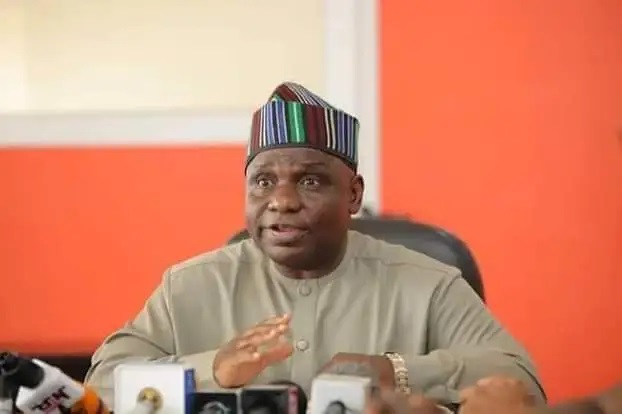
Speaking with journalists at his Makurdi residence on Monday, the former commissioner, who served in both terms of the Samuel Ortom-led administration, said his silence over the past two years was deliberate, to allow the new government time to settle and chart its course.
“I didn’t want to oppose the government immediately after they took over. That’s not how democracy works. But after two years, one must begin to ask tough questions on behalf of the people,” Ityavyar stated.
On the issue of security, Prof. Ityavyar expressed concern over the rising wave of killings across local governments in the state and described the official handling of the crisis as detached and underwhelming. He noted that referring to mass killings as mere “skirmishes” sent a wrong message to grieving communities and discouraged empathy.
He questioned the visibility and effectiveness of “Operation Anyam Nyor,” a security initiative launched by the government to address insecurity in the state.
According to Ityavyar, the vehicles and operatives presented at the launch have since disappeared from public view, with no consistent feedback or results communicated to the public.
He also raised concern over what he described as the government’s quiet position on the anti-open grazing law, a policy widely embraced by Benue people during the Ortom administration.
“The current administration appears reluctant to continue the enforcement of the anti-open grazing law, claiming a lack of capacity. But capacity is part of leadership. If you can’t implement a policy central to the people’s safety and wellbeing, it raises bigger questions,” he said.
Prof. Ityavyar also accused the administration of not clearly identifying those behind the attacks, referencing a public statement where the governor reportedly said the attackers had rights under the ECOWAS protocol. “That kind of interpretation is not helpful. It appears to rationalise violence rather than challenge it,” he added.
Beyond security, Ityavyar lamented what he described as a lack of transparency in government operations, citing issues around budget disclosures, project execution, and internal cohesion.
He alleged that major contracts were awarded even before the State Executive Council was constituted and said there had been conflicting figures on the cost of infrastructure projects, particularly a controversial road project in Makurdi.
Referring to alleged disunity within the current administration, Prof. Ityavyar said: “There’s too much division — within the ruling party, among stakeholders, even within government circles. A house divided cannot build. We need consensus and unity to move Benue forward.”
Responding to questions about whether he was aware of any commissioned projects, particularly roads by the Alia administration, he said he could not speak on what was unseen. “If there’s anything to commission, the media will report it. I haven’t seen any announcements. So, I don’t know,” he said.
While critics have pointed out that the opposition People’s Democratic Party (PDP) in Benue is also allegedly factionalised, Prof. Ityavyar strongly disagreed. He described the PDP structure as stable and unified, affirming that party executives at all levels were elected through congresses duly monitored by the Independent National Electoral Commission (INEC) and ratified by the party’s national secretariat.
“There is no faction in PDP. What exists is mischief. In every local government, congresses were held, and the national office approved them. If someone claims to be chairman but was not elected through congress, that’s not a faction. That’s impersonation,” he said.
Prof. Ityavyar also used the platform to defend the Ortom administration’s record in the education sector during his tenure as commissioner. He said despite limited financial inflows from the federal government during their time in office, they recorded visible improvements in basic education, including the renovation of primary schools, provision of over 100,000 desks and chairs across the three senatorial zones, and support from Universal Basic Education matching funds.
In tertiary education, he said their administration resolved lingering issues that had delayed the graduation of medical students for over a decade and facilitated the payment of academic and non-academic allowances at Benue State University. “We brought in a formula to sustain payments and supported law students to go to law school. If people say we didn’t do well in education, I wonder what they define as performance,” he added.
He acknowledged challenges in the secondary education sector, particularly in renovating dilapidated schools, but said efforts to access loans for this purpose were blocked by the federal government due to political differences.
On his political ambition, Prof. Ityavyar confirmed he would contest the 2027 governorship election, saying his experience in governance and development work positioned him as someone ready to hit the ground running if given the mandate.
“I’m not desperate to win. But I believe I have the ideas, the structure, and the heart to serve. Politics is not just about building roads. It’s about building people, connecting with them, feeling their pain and being accessible. Leadership is about presence, empathy, and the ability to act fast. That’s what I will offer,” he stressed.
Ityavyar maintained that even if he does not win, the opportunity to share his vision and proposals for a better Benue would still make his participation meaningful. “I believe 2027 is my time. But even if it’s not, my ideas will still serve the people. That is what matters,” he maintained.
