


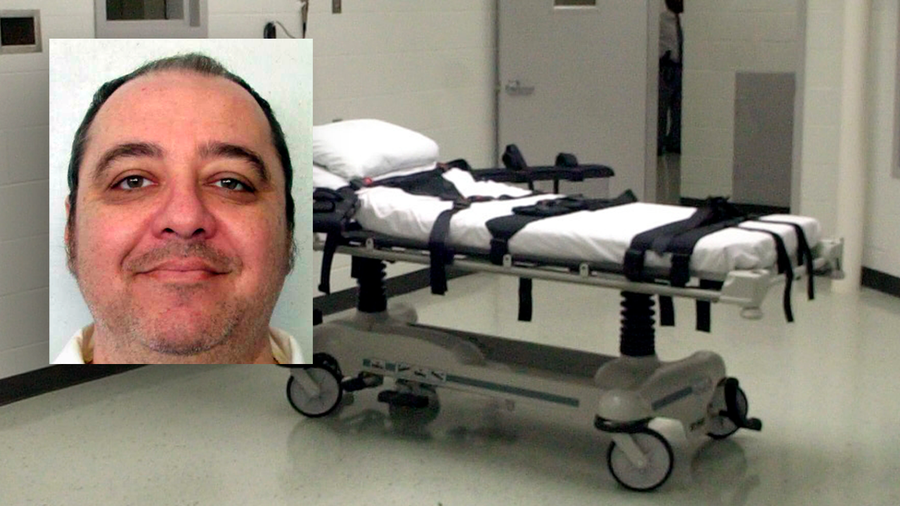
THE STATE of Alabama in the United States of America (USA) on Thursday became the first state to ever execute a death row prisoner using nitrogen gas, potentially opening up a highly controversial method to wider use in prison executions even as experts and advocates have questioned whether it could lead to excessive pain and suffering.
Kenneth Smith, who survived an attempt by the state to execute him by lethal injection in 2022, was put to death Thursday evening in Atmore, Alabama, the rural home to the state’s execution chamber near the Florida state line, Governor Kay Ivey’s office confirmed.
Smith, 58, was executed just before 8:30 p.m. local time, according to the Associated Press. While lying on a gurney, authorities placed a respirator mask over his face that forced him to breath pure nitrogen gas until he lost consciousness and eventually died.

Alabama officials said the nitrogen would knock Smith out in a matter of seconds, and leave him dead in minutes.
Smith’s final meal was served at breakfast. He asked for and received a T-bone steak that was served with hash browns and eggs, all from Waffle House and lathered in steak sauce, The New York Times reported.
A reverend who was in contact with Smith for months said he was repeatedly throwing up in a trash can, fearing a complication could arise.
ALSO READ:
Global Coalition For Social Justice Attracts First 100 Partners
OSH Measures Key To Prevent Violence, Harassment In The World Of Work, Says ILO Report
Imperative Of A Return To Policing Nigeria; By Jibrin Ibrahim
Kidnapping And Death Sentence; By Safiya I. Dantiye
“Kenny is terrified,” said Rev. Jeff Hood, according to the Times. “He’s terrified that this thing is going to completely torture him.”
In a joint statement on Thursday afternoon, Smith and Hood said, “The eyes of the world are on this impending moral apocalypse. Our prayer is that people will not turn their heads. We simply cannot normalise the suffocation of each other.”
The execution method, known as “nitrogen hypoxia,” was used despite some experts voicing concerns that Smith may experience excessive pain or a torturous death, which could have made the execution a violation of the eighth amendment. Alabama authorities have countered that the method is “perhaps the most humane method of execution ever devised.”
The U.S. Supreme Court on Thursday denied a last-minute appeal by Smith’s attorneys to stay his execution, with the court’s three liberal justices—Elena Kagan, Ketanji Brown Jackson, and Sonia Sotomayor—publicly dissenting. A day prior, the high court had declined to take up or intervene in Smith’s case.
In a separate ruling late Wednesday, a federal appeals court declined to halt the execution.
The fatal punishment came more than three decades after Smith was convicted of a bizarre murder-for-hire plot, in which he and two other men were hired by a pastor to fatally stab his wife, Elizabeth Sennett, in 1988. Two of Sennett’s sons had advocated for Smith’s execution, saying it was long overdue.
Alabama, one of 19 states where the death penalty remains active, has struggled to effectively carry out executions in recent years. In 2022 alone, the state had three executions that were deemed as “botches,” meaning they deviated from the stated protocol. Other states have struggled to obtain the drugs needed for lethal injections in the face of pressure from medical groups and activists who opposed the death penalty.
Among those subjected to a botched execution was Smith, who was temporarily spared after guards failed to set an intravenous line to deliver a lethal injection into his veins before his death warrant expired on Nov. 17, 2022.
While the use of nitrogen for an execution was unprecedented stateside, Alabama lawyers who advocated for the method pointed to the use of nitrogen for assisted suicides in Europe as proof that death-by-nitrogen is equally effective and humane.
Smith’s lawyers never disputed that nitrogen could be an effective execution method, but they argued to an appeals court Wednesday that Alabama wasn’t properly prepared to carry out such an execution. They said the use of a mask—rather than a bag or other enclosure—could allow enough oxygen to seep through that’d possibly prolong the process of Smith losing consciousness, which would force him to suffer before eventually succumbing.
Despite those concerns, the federal appeals court ruled 2-1 Wednesday in favor of the execution remaining on schedule using nitrogen.
Smith’s lawyers then brought that same argument to the Supreme Court on Thursday, writing in a petition that Alabama’s use of a “one-size-fits-all mask” could lead to a botched execution with Smith in a “persistent vegetative state” or cause him to choke on his own vomit.
Attorneys for Smith suggested that a firing squad would be a “feasible and available alternative”to replace nitrogen hypoxia. Despite their pleas, the Supreme Court declined to act on the petition.
The White House denied to comment on the execution to multiple media outlets on Thursday, with a spokesperson telling the Times simply, “This is a state-level case and I won’t speak to the details of this particular case.”
Smith’s death by nitrogen has likely opened the door for other states to use the method in place of lethal injections. Even prior to Thursday, both Mississippi and Oklahoma had authorized their prisons to carry out executions by nitrogen hypoxia, but ordered them to do so only if they could not use lethal injection.
