


THE ALUMNI Association of the National Institute (AANI) has renewed its call for a fundamental overhaul of Nigeria’s policing architecture, advocating a decentralised, intelligence-led, and community-based model while stressing that justice, accountability, and societal orientation are indispensable to achieving lasting security.

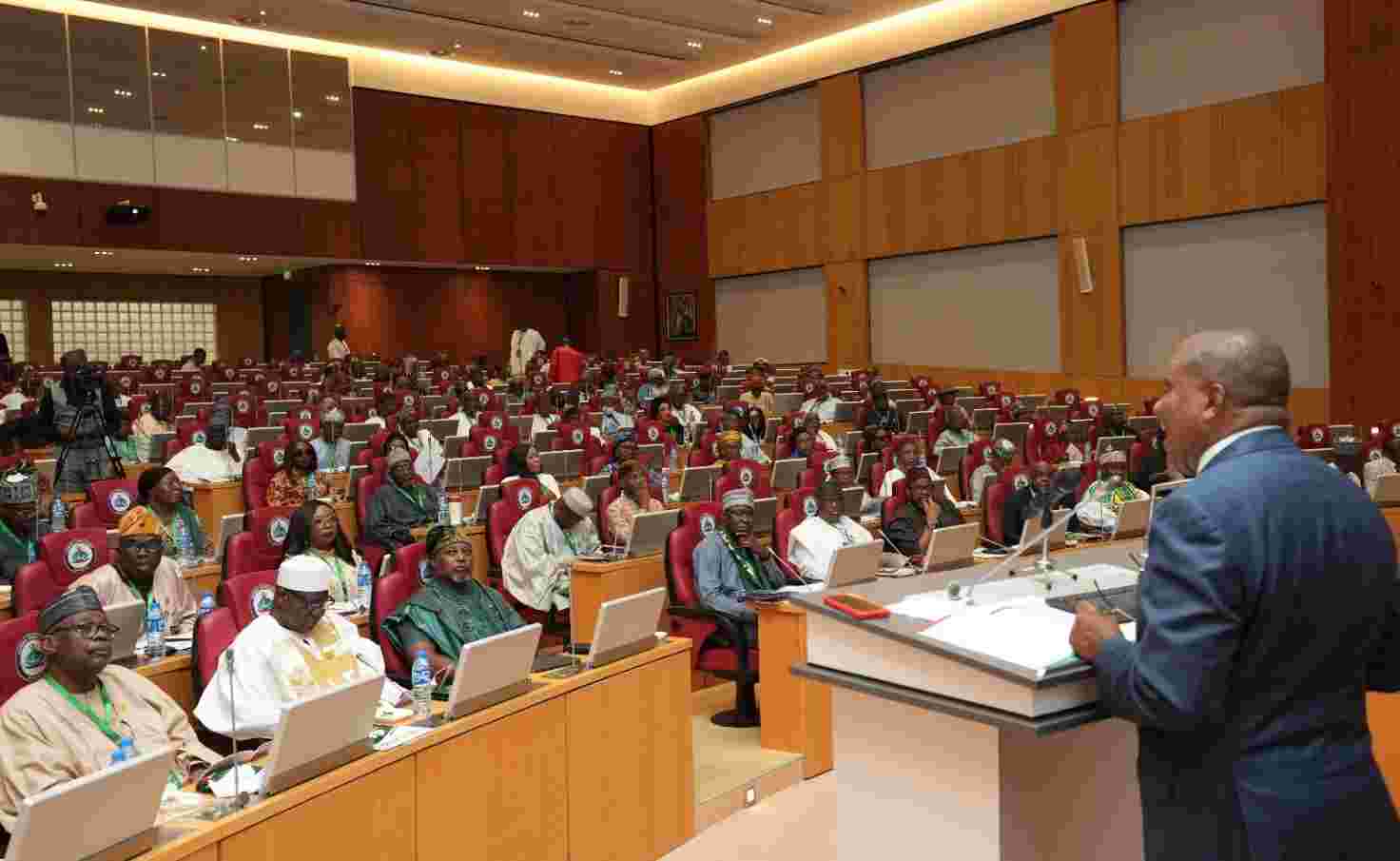
This position emerged as the central resolution of AANI’s 46th Annual General Meeting (AGM) and National Colloquium, held at the Muhammadu Buhari Conference Centre, Abuja, under the theme: “State Police and Community Policing: Challenges, Options and Opportunities.”
The high-level event drew a wide range of stakeholders, including senior security and intelligence officials, representatives of Zamfara and Sokoto State governments, and key federal institutions.

The Secretary to the Government of the Federation was represented by Professor Babatunde Bolaji; the Inspector-General of Police by Assistant Inspector-General Aisha Abubakar; the Chief of Army Staff by Colonel Jubril; the Chief of Naval Staff by Navy Captain Hassan Yusuf; and the intelligence community by Dr. Bakeji.
The Director-General of the Department of State Services (DSS), Mr. Oluwatosin Adeola Ajayi, attended as Special Guest of Honour, while the event was chaired by Professor Tijjani Bande, GCON, former Permanent Representative of Nigeria to the United Nations and former Director General of the National Institute for Policy and Strategic Studies (NIPSS).
In his opening remarks, AANI President, Amb. Emmanuel Obi Okafor, mni, described Nigeria’s prolonged security challenges – including banditry, terrorism, kidnapping, farmers-herders violence, separatist agitations, and oil theft – as a defining moment that has exposed the weaknesses of the country’s centralised policing structure.
Amb. Okafor stressed that incremental measures are no longer sufficient and called for bold, decisive reforms.
Delivering the keynote address, Professor Femi Mimiko, mni, described Nigeria’s single-layer policing system as overstretched and incompatible with federal principles, arguing that an effective security framework must be multi-layered and responsive to local realities.
He identified intelligence gaps, manpower shortages, corruption, and over-centralisation as key drivers of insecurity, making comprehensive reform inevitable.
The Head of the Civil Service of the Federation, Mrs. Didi Esther Walson-Jack, represented by the Permanent Secretary, Federal Ministry of Innovation, Science and Technology, Dr. Mukhtar Mohammed, MFR, mni, commended AANI for sustaining a strategic national dialogue and pledged support for implementing the meeting’s outcomes.
Discussing the keynote paper, retired Deputy Inspector-General of Police, Adeleye Oyebade, mni, proposed a hybrid policing model that integrates state and community policing while retaining the Nigeria Police Force as the central coordinating authority to ensure uniform standards and rapid grassroots response.
Brigadier General Abdulrahman Idris, mni, emphasised the need for a holistic approach, noting that effective policing goes beyond enforcement to include public trust, community collaboration, and addressing socio-economic issues such as unemployment and social exclusion.
The DG DSS, Mr. Ajayi, underscored that President Bola Ahmed Tinubu is fully committed to tackling the nation’s security challenges. He charged community rulers, religious leaders, and grassroots mobilisers to rise to their responsibilities, noting that security is not only institutional but a shared societal duty.
Emphasising the centrality of justice, he stated that “where there is justice, peace comes naturally,” and argued that state policing is both a legitimate exercise of state authority and one of the most effective mechanisms for harmonising Nigeria’s numerous quasi-law enforcement outfits currently operating across states.
Deliberations revealed that Nigeria remains significantly under-policed, with a current strength of 371,800 officers and a police-to-population ratio of approximately 1:740, far below the UN standard of 1:450.
Participants noted that the deployment of the military for routine policing duties across almost all states is unsustainable.
The colloquium endorsed an intelligence-driven hybrid policing model and made key recommendations, including: urgent constitutional amendment of Sections 214 and 215 of the 1999 Constitution to move policing from the Exclusive Legislative List to the Concurrent List; clear delineation of functional boundaries between federal and state police; training for state police coordinated by the Nigeria Police Force; defined funding mechanisms and accountability frameworks; and a whole-of-society approach recognising that kinetic means alone cannot solve insecurity.
The meeting called on the National Assembly to expedite constitutional amendments and urged all levels of government to ensure justice, stating that peace will not prevail without fairness.
AANI reaffirmed its commitment to providing evidence-based policy solutions, noting that a properly regulated state police offers opportunities for improved responsiveness, better intelligence, employment generation, and restored public trust.
The association disclosed that outcomes of the AGM and colloquium would be harmonised into a communiqué and strategic policy proposals for relevant authorities.
