


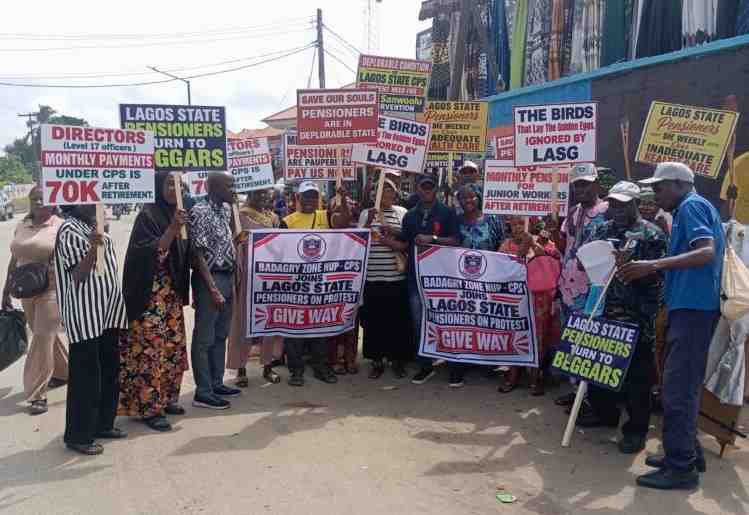
THE CAMPAIGN for Democratic and Workers’ Rights (CDWR) has condemned the alleged use of tear gas by the Nigeria Police against protesting pensioners at the Lagos State House of Assembly in Alausa, Ikeja, describing the incident as an attack on the rights and lives of elderly citizens.
In a statement signed by its National Chairperson, Comrade Rufus Olusesan, and National Publicity Secretary, Comrade Chinedu Bosah, the rights group said the pensioners were tear-gassed during a peaceful protest on August 31, 2026.
The CDWR said the protesters had gathered at the Lagos State House of Assembly after the expiration of an ultimatum issued to the state government over what it described as delays in the payment of pensioners’ entitlements, accumulated arrears and other benefits.

The group also called for an increase in pension payments, arguing that the demands being made by the pensioners were legitimate and should be addressed immediately by the Lagos State Government.
According to the organisation, the alleged use of tear gas against elderly protesters was particularly disturbing because of the potential health risks associated with exposure to the chemical irritant.
“What is shocking is the extension of their bestial action to elderly/senior citizens whose health conditions are fragile,” the organisation said, adding that the use of tear gas could have exposed the pensioners to respiratory complications and other injuries.
The CDWR also rejected the Lagos State Police Command’s reported denial of the incident, accusing the command of attempting to discredit evidence of the attack by focusing on an artificial-intelligence-generated photograph reportedly used to illustrate the incident.
The group argued that the use of an AI-generated image did not, in itself, establish that the alleged police action did not occur.
“There is incontrovertible evidence that cannisters of tear gas were fired at the protesters,” the organisation stated, while accusing the Lagos police of having a history of using force against people protesting government policies and socio-economic grievances.
The CDWR cited an earlier protest on January 28, 2026, involving residents and activists opposing alleged land grabbing, demolitions and forced evictions in communities including Makoko, Owode-Onirin and Oworonshoki.
According to the group, that protest was also violently repressed, with police allegedly deploying tear gas and using excessive force against protesters.
It said the August 31 incident involving pensioners represented a continuation of what it described as a pattern of police brutality in Lagos.
The organisation further criticised the economic conditions of retired public servants in the state, contrasting what it described as low pension payments with the substantial pension packages allegedly awarded to former governors.
The CDWR said some Lagos pensioners, including people who retired as senior civil servants, receive between ₦25,000 and ₦60,000, describing the situation as an example of severe inequality.
It argued that pensioners who spent decades working in public service deserved adequate financial support and dignified treatment in retirement rather than prolonged delays in receiving their entitlements.
The group also linked the current pension crisis to Nigeria’s broader pension reforms, recalling its opposition to the privatisation of the pension scheme in 2005 and the introduction of the contributory pension system under the administration of former President Olusegun Obasanjo.
The CDWR maintained that the contributory pension system had weakened retirees’ earnings and reduced government responsibility for ensuring adequate pension payments.
Beyond the immediate dispute between the pensioners and the Lagos State Government, the organisation framed the incident as part of a broader struggle over the right to protest and dissent.
It said the right of citizens to peacefully protest government policies was fundamental and should not be suppressed through police action.
The group accused Nigeria’s political leadership of increasingly restricting democratic rights in an effort to prevent resistance to what it described as anti-poor policies.
The CDWR called on the Nigeria Labour Congress (NLC), Trade Union Congress (TUC) and civil society organisations to condemn the alleged police action and support the pensioners’ demands.
It urged organised labour and civil society groups to mobilise in solidarity with the retirees and put pressure on the Lagos State Government to resolve the outstanding pension issues.
The organisation also urged workers and young people not to surrender their democratic rights, advocating the development of a broader mass movement against attacks on civil liberties and policies it considers detrimental to working people.
The CDWR ultimately called for the Lagos State Government to address the pensioners’ demands, while insisting that peaceful protest must remain protected as a fundamental democratic right.
