


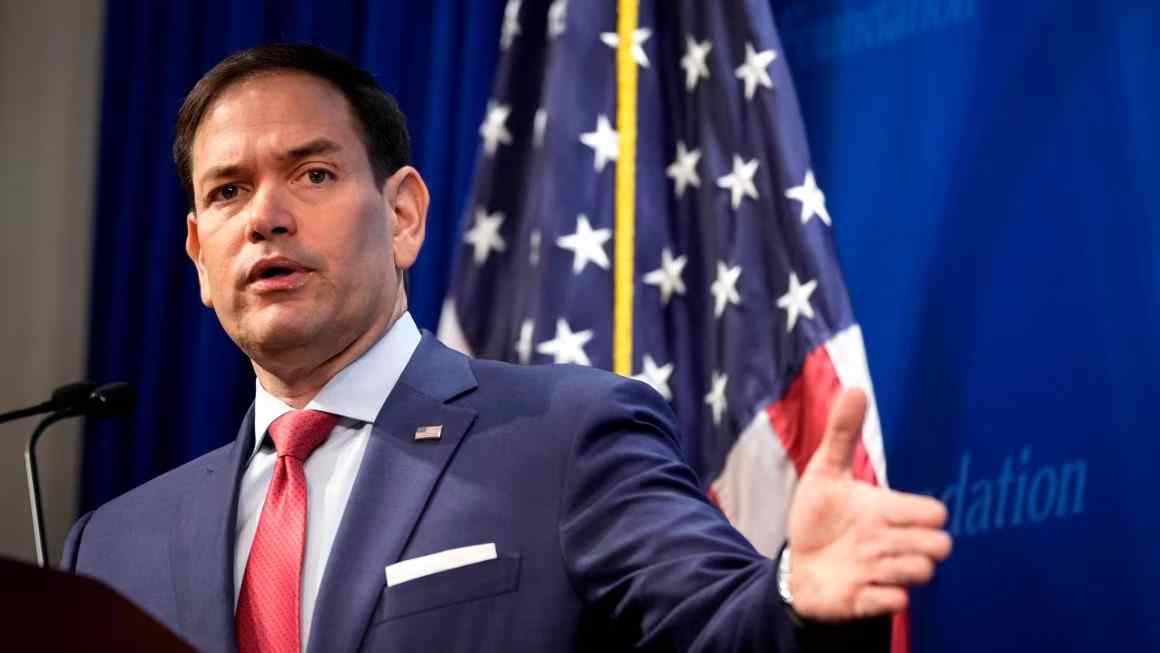
THE INTERNATIONAL Trade Union Confederation-Africa (ITUC-Africa) has issued a strongly worded condemnation of the recent remarks by U.S. Secretary of State, Marco Rubio, at the Munich Security Conference, describing his rhetoric as a “renewed onslaught” against Africa’s sovereignty, dignity, and future.

In a statement released from its headquarters in Lomé, signed by its General Secretary, Akhator Joel Odigie, the continental labour federation warned African workers to interpret Rubio’s words “not emotionally, but historically and politically,” drawing direct parallels between the U.S. official’s language and the colonial-era Berlin Conference of 1884/85 that partitioned the African continent.
“We reject and condemn this Munich statement,” the federation declared, calling Rubio’s address an “insult and a direct and dangerous threat to former colonies still nursing their wounds and living with their scars of colonialism.”

‘Empire Was Never Charity’
The statement took specific issue with Rubio’s nostalgic references to “great western empires” and his call for Western allies to abandon “guilt and shame” over colonial history.
“Empire was never charity. It was an extraction excursion that left Africa and other colonies fractured,” the statement read, warning that such rhetoric signals a return to imperial temperament, not necessarily through direct colonisation, but through “economic control, sanctions, debt, and influence.”
The labour body drew comparisons to U.S. interventions in Venezuela, Cuba, and Palestine, as well as what it described as the “bullying of South Africa” by the Trump administration, describing them as manifestations of a broader doctrine where “economic pressure, sanctions, and geopolitical leverage are used to reshape governments and secure strategic interests.”
Internal Weaknesses: The Real Danger
In a notable departure from purely external criticism, the statement also directed sharp attention inward, acknowledging that “external forces succeed where internal weaknesses prevail – corruption, inequality, poor governance, ethnic divisions, and distrust among citizens.”
The organisation cautioned: “When institutions weaken, economies collapse. When economies falter, workers suffer first,” just as it urged African governments pursuing industrialisation and anti-corruption reforms to remain accountable.
It also called on workers to “demand transparency, anti-corruption enforcement, and fair distribution of wealth.”
A Clarion Call for Unity
Citing reggae icon Bob Marley’s call to “Africa Unite,” the federation described unity not as “poetry” but as “strategy,” urging African workers to reject ethnic, religious, and political divisions while strengthening trade unions and worker solidarity.
The statement concluded with a five-point call to action: vigilance and organisation; rejection of division; strengthened trade union solidarity; engagement with governments through “prescriptive social dialogue”; and resistance to “any agenda – internal or external – that weakens Africa’s sovereignty and economic future.”
