



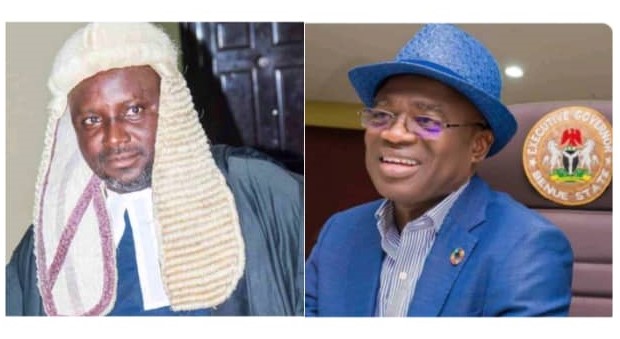
In this piece, Victor Itodo Abuh provides some perspectives on the recent and perhaps still prevailing, war of attrition in Benue State symbolised in the imbroglio at the State House of Assembly.
THE BENUE State House of Assembly is presently navigating, or seemed to have overcome, a period of significant political instability, marked by a rapid succession of consequential events. This turmoil culminated in the resignation of the Speaker, Rt. Hon. Aondona Dajoh, his subsequent suspension from the legislative body, and the expedient election of a new Speaker, Hon. Alfred Berger Emberga.
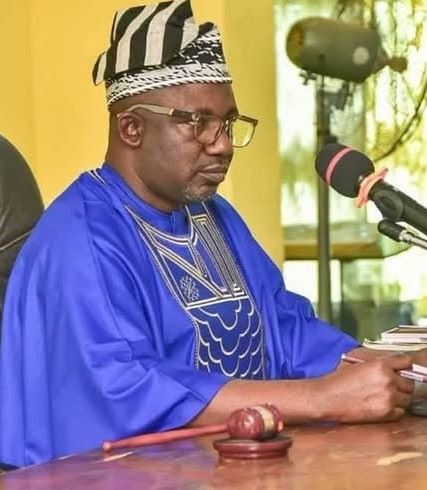
These developments are not isolated incidents but are indicative of profound political divisions within not just the state’s legislature but a grave manifestation of the protracted internal power struggles within the ruling All Progressives Congress (APC) at the state level.
Resignation of Speaker Dajoh
On Sunday, August 24, 2025, Hon. Dajoh formally submitted his resignation from the position of Speaker via a handwritten communication addressed to the House. In his correspondence, Dajoh asserted that his decision was made “in good faith and in the best interest of the state.”
The Speaker, who had ascended to the role in June 2023 following a highly competitive election, had recently been confronted with escalating dissent from a faction of his colleagues. This opposition was largely fuelled by allegations that the Speaker had engaged in efforts to consolidate power, including purported attempts to suspend members who voiced opposition to his leadership.
Reports from Channels Television indicated that Dajoh’s departure was “inevitable,” as a coalition of lawmakers had already initiated the necessary mobilisation to commence impeachment proceedings prior to his decision to step down. Consequently, his resignation was widely interpreted as a strategic manoeuvre to mitigate mounting political tensions and pre-empt a protracted and divisive impeachment process that would have resulted in legislative gridlock.
Emergence of Emberga as Speaker
In an emergency plenary session convened on the same day as the former Speaker’s resignation, the House moved swiftly to elect a successor. Hon. Alfred Berger Emberga, the member representing the Makurdi North Constituency, was elected to the Speakership.
His election is largely regarded as a consensus-driven compromise, aimed at restoring immediate stability to the legislative branch and steering the Assembly back toward its core mandate of effective governance and oversight.
In his inaugural address, Speaker Emberga articulated his commitment to unity, stating: “I will work with all members, irrespective of political affiliations, to ensure that the Benue State House of Assembly regains its dignity and serves the people effectively.”
Nevertheless, while political observers thought that the new Speaker would confront the immediate and formidable challenges, primarily the delicate task of reconciling sharp differences amongst members, particularly members who had been suspended under circumstances considered harsh, and adeptly managing the competing factional interests within the ruling APC caucus, Hon. Emberga instead went for the jugular and blowing trumpets of war.
Conquering Dajoh
In a remarkable turn of events, after the acceptance of his resignation and the election of a new Speaker, the Assembly deliberated and passed a motion to suspend the former Speaker for a period of three months.
The allegations underpinning this disciplinary action cited that Dajoh had sought to clandestinely initiated a process for the impeachment of the state governor and suspension of certain members of the House; political manoeuvres deemed detrimental to the institutional cohesion and integrity of the legislature and the state.
This decision, widely disseminated by various media outlets, has attracted criticism from civil society organisations and political commentators. These groups have expressed concern that the suspension of a member immediately following his resignation could be perceived as a punitive overreach and a potential contravention of democratic norms and principles of fair dealing.
Political analysts have observed that while the leadership reshuffle in the Benue State House of Assembly may have been presented as a bid to reinforce the Assembly’s authority and assert its independence, the reality tells a different story. The crisis has not only deepened existing divisions but also reinforced public suspicions that the turmoil is less about legislative independence and more about executive interference.
Indeed, speculations — and valid ones at that — abound that the entire episode was orchestrated by the governor to keep the legislature under tight control. This view gains further traction when one recalls how swiftly the same Assembly, which had earlier rejected commissioner-nominees based on credible petitions and concerns, made a sudden U-turn to approve them just days later. Such reversals cast serious doubt on the integrity of the House’s decision-making process, suggesting that loyalty to the executive may have outweighed legislative scrutiny.
What emerges, therefore, is not a portrait of a robust legislature exercising its independence, but rather a fragile institution whose stability hinges precariously on the whims of the executive. Far from strengthening democratic governance, the events in Makurdi have exposed how easily legislative processes can be compromised, raising troubling questions about whether the Benue State Assembly truly represents the will of the people or simply echoes the agenda of the state’s ruling establishment.
The Underlying Political Context
No doubt, the present crisis is a symptom of the broader political dynamics playing out within Benue State. Reports suggest that deep-seated divisions within the state chapter of the All Progressives Congress (APC), compounded by strategic jockeying for influence in anticipation of the 2027 general elections, have intensified the struggle for control over the legislative arm of government.
The principal offices of the Assembly have historically functioned as critical levers of political power in Benue. Consequently, the protracted struggle between factions loyal to Governor Hyacinth Alia and other significant political stakeholders, particularly Senator George Akume, the current Secretary to the Government of the Federation (SGF), has profoundly influenced legislative proceedings since the inauguration of the 10th Assembly in 2023.
Public Reaction and Broader Implications
These developments have elicited a spectrum of reactions from the citizenry and stakeholders. Some constituents perceive the leadership transition as a necessary and positive step toward restoring legislative functionality and stability.
Conversely, others interpret the sequence of events as a stark illustration of political elites prioritising internal power contests over their fundamental obligations of public service.
An insight in ThisDay Newspaper cautioned that the suspension of Mr. Dajoh and the rapid election of his successor risk “eroding public trust in the legislature at a time when citizens expect transparency, accountability, and representation.”
Echoing this sentiment, civil society groups have issued calls for the Assembly to redirect its focus toward addressing the pressing issues confronting the state, including pervasive insecurity, high unemployment, and critical infrastructure deficits, rather than perpetuating internal political conflicts.
Prospective Challenges and Conclusion
While Speaker Emberga’s mandate is unequivocally legitimate, well-meaning observers are of the opinion that he must use his new office to bridge the deep divisions within the House, embark on a process to restore public confidence in the legislature, and ensure the Assembly operates as a robust, independent, and effective body.
The efficacy with which he navigates the reconciliation of suspended members and balances the array of competing political interests will ultimately define the success and longevity of his tenure.
While the suspension of Dajoh remains a contentious issue, and believed to be a potential subject of judicial challenge, a development that could potentially prolong the ongoing political drama in Benue State, it is however positive to hear from the speaker that he has “moved on”, meaning that he has no intention to orchestrate a legal challenge.
Clearly, the entire crisis serves as a vivid case study of how internal party machinations and individual ambitions can directly impede the trajectory of governance and policy-making.
For the electorate, it underscores the critical importance of sustained and vigilant engagement with political processes to ensure that the primary focus of government remains the delivery of public service.
