


“Hide nothing from the masses of our people. Tell no lies. Expose lies whenever they are told. Mask no difficulties, mistakes, failures. Claim no easy victories…”
― Amilcar Cabral
ON JULY 18, 2023, petrol prices increased from N537/litre to N617/litre in NNPCL petrol stations. Nigerians screamed in anguish. The GCEO of the NNPCL, Mele Kyari, blamed the petrol price increase on market forces. According to Kyari, “What I know is that the market forces will regulate the market; prices will go down sometimes, sometimes it will go up, but there will be stability of supply. I am also assuring Nigerians that this is the best way to go forward so that we can adjust prices.”

The current PMS price of N617/litre was not decided by market forces. Neither will future higher petrol prices. Petrol prices in Nigeria remains a bureaucratic government decision. How did the government arrive at the price of N617/litre? The PRC of the PPPRA in the NMDPRA decided the current price of N617/litre by using the old PPPRA PMS price template which is based on the IMF import parity pricing model. An example is shown below.
But, are petrol prices determined by market forces? Who decides the price of petrol in Nigeria? How did the government arrive at the price of N617/litre? Will petrol prices ever go down? We will answer these questions unequivocally.
Who decides the price of petrol in Nigeria?
The federal government argues that increased petrol prices are determined by market forces of supply and demand. Market forces do not determine petrol prices in Nigeria. The price of petrol is determined by NNPCL. In March 2020, the federal government set up a Price Review Committee (PRC) in the PPPRA, whose duty was to review prevailing prices of petrol for each month. The PRC began work in April 2020. The Executive Secretary of PPPRA, Abdulkadir Saidu, explained the new function of the PPPRA, thus:
“The agency no longer fixes prices but rather provides a guiding price band within which the operators are expected to operate. This takes into account prevailing market conditions by monitoring petroleum products prices daily, using the average price of the previous month and other components like foreign exchange rates to determine prices for the following month, while ensuring reasonable returns to Oil Marketing Companies (OMCs)”.
In August 2021, the PIA merged the PPPRA, Petroleum Equalisation Fund {Management} Board (PEFMB), the Midstream and Downstream Divisions of the Department of Petroleum Resources (DPR) together to form the Nigerian Midstream and Downstream Petroleum Regulatory Authority (Otherwise known as NMDPRA or “The Authority”). Therefore, the Price Review Committee of the PPPRA in the NMDPRA decided that petrol prices should increase from N537 per litre to N617 per litre.
The Nigerian petrol market is an oligopoly with few sellers and many buyers. The sellers set higher prices that rarely come down. Unlike the theoretical supply-demand free market model taught in freshman economic classes, real markets are not free and prices are sticky downwards.
The current PMS price of N617/litre was not decided by market forces. Neither will future higher petrol prices. Petrol prices in Nigeria remains a bureaucratic government decision. How did the government arrive at the price of N617/litre? The PRC of the PPPRA in the NMDPRA decided the current price of N617/litre by using the old PPPRA PMS price template which is based on the IMF import parity pricing model. An example is shown below.
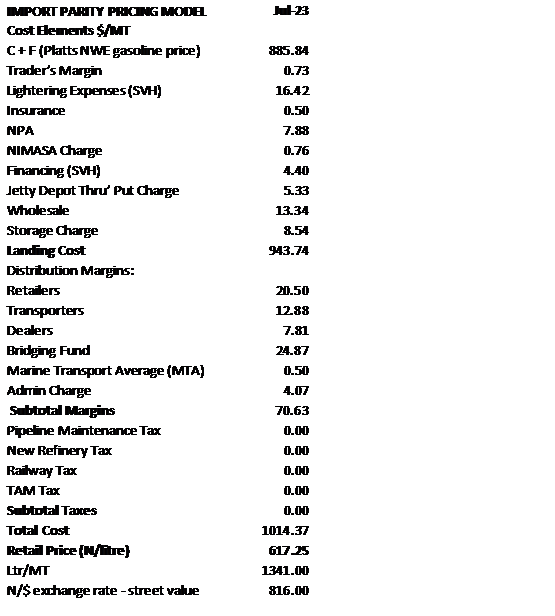
In July 2023, the price of Platts Northwest Europe/Rotterdam gasoline price was $885.84 per metric ton (MT). The Trader’s margin, Lightening Expenses (SVH), Insurance, NPA, NIMASA Charges, Financing (SVH), Jerry Depot Throughput Charges, Wholesale charges and Storage charges were fixed at $57.9/MT by the government. This gave a Landing cost of $943.74/MT. The government also fixed the Distribution margins at $70.63/MT. The Distribution margins is the sum of the margins for Retailers, Transporters, Dealers, Bridging fund, Marine Transport Average (MTA), and Administration charges. Government taxes were $0.00. However, President Tinubu is planning to tax everything to raise government revenue and petrol is no exception. The total price of petrol at the pump is $1,014.37/MT. This translates to N617.25/litre at an exchange rate of $1/N816. There is no invincible hand of the market involved. The government should tell no more lies.
Given the negative impact of petrol price increase on the Nigerian masses and the economy as a whole, it is best for the government to reverse its IMF’s petrol price increase and anti-people policy and fixing our four refineries.
Will petrol prices ever go down?
The Nigerian petrol market is an oligopoly with few sellers and many buyers. The sellers set higher prices that rarely come down. Unlike the theoretical supply-demand free market model taught in freshman economic classes, real markets are not free and prices are sticky downwards.
According to the CEO of the Nigerian Midstream and Downstream Petroleum Regulatory Authority (NMDPRA), Farouk Ahmed, “We have about 56 marketing companies that applied and obtained licenses to import. Out of those, 10 of them have indicated to supply within the third quarter, which is July, August, September. Already, we received some cargoes from these markers: Prudent Energy, AYM Shafa and Emadeb. Emadeb Cargo is arriving tomorrow.”
These 10 marketing companies were involved in the infamous DSDP programme of the NNPCL. In the 2021-2023 DSDP arrangement, Prudent was in a consortium with UTM, Matrix and Petra Atlantic while AYM Shafa was in a consortium with BP Oil international Ltd. Emadeb was in a consortium with AY Maikifi, Britannia-U and Hyde. It is the same old gang of PMS importers. Petrol prices will be fixed at very high rates to maximise profits.
Given a crude oil Production cost of $28/barrel ($236.17/MT), Refining cost of $77.93/MT and other costs such as Headquarters overhead, NPA charges, Depreciation cost and Financial charges, the petrol cost at the Refinery gate would be $338.52/MT. A 10% producer margin ($42.27/MT), Distribution margins of $84.20/MT, VAT at 7.5% and NCBMD at 1% will give a total cost of $504.52/MT using the production cost pricing model. This is equivalent to N297.37 even with the prevailing anti-people brutal floating exchange rate of $1/N791 (N173/litre at the old exchange rate of $1/N461).
Even in the rare cases when gasoline (CIF) prices decline in the Rotterdam market, the ever-increasing floating exchange rates will keep petrol prices high. Even if NNPCL temporarily reduce petrol prices to mimic market forces, Nigerians will get no benefits. In 2020, the Minister of State for Petroleum, Timipre Sylva, explained: “The unfortunate thing is that when we brought down the price of petrol, nobody reacted in the market place. The prices were the same. Nobody reduced their prices because price of petrol had reduced. Even bus fares, taxi fares were the same. It did not go down when we reduced the pump price of petrol. We thought that those people in the market; the transport drivers and transport owners would reduce their prices. But nobody reduced their prices. But anytime there is even a kobo increase in the pump price of product, you see that people will increase their prices triple fold and four-fold.”
In the real world, fuel-induced prices are sticky downwards, and free market supply-demand equilibrium prices do not exist.
Why petrol prices will not come down
We have shown that market forces are not responsible for the increase in petrol price to N617/litre. The petrol price was set by the government. We have also shown how they arrived at N617/litre. Finally, we showed why petrol prices will not come down in the long run.
Given the negative impact of petrol price increase on the Nigerian masses and the economy as a whole, it is best for the government to reverse its IMF’s petrol price increase and anti-people policy and fixing our four refineries.
Given a crude oil Production cost of $28/barrel ($236.17/MT), Refining cost of $77.93/MT and other costs such as Headquarters overhead, NPA charges, Depreciation cost and Financial charges, the petrol cost at the Refinery gate would be $338.52/MT. A 10% producer margin ($42.27/MT), Distribution margins of $84.20/MT, VAT at 7.5% and NCBMD at 1% will give a total cost of $504.52/MT using the production cost pricing model. This is equivalent to N297.37 even with the prevailing anti-people brutal floating exchange rate of $1/N791 (N173/litre at the old exchange rate of $1/N461).
It is clear that domestic production of our petroleum products in our public owned refineries from the 445,000 bpd domestic crude supply is the path to the sustainable development of our nation.
Dr Agbon, now a consultant; was HOD, Department of Petroleum Engineering, University of Ibadan (UI), former ASUU Chairman, UI. He lives in the USA, and can be reached via: Izielenagbon@yahoo.com, or Twitter: @izielenagbon.
July 28, 2023.
