


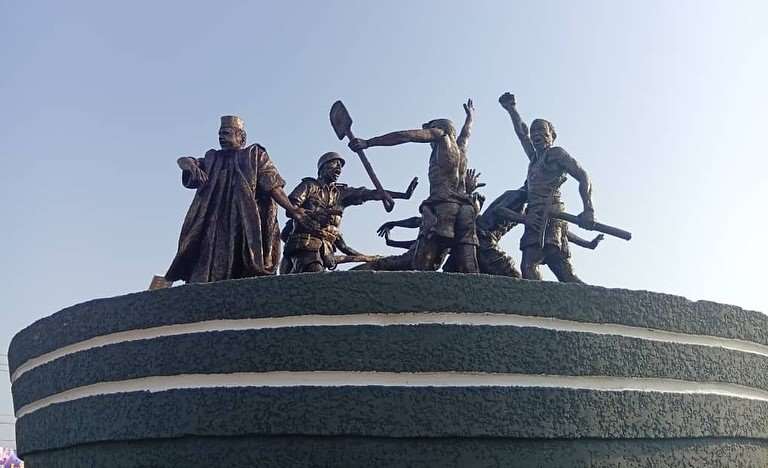
- Links Current Disputes At Dangote Refinery To 1949 Killings of Miners
- Says Ongoing Industrial Relations A Class War Driven By Neo-Liberal Economic Policies
- Says Fierce Media Campaign Vilifying Unions, Legitimising Suppression Of Workers’ Rights
ON THE 76th anniversary of the Iva Valley massacre, where British colonial police killed 21 coal miners in Enugu, a coalition of Nigerian trade unions and labour analysts are warning that the nation’s class conflict is intensifying, marked by the systematic erosion of workers’ rights and a resurgence of anti-union sentiment.
The event, held both physically in Abuja and via podcast, was anchored by the Movement for Socialist Transformation (MOST), featuring a presentation by Prof. Omotoye Olorode, entitled: “Iva Valley 76 Years After: Oil Workers, Health Workers, Civil Servants, ASUU, Electricity Workers, etc., and Nigeria’s Escalating Class War”.
The sombre commemoration of the 1949 tragedy, which occurred when miners were protesting for better working conditions, has been cast against the backdrop of recent, highly publicised disputes between the two major unions in the oil and gas sector – Petroleum and Natural Gas Senior Staff Association of Nigeria (PENGASSAN) and the Nigeria Union of Petroleum and Natural Gas Workers (NUPENG) – and the Dangote Refinery.

Prof. Olorode contended that the fundamental right to associate and bargain collectively is under unprecedented assault, drawing stark parallels between colonial-era suppression and contemporary industrial relations.
“The murder of those miners in 1949 was a brutal denial of rights guaranteed even then by emerging international norms,” he stated, adding: “Today, we see a sophisticated continuation of that suppression through policies like ‘no-work-no-pay,’ the designation of essential services to outlaw strikes, and a media landscape hostile to organised labour.”
Olorode described the recent confrontation between PENGASSAN and NUPENG with the Dangote Refinery as a case study in this escalating tension. He said the dispute, which involved mass sackings (of about 800 oil workers) and allegations of union-busting, is not an isolated incident but a manifestation of long-standing economic policies.
He pointed to the enduring influence of Structural Adjustment Programmes (SAP) from the 1980s, which prioritised privatisation and deregulation.
These policies, he argued, have created a fertile ground for the concentration of wealth and a corresponding weakening of labour power.
The Dangote Group, often hailed as a national industrial saviour, Olorde argued, is a “phenomenon” enabled by this specific economic and political dispensation.
A War of Narratives in the Media
According to the progressive intellectual, significant portion of the current struggle is being waged in the media. He accused major television networks of conducting a “media war” against PENGASSAN and NUPENG. He cited specific interviews on television channels such as Arise TV and Channels TV where union leaders were met with hostility, condescension, and accusations of economic sabotage.
He referenced an instance where commentators invoked the historical precedent of the “NEPA 11,” workers sentenced to death under the military regime of General Ibrahim Babangida for going on strike, as a veiled threat against modern unionists. He said union leaders were also publicly accused of corruption and “squandramania” without substantive evidence.
“The control of information, largely in the mode of dis-information, is made possible by ruling class control of the media,” Prof. Olorode asserts, alleging a direct link between media ownership, corporate boardrooms, and the political class.
Privatization and the Undermining of Public Enterprise
In his critique, Olorode also espoused that the fundamental philosophy of privatisation, which he labelled as the “looting of public resources,” led to the systematic underfunding and sabotage of public refineries by successive governments thereby creating a vacuum filled by private interests.
He noted government’s significant shareholding in the Dangote Refinery and its guaranteed crude oil supply as evidence of a state policy that strengthens private monopolies at the expense of public assets.
He also argued that Dangote Refinery’s location in an Export Processing Zone (EPZ) – which often restricts trade union activity – is a deliberate mechanism to curtail workers’ rights.
A Call for Labour Reawakening
Concluding on a prescriptive note, Olorode called for a major summit of Nigeria’s labour movement, noting that the current crisis of awareness and organisation within the ranks of organised labour and its civil society allies, demands a unified front to counter the prevailing economic model.
“The task hopefully triggered by the alliance of anti-worker forces in Nigeria today is to rebuild the Nigeria labour movement,” paper states, hearkening back to the movement that resisted military dictatorship in the 1980s.
Below is the full text of Prof. Olorode’s presentation:
Iva Valley 76 Years After: Oil Workers, Health Workers, Civil Servants, ASUU, Electricity Workers, etc., and Nigeria’s Escalating Class War
Introduction
Today seventy-six years ago (November 18, 1949), British colonial police shot and killed twenty-one Nigerian coal miners who were asking for better conditions of work at the Enugu Coal Mines Ivalley in today’s Enugu State. Fifty other coal miners were seriously injured while one by-stander was also killed. It is this killing of working people that we are reflecting upon today in an independent resource-full Nigeria in which trade union rights are being routinely violated and strikes are outlawed by employers starving striking workers to death by what they now call “no-work-no-pay”!
We must emphasise that on November 18, 1949, when the first trade union was already in existence (since 1912) for twenty-six years, the coal miners’ union, the Colliery Workers’ Union, was not recognised by the British colonial government. We must emphasise further that on that day in 1949, the 1938 Trade Union Ordinance which regulated trade union activities in the colonial Nigeria of that time, had been in existence for eleven years (i. e. since 1938)!
The coal miners were thus not just denied their right to associate, which the United Nations Declaration of Human Rights (UNDHR) guaranteed one year before (December 10, 1948), they were murdered and maimed! As we observed below, Nigeria is moving rapidly back to the mid-1980s Babangida era when workers (the NEPA 11) were sentenced to death for going on strike!
The foregoing is why the so-called face-off between Dangote Refineries and segments of workers, pre-eminently PENGASSAN and NUPENG in Nigeria’s oil industry, had brought into very sharp relief the class consequences of the economic and social policies of the Nigerian ruling class which remain under the direct control of neo-colonial forces. The said policies had been put in place since the late 1970s under the direct supervision of international and largely imperialist financial institutions, especially the IMF, the World Bank, WTO, African Development Bank (AfDB) etc. This dispensation was enforced under direct military rule the leaders of which had remained, along with their close civilian friends, in power since then.
It is important to highlight a number of crucial facts of the class foundation of the face-offs. The very first issue, one that “mainstream media” and their “middle-class” anchors and “experts” struggled valiantly to keep out of public view, is the entire private (especially primitive) accumulation, privatisation, IMF/World Bank Program, the looting program, which the military wing of the Nigerian ruling class imposed since the early 1980s. The second issue is the overall social, economic, and political consequences of the continuing IMF/World Bank SAP (Structural Adjustment Program) policies for the rights and livelihood of the masses of the victims of the policies—Nigeria’s Labour movement generally, organised labour in particular, and the urban and rural poor at large. Thirdly, we need to explore the trajectory, specifically of the imposition of the Dangote Phenomenon, government-ordered PMS price manipulation, and the development of the propaganda around how “Dangote is saving Nigeria from ruin” when indeed organisations like Dangote Refinery are actually the illegitimate children of overlapping ruling class governments especially in the last few decades. In the fourth place it is important for Nigeria’s working people, especially rank and file of organised labour and its allies, to urgently address the state of organised labour history: the character and political consciousness and commitments of its leadership, and the extent to which the labour movement had been enabled or disabled to resist its own victimhood.
The Media War against PENGASSAN and NUPENG
The Nigerian labour movement, organised labour in particular, and the generality of the rural and urban, need to fully apprehend the ruthlessness of the media war deployed against PENGASSAN and NUPENG as a measure of the length to which the Nigerian ruling class and its agents will go to enforce the rules which enable and entrench the massive accumulation of wealth by their class in the last few decades. We will address the modes of this accumulation in a subsequent section of this discussion.
The control of information, largely in the mode of dis-information, is made possible by the ruling class control of the media (radio, television, print media, and communication companies) and the so-called regulatory agencies that superintend them!
The ruling groups in the so-called political parties are of course, hooked on directly to the employers’ associations such as NECA and the various elements of the boardrooms including those that own companies such as Dangote Refineries, and the media houses. There is also the organic link between the current owners of Nigeria with “journalists” (radio, television and print) who have enjoyed the privilege of hanging around the state houses (at the highest levels including the “Presidencies”),
Parastatals, and MDAs at State and Federal levels. To be sure, the middle-class core of the ideologues and the class base of Nigeria’s ruling class extend beyond the media houses and board rooms! Ruling class takeover and demobilisation of the Nigerian education sector had produced universities with a huge reserve of academics that run “research” centres and units from which reactionary academics are recruited by the mainstream media to wage the ruling class neo-liberal war against Nigeria and her working people. We also mention later in this discussion, the labour movements collaborators (active and retired) that the media recruit in the war against Nigeria’s working people.
We illustrate the scenes of this war with specific reference to TV discussions on Arise TV with Oseni Rufia and Reuben Abati and Channels TV where Ehi Braimah (October 4 You-Tube) made all sorts of claims!
The interviews need to be watched to understand the outright lies, distortions, blackmail against oil workers, pure myths about private enterprise and altruism of “investors”, condescension.
In general TV anchors demonstrated so much hostility, bias, and condescension to the representatives of (leaders of) oil industry workers who were guests. In the interview with Bill Harry and Kelvin Emmanuel, Emmanuel accused PENGASSAN and NUPENG of forcing workers to join the union while anchor (Ogodor), from the blues, accused the unions of “squandramania”: whatever “squandramania” was about in that context! This is in a situation where eight hundred workers were sacked by Dangote over a strike!
Kelvin Emmanuel did not only accuse striking oil workers of economic sabotage, alleging that the oil industry is an “essential service”, the Arise News anchor invoked the “crimes” of the NEPA workers’ leaders that Ibrahim Babanginda’s junta sentenced to death in the 1980s. The threat of death sentence for going on strike was similarly deployed in the Oseni-Abati interview with Peter Esele who one of the Arise TV interviewers referred to as Dangote’s friend! Incidentally Kelvin Emmanuel said to be an (economist and “energy expert”) in particular railed relentlessly at PENGASSAN, accusing the leaders of fronting for oil marketers and “keeping permanent (Hotel) suites” in Abuja.
From the word go, in one of Arise News “interviews”, the anchors (Abati and Oseni) reminded Esele of the crime of going on strike “…and a lot of total disruption…” under the Abacha regime and then insisted, “…this same PENGASSAN is asking for check-of dues threatening to cause problem for ordinary Nigerians… why should a unionist sabotage the country. Isn’t that economic sabotage?”
The alleged “interview” by Oseni and Abati were so intent on discrediting PENGASSAN. Osifo was accused of heading “two unions” being at the same time, President of PENGASSAN and President of TUC; they forgot conveniently that Esele, their interviewee, was President of PENGASSAN and TUC! Both Rufia Oseni and Ruben Abati also forgot or they did not know that nothing in the rules, constitution, or practice of organised labour in Nigeria forbids the President of a union from becoming the President of a labour centre such as NLC or TUC! And distinguished Senator Adams Oshiomhole who is “on all fours” with Dangote on the siege against PENGASSAN and NUPENG was President of NLC for a full year before his Textile union managed to appoint a substantive General Secretary to replace him (Adams Oshiomhole)!
In all of this, Ruben Abati considered it necessary to ventilate Dangote who, according to Abati, said “PENGASSAN is a cabal of hooligans” without assisting Nigerians to know when Dangote discovered what he claimed about PENGASSAN.
The myth of altruistic hard-working investor, creating jobs, and “earning” foreign exchange for Nigeria
In support of Dangote Refinery and against the striking workers, Labour laws which are largely ruling class laws, interpreted largely by institutions on which the ruling class also exercise overarching influence, were quoted selectively in some of the interviews referred to earlier on. Cavalier assertions supportive of primitive labour relations paradigms like “… an employer can hire and fire…”, were peddled to justify the abnegation, by employers, of fundamental rights now entrenched in Nigerian laws and international conventions. All of these perspectives were laying the foundation of the clearly oppressive government-mediated resolution which then allowed Dangote to “deploy” workers to anywhere to be determined by the Dangote Refinery; deployments that subvert the union’s capacity to organise, deployments that are bound to scatter workers’ families, etc. Dangote Refinery deported the union leaders to the company’s Sugar Cane Farm at Bacita! The “agreement” with Dangote that no worker will be victimized was thus a stupendous joke!
An even more serious joke is the ridiculous propaganda that companies and businessmen engage in investments to create jobs and industrialize the country. This propaganda enables the anti-labour campaign to suggest that employers actually set out to help workers to stay alive and so can decide to impose conditions of slavery on workers and decide whether they have the right to defend their humanity even as limited as the so-called ruling class labour laws prescribe! In the process of eclectic mix of myths and manufactured illusion, the anti-labour media crowd stumbled on the truth of profit—the main and true purpose of capitalist investment. As such, they hide the well-known fact that in the jungle of capitalist accumulation (general and primitive), the capitalist investment cares neither about people nor country. This is really the truth about the economic policies especially those that have, because the ruling class monopolises political power, so concentrated national resources in so few hands and contrary to the provisions of Chapter II of the Constitution of the Federal Republic of Nigeria, as to produce the richest persons in the world!
In spite of the vigorously-peddled and globally-enforced mythologies of “free market” economy, “free enterprise”, liberty, and “democracy”, capitalism is unravelling under our very own eyes in America and Europe. Capitalism continues to enhance environmental destruction violence, wars and genocide around the world as it did under settler colonialism in USA, North and South America, South Africa; and as it did in colonial Nigeria at Iseyin, Bonny, Satiru and Arochukwu!
At its very best, capitalist accumulation and the concomitant of exploitation, had engendered rising global and intra-national inequality and increased poverty all over the globe, simply spreading and entrenching the mythology that capitalism can deliver authentic social dialogue and social cohesion! What they call “Corporate Social Responsibility” and philanthropy are all part of this mythology of “the partnership between the horse and the horse rider”— ensuring that the slave continues to be a slave; ensuring that the enslaved does not embark on any independent project of self-liberation! That is why Dangote declared publicly as part of the current war against PENGASSAN and NUPENG that the company (Dangote Refinery) was willing to pay sacked workers for five full years without working (https://share.google/GUW4to3yP2114)! Naturally capitalists simply want to keep those who abhor slave status off their business! And that is the point; capitalist accumulation is always willing to give “hand-outs” to starving citizens and to the nations that they are pillaging. They prefer dependence, not independence of the exploited peoples and nations. Regarding exploited peoples and nations, that is what imperialist “foreign aid” is all about!
The fraud and myth of the touted altruism of the exploiting capitalist interests and the so-called investors is amply demonstrated by the collapse of industrial capitalism in the capitalist, metropolises of America and Europe and the outsourcing of industrial production to South East Asia and segments of Africa. This was what led, for example, to the collapse of the automobile industry in USA’s Detroit! It is what led to the rise and dominance of massive rentier profit in FIRE (Finance, Insurance and Real Estate in USA, Europe and capitalist centres in South East Asia). In places like Nigeria, bank owners, insurance and real estate oligarchs control money and governments! Practically all the new oligarchs in Nigeria own huge interests in banks where forex speculation is a gold mine! As for real estate, they (all of them–Jukun, Yoruba, Igbo, Fulani, Kanuri and Hausa less-than-one per cent) own Abuja, Lagos, Kaduna, Port Harcourt, Enugu, Kano, Jos, etc.)
Where profits are meagre or insufficient, capital and capitalists abandon workers. Abandoned workers are then thrown out on the streets; that is the reason for homelessness in major cities of USA—the richest country in the world! In the last eight months or so in the US, thousands of public service workers have been retrenched by Trump’s DOGE, the so-called Department of Government Efficiency headed by a major government contractor, Elon Musk!
Privatisation and its specific conjuncture with public Oil Refineries and the Dangote Refinery
Let us re-echo Bola Ige’s observation that privatisation is looting of public resources. In many cases, privatisation is about cannibalising the privatised assets! That is what happened to Ajaokuta and NITEL. Banks were privatised and the alleged buyers wrecked them stealing all their assets; public money was then used to “bail” them out!
Under Obasanjo government’s privatisation, BPE and TCPC, superintended by Atiku and El-Rufai, were characterised by the magazine Insider as a “RIP-OFF”
In the case of NNPC’s Refineries, those who employed or elected to protect public interests and investments are the people who work hard to kill them in favour of private interests and profit. The incumbent Chairman of the Presidential Fiscal Policy and Tax Reforms Committee, for example, asked Nigerians, publicly early in the life of Nigeria’s incumbent government, to pray that public refineries do not work! What do we make of such a request? It is simply that the ruling class will make sure that public refineries do not work; that the ruling class is the force sabotaging public refineries. Ruling class sabotage of public enterprise is the major means of private accumulation!
Government-aided NNPC increases of fuel price from N165 per litre to N1,000 ahead of the commissioning of Dangote’s Refinery with over $2 billion (20%) FGN shareholding and guarantee of 600,000 bpd supply of crude oil all strengthen Dangote and weakened NNPC’s public refinery. It is that 20% shareholding that Dangote claimed to worth only 7% clearly with the connivance of NNPC and FGN!
Being in what they call Export Processing Zone (EPZ); Dangote Refinery is said to occupy land the propriety of occupation of which is disputed. EPZs are, of course, zones with tax and import waivers and where workers have no right to organise as trade unions!
Without prejudice to whatever crimes the labour leaders or leaders of working people’s organisations may be alleged of committing, the foregoing is the huge carte blanch that those who kill public enterprises were endowed with by laws that their friends in government establish and enforce! Talk of the huge gap between legality and legitimacy!
Government Power and Private Accumulation: Myths and Propaganda Justifying Private Wealth, Inequality and Generalised Poverty in Nigeria
We already made the point about the direct link of private riches and government power. Apart from direct stealing from public treasury, most of really significant resources in private custody in Nigeria in the last half a century or so, had been enabled by the direct control of government power by alleged businessmen and women and the so-called investors. This explains why Vice-President Shettima was reported to have asserted categorically that Dangote Refinery in a national asset! Where most of the public resources of a nation becomes alienated to a few individuals, as happened in the “privatisation” policy especially since 1999, the new owners of Nigeria naturally conceive “national assets” as their private assets!
The Dangote/PENGASSAN-NUPENG face-off thus brings to the fore, again, the capitalist ruling class propaganda of “the efficiency of private enterprise” which has been used as a cover-up for sabotage of public purpose; this policy they call privatisation is what Bola Ige (who became Obasanjo’s Minister of Power and Steel, and Attorney General and Minister of Justice) called looting in Karl Maeir’s 2000 book, This House Has Fallen (Allen Lane Penguin).
Of course to cover up the illegitimacy and actual criminality of most private wealth, the connections of this wealth to government power and the deployment of both to visit violence on workers, communities and whole regions, ruling class propaganda and lies are peddled on how rich people are “business gurus” and how their riches come from “hard work”, “ingenuity” and frugality. These are all part of the ruling class war against the victims of capitalism.
The evidence for these crimes is, most of the time, in plain public view while the entire political, economic and social ambience (legislatures, the judiciary, the educational and cultural sector, religious organisations and ruling class media) divert public attention from these. The evidence is even available in the books and opinions of participants in, and enablers of, these crimes. Quite a lot of details assembled from print and electronic media (local and international) are available in print. As a sampler, we quote below, segment of a large swathe from a lecture to HEDA (Human Environmental Development Agenda), Corruption, Transparency, and Good Governance: A Review of the political Economy of Private Accumulation and the Current Socio-economic Challenges and Reality in Nigeria presented on Sunday December 10, 2023 at Ikeja in Lagos. A more extensive documentation and interrogation of Nigeria’s ruling class devastating and self-serving economic policies was provided in the book Neoliberal Siege Against Nigeria (Darosat Global Limited, Ibadan: 2024) in memory of Festus Iyayi.
The “worst” cannot be over until ruling class economic policies are dismantled. The foregoing is why the Nigerian ruling class had always insisted, especially since the late 1970s that their IMF/World Bank economic and social policies have no alternative even as socialists and the Nigeria labour movement consistently articulated patriotic alternatives especially since the military wing of Nigeria’s ruling class seized Nigeria for the World Bank in January 1984!
No one should therefore be surprised that President Tinubu, in his October 1, 2025 Independence Day broadcast, claimed that “the worst is over”. Of course, no serious Nigerian, certainly none of the victims of the unending economic and social pains the Nigerian people keep undergoing today, believes that sort of illusory assertion. But this illusion, which had been kept alive by Nigeria’s ruling class in the last fifty years, also maintains and underscores the commitment of Nigeria’s ruling class to progressive reversal of all the envisaged gains of the 1960 independence and the gains of post-independence struggles of Nigeria’s working people.
The violent intra-class competitions manifested as coup d’etat or as unprincipled alliances and collapse of alliances under their so-called democratic rule since 1999 are thus the logic of primitive capitalist accumulation. The burden of that logic is always on the shoulders of Nigeria’s working people, and the oppressed generally, who the ruling class keep divided on geopolitical, ethnic and religious lines!
How have the oppressed paid for ruling class social and economic policies?
The Dangote Refinery bitter war against PENGASSAN and NUPENG must be seen properly as a re-calibration and reinstatement of the war against organised labour especially since the ruling enacted the Labour Act of 1978 under military dictatorship! It re-iterates the essence of that law as an instrument for constantly sustaining anti-worker wage regimes, for intimidating and debilitating labour unions, and for the deployment of law courts and state power against working people, for seizing workers’ salaries when they dare to challenge the ruling class pillage of Nigeria and the specific war against trade unions—sack of oil workers, sack of doctors (NARD members), sack of lecturers and teachers, and de facto prohibition of trade unionism.
And, at another level, how have the Nigerian people generally been paying for the unending pillage of Nigeria since colonial days? The dominance of extractive industries since colonial days has created landlessness across the country (land seizures) and total destruction of the environment (tin mining on the Plateau, cement “industries” across the country, oil drilling in the Niger Delta), the now complete destruction of Nigerian forest cover, and the disabling of food crop production by “export crop” absentee-farmer longer-scale agriculture. Various reports in the media had fingered Dangote and others on the sorry state and lack of safety of working conditions of employees, large-scale pollution (poisoning) of water supply in various communities (especially in Benue State), devastation of coastal environments, and enforced displacement of indigenous inhabitants in the oil-prospecting and “refining” areas of Southern Nigeria
The state of the labour movement, organised labour, and their allies under Dangoteism and the looting they call Privatisation
What the recent Dangote-PENGASSAN-NUPENG encounter emphasises is the almost complete take-over of Nigeria by the ruling class/imperialist/conspiracy. That take-over occurred over the last forty years or so. And, needless say, and in spite of the various capitalist looting spins that the ruling class and their media impose on popular consciousness, that conspiracy is fully responsible for the escalating poverty, hunger, economic and social, “insecurity”, collapse of social and public services (health, education, housing, etc.) and collapse of public infrastructures.
But the capitalist crisis and violence remain intractable and its violence against our people persists, because the movements of the victims are also in deep crisis of awareness and organisation. The crisis of the movement exists in the in-built disabilities of organised labour which further, and causally, disable the labour movement and the mass of the movement and their allies at large. We identify the allies of organised labour and the labour movement as the socialists inside and outside organised labour and the “civil society organisations”. The synergy of these elements of the alliance in the movement was what produced the powerful movement that checkmated the World Bank agents under military dictatorship between 1984 and 1988!
The labour movement (organised labour, peasants, women and the youth) achieved independence in the hope to decolonise Nigeria. The post-1960 ruling class regimes have since embarked on stultifying the promise of independence and sovereignty of Nigeria. The task hopefully triggered by the alliance of anti-worker forces in Nigeria today is to rebuild the Nigeria labour movement.
This urgent task requires a major summit of Nigeria’s labour movement.
Long Live Labour Power!
