


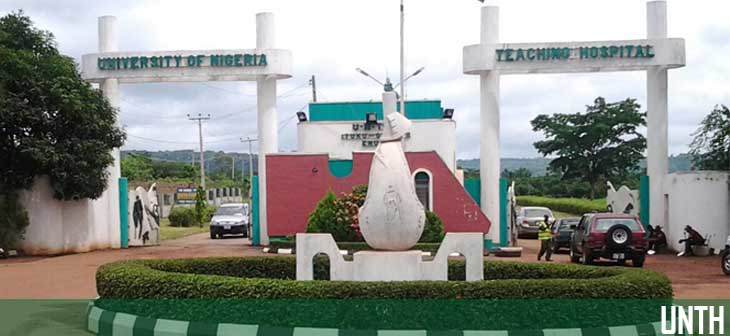
THE UNIVERSITY of Nigeria Teaching Hospital (UNTH), Ituku-Ozalla, Enugu State, has given families and members of the public three weeks to identify and claim 126 unclaimed corpses in its mortuary, warning that it may seek a court order for their mass burial if they remain unclaimed.
The ultimatum was contained in a public notice issued by the hospital’s Department of Morbid Anatomy, Morgue Unit, released on Friday.
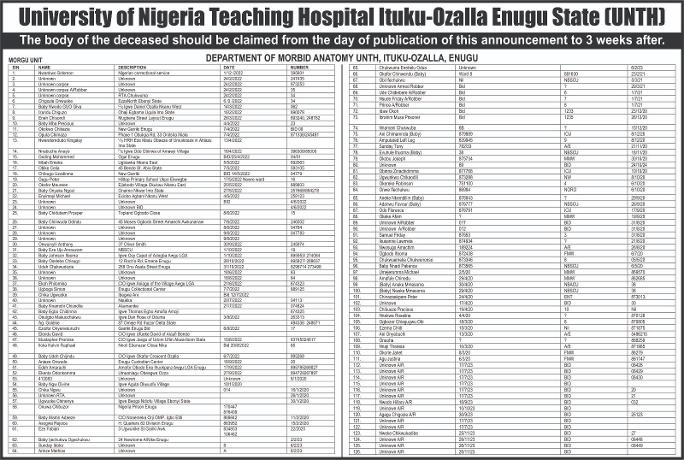
According to the notice, some of the bodies have remained in the morgue for more than 15 years, with the earliest entry on the accompanying catalogue dated December 11, 2008.

The hospital urged relatives and anyone with information that could help identify the deceased to come forward within three weeks of the notice’s publication.
“The body of the deceased should be claimed from the day of publication of this announcement to 3 weeks after,” the notice stated.
The catalogue contains 126 entries, including the names of some deceased persons and descriptions of how their bodies were brought to the hospital. Many of the entries, however, are recorded simply as “Unknown” or “Unknown Corpse.”
The list covers both adults and infants and includes victims reportedly brought to the hospital after fatal road traffic accidents, as well as unidentified people found dead in different locations.
Security agencies were listed among those who brought several of the bodies to the facility.
SaharaReporters reported, citing hospital sources, that about 80 per cent of the corpses, many of them young people, were brought to the morgue between 2020 and 2023, during a period of heightened pro-Biafra agitation in parts of the South-East.
The sources alleged that some of the bodies belonged to individuals who died in the custody of security agencies and were subsequently labelled members of the Indigenous People of Biafra (IPOB).
The circumstances surrounding the deaths could not be independently verified.
The situation nevertheless underscores a wider problem confronting public hospitals in Nigeria, where unclaimed bodies can remain in morgues for years, placing additional financial and logistical pressure on already overstretched health institutions.
Families may fail to retrieve bodies because relatives cannot be located, identities cannot be established or the cost of prolonged mortuary storage is beyond their means.
For teaching hospitals such as UNTH, the prolonged preservation of unclaimed remains also diverts morgue resources from their primary healthcare responsibilities.
The development follows a similar warning by Annunciation Specialist Hospital in Emene, Enugu, which recently threatened to conduct a mass burial for 58 unclaimed corpses, some of which had reportedly been in its morgue since 2008.
The hospital had also raised concerns over the substantial cost of preserving the remains.
