



AS THE ALL Progressives Congress (APC) secured a decisive victory in the February 21, 2026 Federal Capital Territory (FCT) Area Council elections, winning chairmanship seats in five out of the six area councils, observer groups, however, raised alarm that the electoral exercise was marred by widespread incidents of late polling unit reassignments, voter disenfranchisement, and brazen vote-buying.
The Independent National Electoral Commission (INEC) declared results across the territory’s six councils on Sunday, with the APC securing victory in Abuja Municipal Area Council (AMAC), Bwari, Kuje, Abaji, and Kwali, while the Peoples Democratic Party (PDP) managed to secure only one seat, claiming victory in Gwagwalada Area Council.
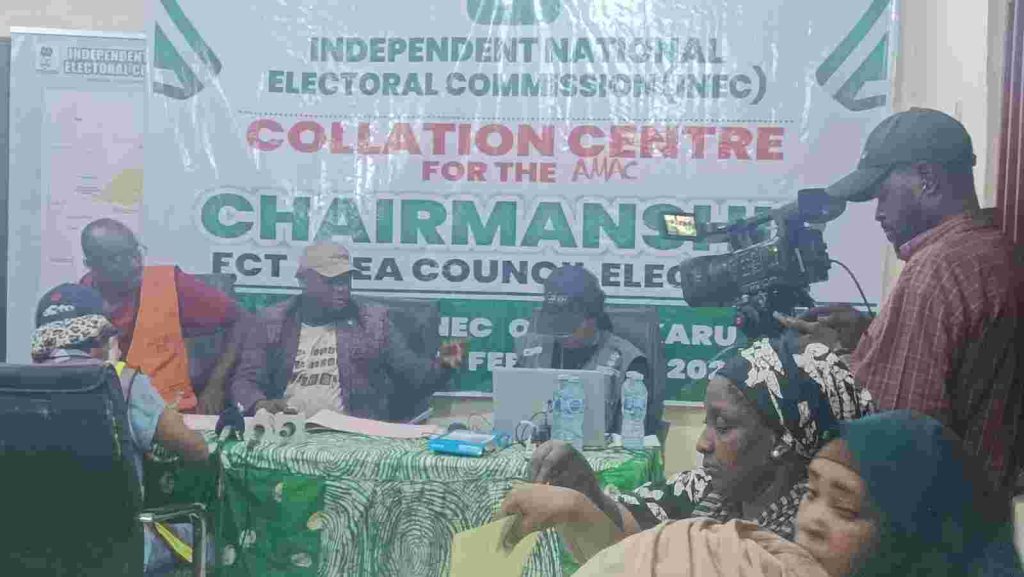
In the most high-profile race, the incumbent, Christopher Maikalangu, of the APC was re-elected as chairman of AMAC, the territory’s most populous council.

Maikalangu polled 40,295 votes to defeat his closest rival, Paul Ogidi of the African Democratic Congress (ADC), who scored 12,109 votes.
The PDP’s candidate, Dantani Zanda, trailed far behind with 3,398 votes. In Bwari, APC’s Joshua Ishaku won with 18,466 votes, while in Kuje, Danjuma Shekwolo (APC) defeated his PDP counterpart with 17,269 votes.
The only opposition victory came in Gwagwalada, where PDP’s Mohammed Kasim secured 22,165 votes to defeat APC’s Yahaya Usman, who polled 17,788 votes.
A Celebration of Democracy or a Display of ‘Political Dividends’?
President Bola Tinubu welcomed the outcome, congratulating the winners and urging them to serve “with humility, patriotism, and dedication.”
In a statement issued by his spokesperson, Bayo Onanuga, the President lauded the peaceful conduct of the elections and specifically commended the Minister of the Federal Capital Territory, Nyesom Wike, for his “remarkable achievements in the territory, which he said yielded political dividends to the governing All Progressives Congress.”
The APC National Chairman, Prof Nentawe Yilwatda, described the victories as a “resounding endorsement” of President Tinubu’s reforms and a testament to the party’s grassroots strength.
Minister Wike himself declared that the results had exposed “emergency democrats” and clearly distinguished the ruling party from the opposition.
Observers Paint a Contrasting Picture: ‘Systemic Issues’ and Disenfranchisement
Despite the ruling party’s celebration, a coalition of observer groups presented a concerning assessment of the voting process.
The Centre for Democracy and Development (CDD-West Africa) released a preliminary report detailing what its Director, Dr Dauda Garuba, described as significant administrative and logistical challenges that hampered voter participation.
The CDD’s Election Analysis Centre reported multiple incidents where voters arrived at their usual polling units only to discover their details had been reassigned elsewhere without adequate notice. A clear example was cited at Polling Unit 055 on Ouagadougou Street in Wuse, where over 20 voters were unable to cast their ballots.
The situation was exacerbated by movement restrictions across the FCT, making it nearly impossible for disenfranchised voters to locate their new assigned units.
Other operational failures documented include delays in the commencement of accreditation due to logistical shortcomings.
At Polling Unit 004, Wuse Zone 2 Primary School in AMAC, only 504 names were displayed out of 751 registered voters, while no register was reportedly displayed at a polling unit in Wowo Nursery and Primary School in Kuje.
Furthermore, there were reports of election officials arriving with incorrect Bimodal Voter Accreditation System (BVAS) machines, leading to further delays as replacements were sought.
Vote-Buying and Security Incidents Mar the Process
Beyond logistical issues, the CDD and other monitors documented widespread electoral malpractice. Garuba reported that observers recorded financial inducements ranging from ₦1,000 to ₦5,000 in parts of Lugbe, Kutunku in Gwagwalada, and Kuje, with some party agents allegedly offering up to ₦10,000 to voters.
The Economic and Financial Crimes Commission (EFCC) was active, reportedly arresting suspected vote traders in Gwagwalada. In a separate incident at Kabusa Primary School, the police arrested a woman allegedly found with more than 20 voter cards.
Tensions flared in one instance in the Abaji Area Council, where an unauthorised individual reportedly entered a voting area with a security operative. The situation escalated, leading to the use of tear gas and a temporary disruption of voting before order was restored.
Political Reactions: From Allegations of Intimidation to Fears for Democracy
The opposition was quick to challenge the credibility of the process. The Kabiru Turaki-led National Working Committee of the PDP alleged “unprecedented intimidation, high-powered money politics and brazen executive brigandage.” The party claimed to have video evidence of armed security personnel being used to cart away result sheets and announced the constitution of a special legal team to handle post-election petitions.
The Civil Society Legislative Advocacy Centre (CISLAC) and the Transition Monitoring Group (TMG) went a step further, directly accusing FCT Minister Nyesom Wike of interference.
They described the minister’s presence at several polling units as “patently inappropriate” and “anti-democratic,” arguing it was intended to intimidate voters and electoral officials, thereby undermining the credibility of the exercise.
Former Vice President Atiku Abubakar also weighed in, describing the low voter turnout – which dipped as low as 7.8% in AMAC – as a sign that “democracy is under siege.” He described the situation as the “predictable outcome of a political environment poisoned by intolerance, intimidation, and the systematic weakening of opposition voices”.
A Call for Reform
While INEC Chairman, Prof. Joash Amupitan, described the election as “orderly, efficient and peaceful” on election day, the CDD urged the commission to investigate the reported polling unit reassignments and address the logistical and administrative shortcomings.
Garuba emphasised that “these identified gaps point to systemic issues requiring urgent attention ahead of upcoming off-cycle elections in Ekiti and Osun states as well as the 2027 general elections”.
As the APC celebrates its dominance in the nation’s capital, the chorus of concerns over the integrity of the process serves as a pointed warning about the health of Nigeria’s democracy.
