



By Max Amuchie
THERE are ideas that begin in institutions.
There are ideas that begin in universities, think tanks, laboratories and conference rooms, surrounded by shelves of books and the reassuring architecture of intellectual authority.

And then there are ideas that begin at a desk.
A desk can be ordinary furniture. It can also be a place from which a person decides that the world does not have to remain exactly as it was handed to him.
An African newsroom does not have to choose between being locally grounded and globally relevant. It can be both. Indeed, its local grounding can become the source of its global contribution.
In the concluding part of my treatise on the Sundiata Post Model, published through The Sunday Stew and as a working paper on scholarly platforms, I wrote: “From my desk at the Sundiata Post, Abuja, I release these ideas—the Sundiata Post Model—into the world.”
I did not mean it merely as a description of where the manuscript was written. It was a statement about origin. It was also, perhaps unintentionally, a statement about power.
For too long, the geography of knowledge production has been organised around a familiar hierarchy: some places are imagined as centres from which concepts emerge, while others are treated primarily as the periphery from where empirical material is gathered.
The centre provides the theory. The periphery provides the case study. The centre names the problem. The periphery supplies the evidence. And Africa, too often, has occupied the latter position.
But what happens when the desk in Abuja becomes a place from which ideas are not merely received or applied, but produced?
That question became especially vivid after the publication and archiving of the Three-Month Sprint and the Sundiata Post Modelacross leading international scholarly repositories and research platforms. What began at a desk in Abuja had entered the permanent scholarly record and, from there, the wider world. It was that movement—from desk to archive to world—that prompted this reflection.
ALSO READ: Of Caps, Marabouts And Politics Of Envy; By Hassan Gimba
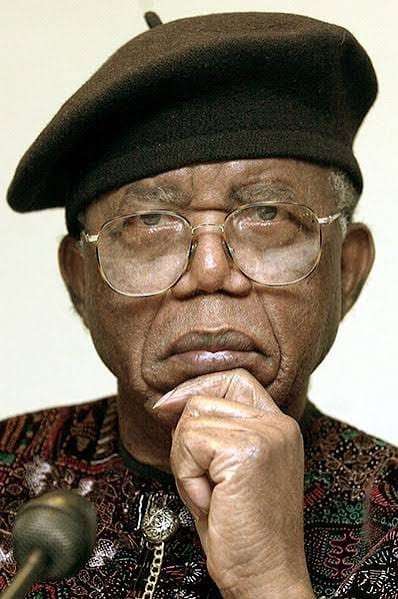
That is also where Chinua Achebe becomes useful. Not because Achebe influenced the formation of the Sundiata Post Model. He did not. The intellectual genealogy of the SPM runs through a different philosophical triad: Sigmund Freud, Edward Said and Antonio Gramsci.
Achebe belongs to the interrogation that comes afterwards. He gives us a powerful African literary lens through which to ask what intellectual sovereignty looks like when an African writer decides that his world does not have to wait for somebody elsewhere to explain it.
The Story That Is Told About You
When Things Fall Apart appeared in 1958, Achebe was not simply writing another novel about Africa. He was doing something more consequential.
He was taking an African world that had frequently been represented from outside and placing that world inside its own narrative centre.
The significance is not merely that Achebe wrote about Igbo society. It is that he allowed Igbo society to speak, reason, organise, worship, trade, argue, love, fear and suffer on its own terms.
The village was no longer merely a setting. It became a world.
Its people were no longer background figures in somebody else’s story. They became subjects.
Its proverbs were not decorative curiosities. They carried a philosophy. Its institutions were not signs of an absence of civilisation. They were institutions.
ALSO READ: The United Nations Fail The Saharawi, Africans Must Defend Them; By Owei Lakemfa
Achebe therefore did something larger than tell a story. He altered the direction of the narrative gaze.
The colonial world had often looked at Africa. Achebe made Africa look back.
The District Commissioner’s Book
There is a revealing moment near the end of Things Fall Apart. The District Commissioner imagines writing a book about the people whose lives he has encountered. Even Okonkwo’s complicated existence can, in his imagination, become material for a few paragraphs in a colonial account.
The irony is profound.
A man’s entire life can be reduced to a paragraph by someone who believes he possesses the authority to describe the world.
Achebe’s novel quietly overturns that hierarchy. The District Commissioner thinks he can write the African story. Achebe writes the African world.
That distinction is important because the struggle over representation is ultimately a struggle over who possesses the authority to name reality.
And that question extends far beyond literature. It belongs to journalism, scholarship, policy and the production of knowledge itself.
The Desk as Centre
This is where my desk enters the story. Not because my desk is comparable to Achebe’s in literary consequence. That would be absurd. The point is conceptual.
Achebe demonstrated that a writer sitting in Nigeria could produce a work through which Nigeria would not merely be observed by the world; it would speak to the world.
The direction of intellectual traffic could be reversed. That is the inversion, and it is this inversion that I find useful in thinking about the Sundiata Post Model.
Too often, African realities become empirical material for theories whose conceptual centres lie elsewhere.
Africa becomes the case. Africa becomes the field site. Africa becomes the data. Africa becomes the problem.
But what if the African institution that encounters the problem also develops the concepts through which the problem can be understood?
ALSO READ: The Mirror Of Thrones: When Power Mistakes Itself For Destiny; By Iduh Onah
That is how the constructs —The Insecurity Triad, Trinity of Sovereignty Decay and the Decoupling Sovereignty Index — came about, and that is the question underneath the SPM.
The desk in Abuja is no longer imagined as a peripheral desk waiting for theory. It becomes, in the SPM’s conception, a centre from which theory can be produced and released into the world.
This is not a claim about geography. It is a claim about epistemic position. The geography has not changed. The epistemic position has.
A desk becomes a centre when it becomes a point of origin for knowledge.
From the Newsroom to the Knowledge Institution
This is what distinguishes the SPM from an argument that journalism should simply become more analytical. That would not be enough.
The proposition is more institutional.
The SPM asks what happens when a newsroom deliberately integrates journalism, original research, conceptual innovation, knowledge governance, institutional memory and scholarly dissemination within one architecture.
The newsroom does not cease to be a newsroom. It becomes more than a newsroom.
The SPM therefore develops structures for doing this: the Dual Engine Architecture, with Media Operations and Knowledge Operations functioning as mutually reinforcing components; the Realm of the Long Term, built around seven pillars intended to move an institution beyond immediate survival towards stewardship; and a conception of success that moves through Operational Success, Institutional Success, Civilisational Success and, ultimately, Legacy.
There are also concepts that emerged through the research including the Money–Land–Mind dynamic, Institutional Mirage, Shadow Order, Sovereign Decoupling and the Architecture of Resurrection.
These are not isolated ornaments.
They demonstrate the central proposition:
A newsroom can produce concepts.
And when it produces concepts systematically, it begins to occupy a different position in the knowledge ecosystem.
The Newsroom That Explains Itself
Journalism has traditionally been understood principally as a transmission system.
ALSO READ: Nigeria’s Democracy And The Dangerous Meaning Of ‘Strategy’ In Electoral Victory; By Abadom Lawrence Amechi
Something happens. The journalist observes, verifies and reports. The audience receives.
That function remains indispensable. But it does not exhaust what journalism can become.
There is a curious journey behind the SPM. It did not begin as a conventional academic project. It emerged through journalism. Through ‘The Sunday Stew’. Through sustained observation. Through conceptual experimentation. Through the gradual discovery that individual columns were beginning to connect into larger structures.
What if the newsroom also asks: What concept explains what we are observing? What framework can organise the evidence? What new vocabulary is required? What institutional memory should be preserved so that knowledge does not disappear with the journalist who produced it? How can the work move from the news cycle into the permanent knowledge ecosystem?
Those questions turn the newsroom into a site of knowledge production.
That is the institutional proposition at the heart of the SPM.
This is where the difference between information and knowledge becomes important. Information tells us what happened. Knowledge asks what it means, how it connects, what patterns it reveals, what concepts can explain those patterns, and what future inquiry might be built upon them.
The newsroom can therefore become both observer and theorist. Not theorist instead of journalist. Theorist because it remains deeply engaged with reality.
Intellectual Sovereignty
This is also why Achebe’s work offers such a useful lens.
Intellectual sovereignty does not mean intellectual isolation. It does not mean rejecting ideas produced elsewhere.
It is the ability to enter the global conversation without surrendering the authority to produce one’s own ideas.
Achebe did not need to reject the world to write Things Fall Apart. He entered the world by bringing his own world into it.
The SPM makes a related proposition.
ALSO READ: Passenger Rights: Real Protection Or Paper Decoration? By Lanre Ogundipe
An African newsroom does not have to choose between being locally grounded and globally relevant. It can be both. Indeed, its local grounding can become the source of its global contribution.
The strongest contribution an institution can make to global knowledge is not necessarily to imitate the intellectual centre. It may be to bring something the centre cannot see from where it stands.
The sovereign thinker is not the thinker who cannot be challenged. It is the thinker who possesses the confidence to produce, the discipline to preserve, and the humility to submit what has been produced to the judgment of others.
The world does not need another newsroom trying to sound like every other newsroom. It needs institutions capable of seeing reality from different locations and turning those observations into durable knowledge.
From The Sunday Stew to the Archive
There is a curious journey behind the SPM. It did not begin as a conventional academic project. It emerged through journalism. Through ‘The Sunday Stew’. Through sustained observation. Through conceptual experimentation. Through the gradual discovery that individual columns were beginning to connect into larger structures.
The three constructsemerged.The Sundiata Post Intelligence Unit (SPIU) emerged.
And eventually the Sundiata Post Model itself emerged as an attempt to explain not simply what had been produced, but how an institution could deliberately produce such knowledge.
That distinction is crucial.
The SPM is therefore not merely a theory about journalism. It is also an attempt at institutional self-understanding.
The Archive, the Discovery
This is why repositories matter.
The movement of an idea from a desk into SSRN, Zenodo, Harvard Dataverse, SSOAR, Mendeley Data, Figshare and other permanent platforms is not merely administrative. It changes the temporal life of the work.
ALSO READ: Atiku Abubakar And The Neoliberal Siege On Nigeria; By Adagbo Onoja
A newspaper article belongs to the news cycle. An archived research work enters a different temporal order. It can be found. It can be cited. It can be challenged. It can be extended. It can be rediscovered years after the author has moved on.
That is the archive. But there is also the discovery layer — ResearchGate, Google Scholar, Academia.edu — where the world encounters what the archive preserves. The archive ensures the work survives. The discovery layer ensures the world can find it.
Together, they complete the movement: from desk to archive to world.
The World Gets the Final Word
There is another reason the final phrase matters:
“I release these ideas – the Sundiata Post Model – into the world.”
Once released, an idea belongs to a larger intellectual environment. Scholars can question it. Journalists can test it. Practitioners can apply it. Critics can attack it.
Intellectual sovereignty does not mean intellectual immunity.
The sovereign thinker is not the thinker who cannot be challenged. It is the thinker who possesses the confidence to produce, the discipline to preserve, and the humility to submit what has been produced to the judgment of others.
The desk is the point of origin. The institution is the mechanism of endurance. The archive is the mechanism of memory. The world is the mechanism of testing.
That is why the phrase does not celebrate the individual at the expense of the institution. It begins with the individual and ends with something larger.
And perhaps that is the deeper lesson I take from Achebe. He did not need to wait for permission to make Umuofia intellectually visible. He did not need an address at the centre to produce a work that would travel across the world.
He began where he was.
But what he began did not remain there.
It entered the world.

An idea begun at a desk in a modest newsroom in Abuja can now enter the permanent architecture of global knowledge—not merely as material gathered from the periphery, but as knowledge produced there and released into the world.
The Four Enoughs
If the Philosophical Triad of Enduring Influences explains the intellectual inheritance behind the Sundiata Post Model, the Four Enoughs express its philosophy of transmission:
The desk is enough to begin.
The institution is enough to sustain.
The archive is enough to preserve.
The world is enough to test.
The world—not Nigeria, not Africa.
That, ultimately, is what I mean when I say: My desk is enough.
Trust is sacred. Stay seasoned.
Dr. Amuchie is Scholar-Journalist, Media CEO, Lead Researcher at Sundiata Post Intelligence Unit, and Expert Member and Peer Reviewer at ScienceOpen.
