


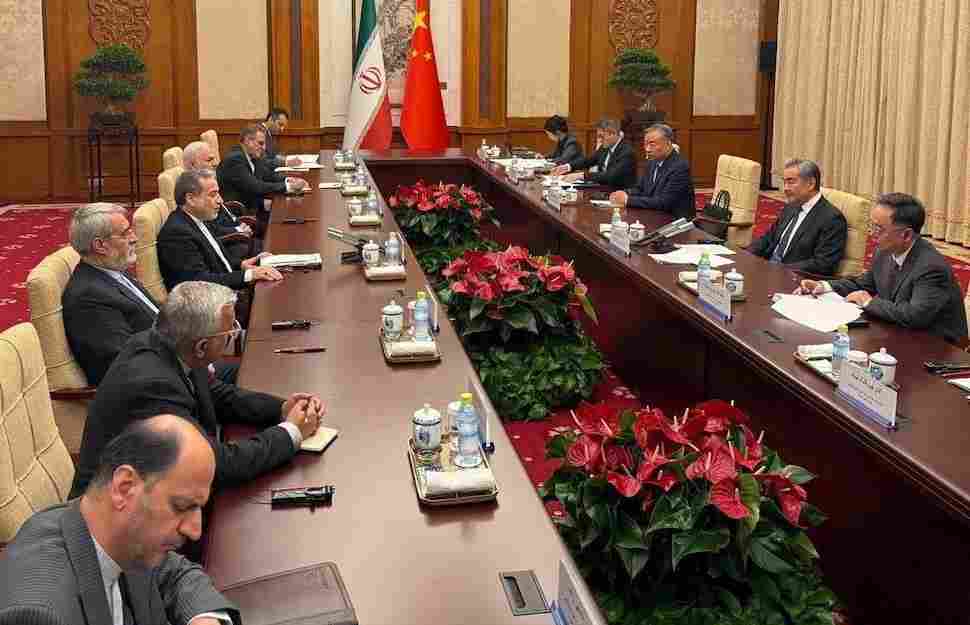
IRAN said on Wednesday it was reviewing a new U.S. proposal, after sources said Washington and Tehran were closing in on a one-page memorandum to end the war in the Gulf while leaving tricky issues such as Iran’s nuclear programme for later.
An Iranian foreign ministry spokesperson, cited by Iran’s ISNA news agency, said Tehran would convey its response soon via Pakistan, which hosted the war’s only peace talks and has since served as the main conduit for messages between the sides.
U.S. President Donald Trump said that Iran wanted to negotiate.

“We’re dealing with people that want to make a deal very much, and we’ll see whether or not they can make a deal that’s satisfactory to us,” he said at an event at the White House.
A Pakistani source and another source briefed on the mediation confirmed information initially reported by the U.S. media outlet Axios about a proposed 14-point, one-page memorandum that would formally end the war.
The memorandum would be followed by discussions to unblock shipping through the Strait of Hormuz, lift U.S. sanctions on Iran and agree curbs on Iran’s nuclear programme, the sources said.
“We will close this very soon. We are getting close,” said the source from Pakistan.
Israeli Prime Minister Benjamin Netanyahu, Trump’s ally against Iran, said the two men planned to speak later on Wednesday and that they agreed that all enriched uranium must be removed from Iran to prevent it from developing a nuclear bomb.
Tehran denies wanting to acquire a nuclear weapon.
Oil Prices Tumble
Reports of a possible agreement caused global oil prices to tumble to two-week lows, with benchmark Brent crude futures falling around 11% to around $98 a barrel at one point before paring some of their losses.
Global share prices also leapt and bond yields fell on optimism of an end to a war that has disrupted energy supplies.
In an early morning post on Truth Social, Trump said: “Assuming Iran agrees to give what has been agreed to, which is, perhaps, a big assumption, the already legendary Epic Fury will be at an end, and the highly effective Blockade will allow the Hormuz Strait to be OPEN TO ALL, including Iran.”
“If they don’t agree, the bombing starts, and it will be, sadly, at a much higher level and intensity than it was before,” Trump added.
Hours earlier, Trump paused a two-day-old naval mission to reopen the blockaded strait, citing progress in peace talks.
U.S. military forces fired several rounds at an unladen Iranian-flagged tanker on Wednesday, disabling the vessel as it attempted to sail toward an Iranian port in violation of the blockade, U.S. Central Command said in a post on X.
No Mention of Key U.S. Demands
The source briefed on the mediation said the U.S. negotiations were being led by Trump’s envoy Steve Witkoff and son-in-law Jared Kushner. If both sides agreed on the preliminary deal, that would start the clock on 30 days of detailed negotiations to reach a full agreement.
The full agreement would include the U.S. lifting sanctions and releasing frozen Iranian funds, Iran and the U.S. lifting competing blockades on the Strait of Hormuz, and some curbs on Iran’s nuclear programme, with the aim of a pause or moratorium on Iranian enrichment of uranium.
While the sources said the memorandum would not initially require concessions from either side, they did not mention several key demands Washington has made in the past, which Iran has rejected, such as curbs on Iran’s missile programme and an end to its support for proxy militias in the Middle East.
The sources spoke of potential curbs on future Iranian enrichment of uranium, but made no mention of Iran’s existing stockpile of more than 400 kg (900 pounds) of it, already enriched to near weapons grade, which Washington has previously demanded it yield up to end the war.
And even if the reported text appeared to sidestep some demands rejected by Iran in the past, there were indications Tehran could still hold out for more.
In a post on X, Iranian lawmaker Ebrahim Rezaei, a spokesperson for parliament’s powerful foreign policy and national security committee, described the text reported by Axios as “more of an American wish-list than a reality”.
“The Americans will not gain anything in a war they are losing that they have not gained in face-to-face negotiations,” he wrote.
