


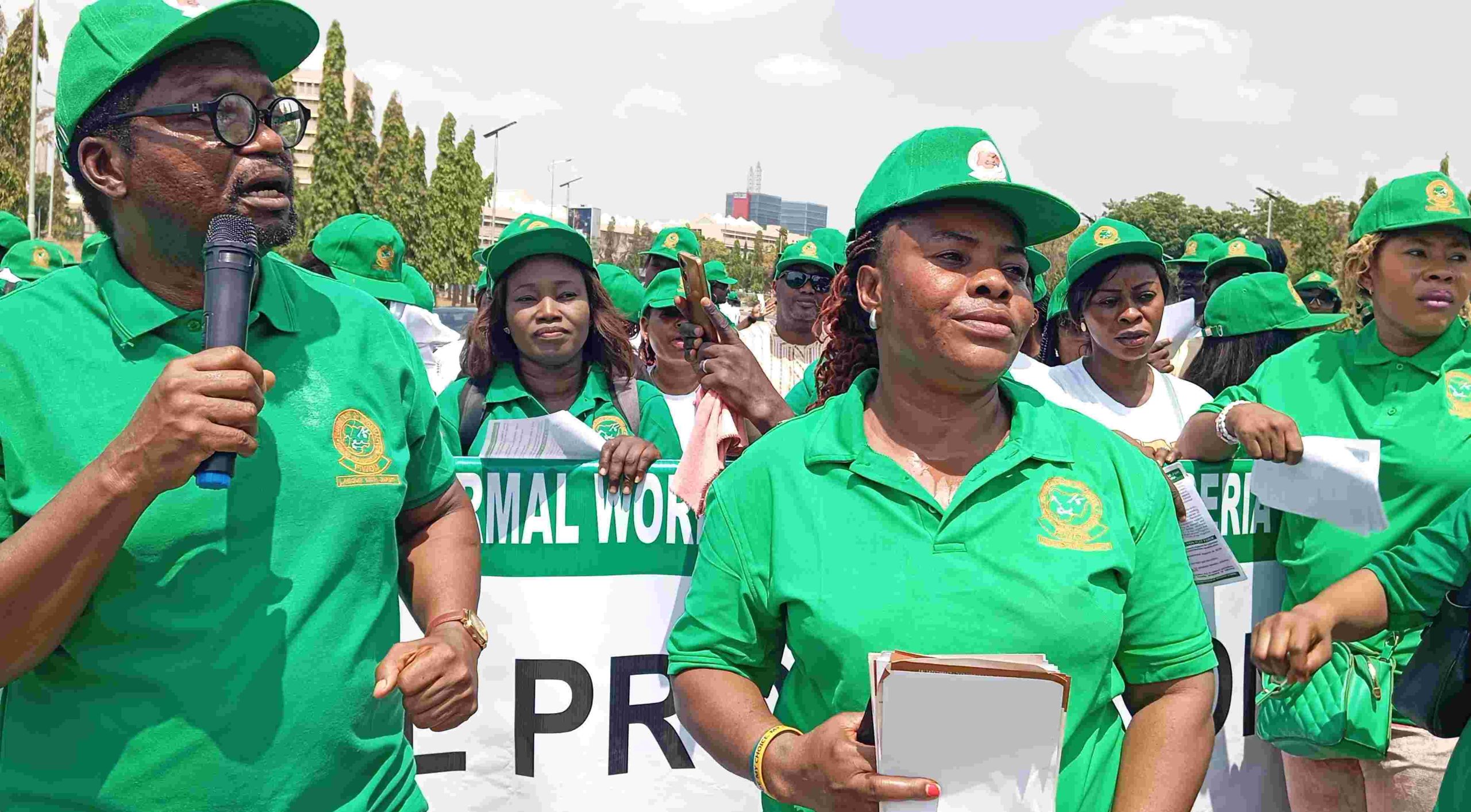
A COALITION of informal workers, under the aegis of Federation of Informal Workers’ Organisations of Nigeria (FIWON), on Wednesday descended on the National Assembly (NASS) in Abuja on a peaceful mass protest to demand comprehensive social protection for the millions of Nigerians who labour outside the formal economy.
In the powerful show of solidarity, the protest brought together a diverse cross-section of informal workforce, including market women, artisans, domestic staff, mechanics, and technicians.
According to FIWON’s General Secretary, Comrade Gbenga Komolafe, this demographic represents over 93 percent of Nigeria’s active workforce and contributes an estimated 65% to the nation’s Gross Domestic Product (GDP).

Comrade Komolafe lamented that despite this critical economic backbone, these workers remain largely excluded from the country’s existing social safety nets.
Komolafe outlined a series of demands aimed at rectifying what he described as a systemic neglect.
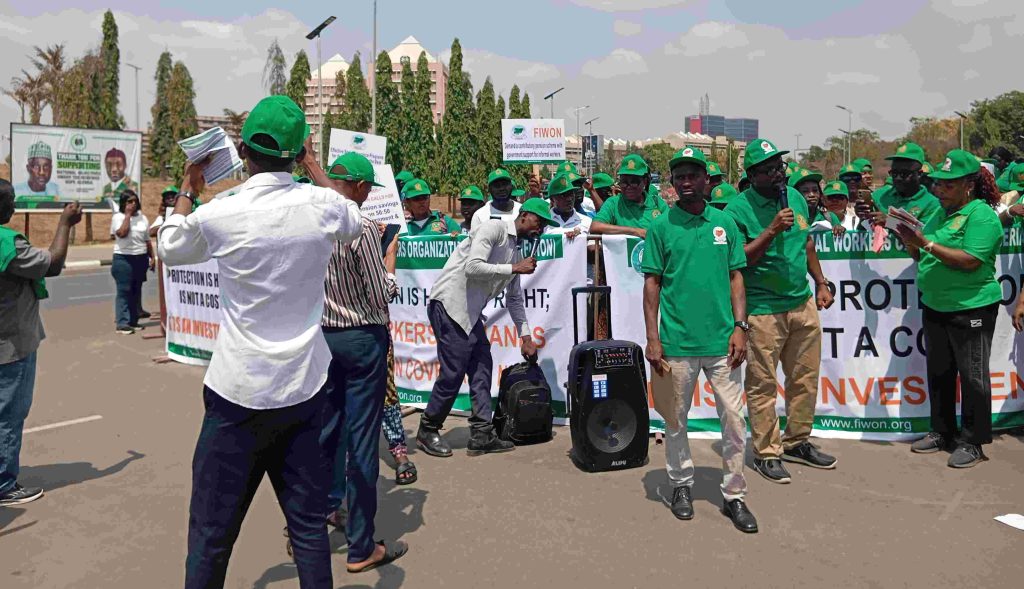
“We believe it is time for workers in the informal economy to access basic social protection, including pensions, healthcare, and workplace safety,” he stated.
A key point of contention was the current micro-pension scheme administered by the National Pension Commission (PenCom), which Komolafe dismissed as ineffective in the face of rising inflation that steadily devalues long-term savings.
To make the program viable, he proposed a government-backed matching grant system, suggesting that for every ₦1,000 a trader contributes, the government should add another ₦1,000 to cushion the impact of inflation.
On healthcare, the FIWON secretary decried the low enrolment in health insurance schemes, noting that less than 10% of Nigerians – primarily those in formal employment – are covered.
He called on state governments to subsidise premiums for informal workers, proposing that if a premium stands at ₦20,000, the state should cover half to encourage participation.
He further advocated for free, comprehensive healthcare for vulnerable groups such as pregnant women, children under five, the elderly, and persons with disabilities, framing this as a direct strategy to combat Nigeria’s high maternal and infant mortality rates.
The protesters also pushed for a constitutional pension for citizens aged 65 and above, urging that beneficiaries receive at least the equivalent of the national minimum wage to ensure a basic standard of living.
Turning to workplace safety, Comrade Komolafe noted that informal workers frequently suffer injuries without compensation, as existing laws like the Employee Compensation Act of 2010 are not effectively enforced in the informal sector.
He called for the inclusion of these workers in workplace insurance schemes and for increased investment in occupational health and safety training.
Strengthening these social protection systems, Komolafe argued, is not merely a welfare issue but a critical tool for reducing poverty, improving social cohesion, and addressing insecurity.
“Nigeria must act now to protect its most vulnerable workers,” he asserted. “Countries with strong social protection systems tend to have lower crime rates and greater social stability.”
The protest culminated in the formal submission of a letter addressed to the Speaker of the House of Representatives, Abbas Tajudeen, outlining their core demands.
The demands include state-supported pensions for informal workers, state-subsidised health insurance, a social pension system for the aged and infirm, and free, state-supported healthcare for vulnerable populations.
Komolafe argued that social protection should be viewed not as a cost, but as an essential investment. Citing data from the National Bureau of Statistics, the group emphasised that the self-employed in Nigeria’s informal economy – estimated at around 77 million people, constitute over 92% of the nation’s labour force – form the true backbone of the country’s economy.
The demonstration underscored a growing urgency to address the welfare of this vital yet underserved segment of Nigerian society.
