


Key Takeaways
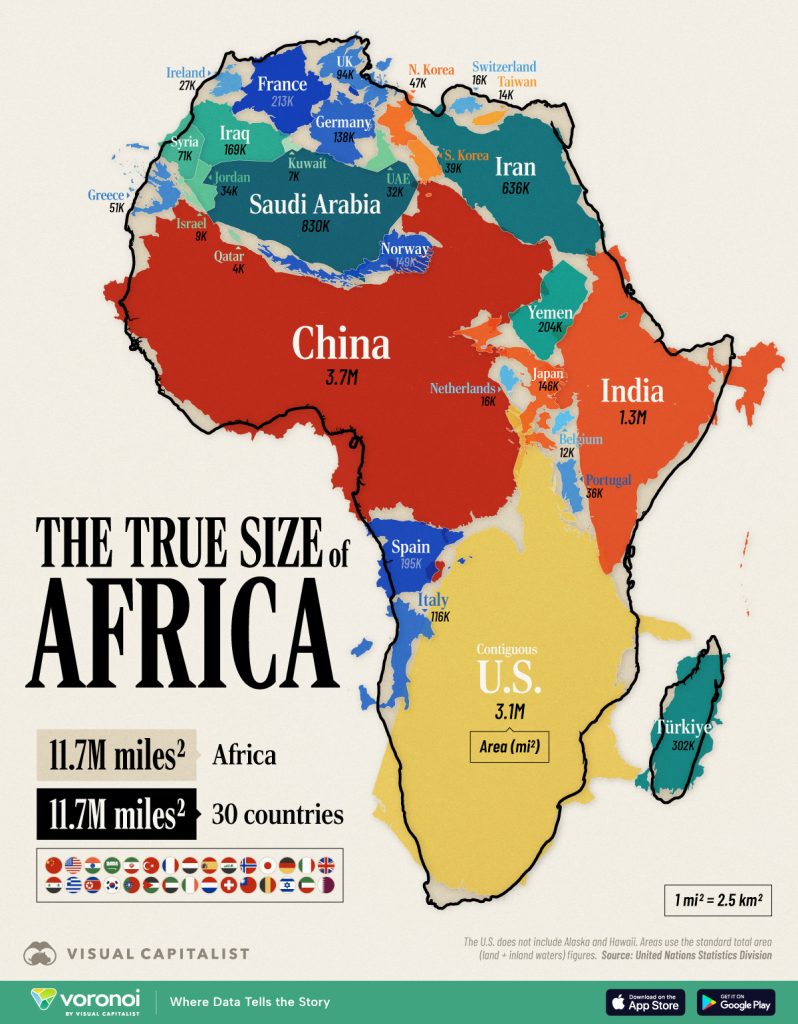
THE CONTINENT of Africa covers 11.7 million mi² (30.4 million km²), roughly equal to the size of 30 countries.
These 30 include some of the world’s largest countries like the (contiguous) U.S., China, and India.

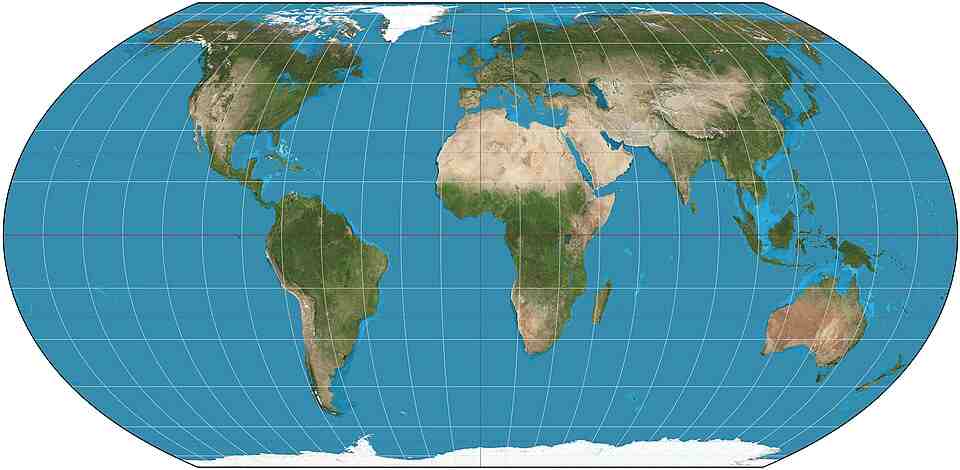
However, the most common map projection, called the Mercator projection, makes Africa appear smaller than it actually is.
The African Union has urged governments to not use it anymore as it gives the impression that Africa is “marginal” on the world stage.
For reference, Africa is the second-largest continent, both by size and population (1.6 billion people).
Africa is vast
So vast that its full scale can be hard to grasp by looking at most world maps.
The graphic above solves this by combining individual countries inside the continent’s area, showing that Africa’s landmass is on par with the (contiguous) U.S., China, India, and much of Western Europe combined.
Data for this visualization comes from UN Statistics Division and total area (land + inland waters) was used for this comparison.
Africa’s Area in Raw Numbers
At 11.7 million mi² (30.4 million km²), Africa is the world’s second-largest continent after Asia.
Put another way, it easily contains the contiguous U.S. (3.1M mi² / 8.1M km²) and China (3.7M mi² / 9.6M km²) with room to spare.
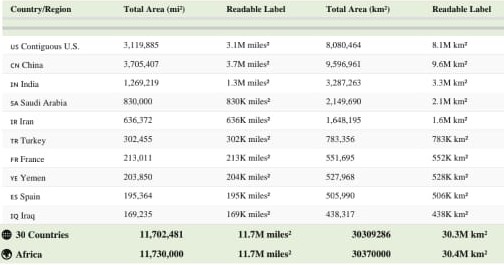
In fact, it takes a total of 30 countries together—shown in the graphic above —to equal Africa’s total area, underscoring how massive the continent is in absolute terms.
Of course, country selection can change these numbers. If prioritizing Central and South American countries instead (like Mexico and Argentina,) the comparison could reduce to 18 entities.
Including Alaska and Hawaii would increase America’s footprint by 700,000 mi² (1.8M km²).
Why Your Wall Map Gets Africa Wrong
Many of us grew up looking at wall maps that use the Mercator projection.
This 16th-century design keeps straight lines for navigation but dramatically enlarges regions near the poles and compresses those near the equator.
Africa, which straddles the equator, is one of the biggest victims of this distortion.
Related: On a Mercator map, Greenland can appear almost as large as Africa. In reality, Africa is 14x bigger.
That discrepancy fuels common misconceptions about just how expansive Africa really is.
African Union Calls For Equal Projections Map
The African Union has asked international organizations to stop using the Mercator projection.
They say this size misrepresentation undermines the perceived global influence and importance of Africa and perpetuates stereotypes.
For example, the frequent use of the Mercator map in educational settings and media can lead many to unconsciously imagine Europe and North America as disproportionately significant.
Meanwhile Africa appears less substantial and “marginal.”
The map above also drives home another point. When discussing global development, trade, or climate impacts, treating Africa as a single bloc overlooks the continent’s enormous spatial and cultural complexity.
