


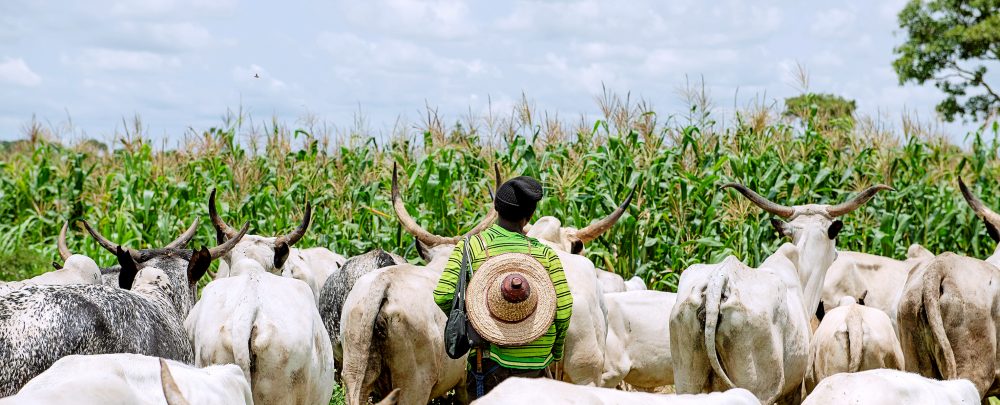
THE FEDERAL Government has identified six states and the Federal Capital Territory (FCT) for the pilot implementation of its National Ranching Policy.
Minister of Livestock Development, Alhaji Idi Maiha, disclosed this after briefing President Bola Tinubu on the ministry’s activities at the Presidential Villa, Abuja, on Tuesday.
Maiha said the pilot programme would commence at the Wase Grazing Reserve in Plateau as a proof of concept for the new ranching model.

He identified the states as Benue, Plateau, Nasarawa, Kaduna and Adamawa, alongside the FCT.
According to him, the areas were selected because they have recorded some of the highest incidences of farmer-herder conflicts in recent years.
“Our understanding is that large numbers of cattle on the move are crisis-prone because grazing routes have disappeared due to farming, urbanisation and infrastructure development.
“Nomadism, as we know it, is no longer sustainable and we need a different concept,” he said.
Maiha said the government had engaged more than 34 pastoral organisations and would continue consultations to build support for the policy.
He said the ministry recently met pastoralist leaders under the leadership of the Sultan of Sokoto, Alhaji Muhammadu Sa’ad Abubakar III, and would hold another engagement within two weeks.
The minister said the policy would encourage pastoralists to rear animals in designated locations rather than move them over long distances in search of feed and water.
“Today, we go and fetch the grass and bring it where the animals are. Better still, grow the grass where the animals are.
“There are genetically developed grasses with all the nutritional value required to feed livestock,” he said.
Maiha said the government would provide housing, veterinary clinics, schools, primary healthcare centres, solar lighting and water infrastructure in designated ranching communities.
He added that each grazing reserve would evolve into an economic hub capable of attracting milk processors, modular abattoirs, bio-digesters and other livestock-related businesses.
“Imagine what you are going to have if you have 30,000 herds of cattle in one area. The milk collection alone will attract processors and many other investments,” he said.
The minister said the Federal Government was also implementing a nationwide livestock identification programme using radio frequency technology.
According to him, all four-legged livestock would be tagged for identification, geolocation and proof of ownership.
He said the initiative would help combat cattle rustling, recover lost animals and build a comprehensive national livestock database.
Maiha said the ministry was also promoting dairy development, commercial fodder cultivation, modern abattoirs, veterinary services and poultry production.
He disclosed that seven model veterinary clinics had been established, with plans to provide at least one model veterinary hospital in every state.
The minister added that the government was strengthening vaccine storage facilities and encouraging investments in dairy and red meat value chains.
On the ministry’s progress, Maiha said about 20 states had established similar livestock ministries or agencies, reflecting growing acceptance of the Federal Government’s livestock development agenda.
He commended Tinubu for his support and commitment to transforming the livestock sector.
He quoted the President as saying, “The value chains in the livestock sector are fantastic,” while urging Nigerians to take advantage of opportunities across the industry. (NAN)
