


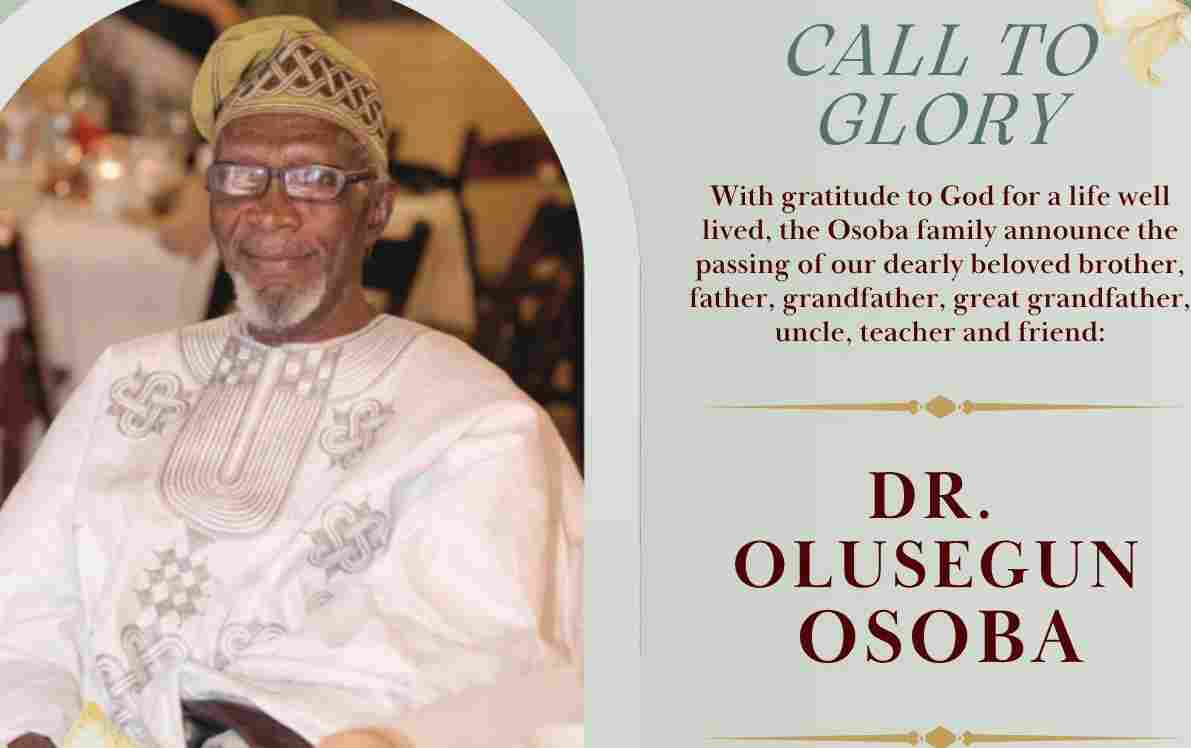
THE FAMILY of iconic Marxist scholar, historian and public intellectual, Dr Samuel Olusegun Osoba, has announced funeral arrangements for the late academic whose death at the age of 92 has drawn tributes from scholars, labour activists and progressive organisations across Nigeria and beyond.
According to a funeral programme released by the family, activities leading to the burial of the respected historian will begin with a symposium and luncheon in his honour involving members of the Academic Staff Union of Universities (ASUU), the Yusufu Bala Usman Institute and socialist comrades.
The event is scheduled to hold at Tunwase Hall, Ijebu-Ode Club, Ogun State, where friends, colleagues, former students and associates are expected to reflect on the life, scholarship and ideological contributions of the late intellectual.

A Christian wake will later take place at St. Luke’s Church Hall, Ogbogbo, ahead of the funeral service to be held at the same church in Ogbogbo.
Interment will follow immediately at the Ogbogbo Cemetery, while a reception and evening gathering for sympathisers and guests will hold at the church hall after the burial.
Dr Osoba, one of Nigeria’s most respected radical scholars and socialist thinkers, died on May 14, 2026, at his residence in Ijebu-Ode, Ogun State.
Widely regarded as one of the country’s leading Marxist historians, he spent several decades shaping intellectual debates around political economy, social justice, constitutionalism and national development in Nigeria and Africa.
Born in Ijebu-Ode, Ogun State, Dr Osoba studied at the University College Ibadan before obtaining a doctorate degree in History from Moscow State University. He later joined the then University of Ife, now Obafemi Awolowo University (OAU), Ile-Ife, where he became a prominent scholar of economic history and political economy.
Throughout his academic career, he remained a strong critic of neo-colonialism, economic inequality and elite domination, earning widespread respect among progressive academics and labour activists for his principled socialist convictions.
His writings and interventions focused extensively on underdevelopment, state formation, democracy and the exploitation of Africa within the global capitalist system. Colleagues and admirers often described him as a scholar whose intellectual engagement was deeply connected to the struggles of ordinary people.
Dr Osoba was also widely recognised for his role within the influential “Ife Collective,” a group of radical scholars associated with progressive academic and democratic struggles in Nigeria from the 1970s onward.
Among his enduring intellectual contributions was the co-authorship, with the late Dr Yusufu Bala Usman, of “The Minority Report and Draft Constitution for the Federal Republic of Nigeria, 1976,” a landmark intervention in debates over federalism, democracy and social justice in Nigeria.
The publication continued to influence constitutional and political discussions decades after its release and reinforced Dr Osoba’s reputation as a scholar deeply committed to the restructuring and democratic transformation of Nigeria.
Following news of his death, tributes poured in from former students, labour leaders, socialist organisations and academics who described him as a patriot, teacher and mentor whose life embodied courage, integrity and intellectual discipline.
Several associates also praised his consistency in defending progressive causes and his commitment to using scholarship as a tool for social emancipation and national development.
The late historian is survived by children, grandchildren, great-grandchildren and numerous associates across academic, political and civil society circles.
For many of his admirers, Dr Osoba’s passing marks the end of an important era in Nigerian intellectual and progressive political history, although they insist that his ideas, writings and lifelong commitment to justice will continue to inspire future generations.
