


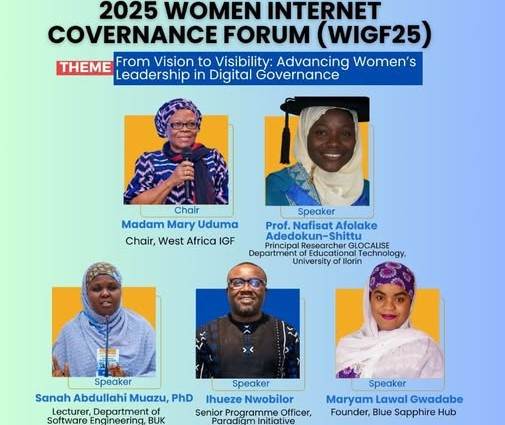
A COMPREHENSIVE framework for advancing gender-inclusive digital governance in Nigeria has been issued via a collaborative effort by the Centre for Information Technology and Development (CITAD) and the Women Internet Governance Forum (WIGF).
This framework is contained in a communiqué issued after a virtual Women Internet Governance Forum 2025 (WIGF25), convened on November 25th under the theme: “From Vision to Visibility: Advancing Women’s Leadership in Digital Governance.”
The forum, partnered with the Nigeria Internet Governance Forum (NIGF) and chaired by Madam Mary Uduma of the West Africa IGF, served as both a diagnosis of systemic flaws and a platform for solutions.

In her keynote address, Prof. Nafisat Afolake Adedokun-Shittu, called for digital solutions crafted within the Nigerian context and steered by women’s leadership, a call that foreshadowed the forum’s core finding of an unequal digital foundation.
A technical session on “Feminist Perspectives on Digital Policy: Rethinking Safety, Privacy, and Online Inclusion” wove personal experience into systemic critique, leading to critical observations of the current landscape.
Participants highlighted the glaring underrepresentation of women in digital policy spaces, from corporate boards to global platforms, and identified a web of barriers including socio-cultural constraints, online gender-based violence, and a crippling reliance on foreign digital solutions.
The forum itself was intermittently hampered by poor connectivity, ironically exemplifying the infrastructure deficits that exclude millions.
From this assessment flowed a number of actionable resolutions, with the communiqué directly charging regulatory bodies like the Nigerian Communications Commission (NCC) and National Information Technology Development Agency (NITDA) to mainstream gender perspectives into all ICT and AI policies and to strengthen protections against cyberstalking and algorithmic bias.
The communiqué also calls for a revolution in capacity building, urging a massive scale-up of mentorship and training for women and girls in AI and cybersecurity, especially in underserved communities.
The framework while championing investment in digital tools and education rooted in Nigeria’s indigenous languages and local knowledge, it also issued an unequivocal demand to government and service providers to fix the nation’s broadband infrastructure, as it also condemned high costs and poor quality as active agents of exclusion.
The forum’s final mandate calls for collective action by ensuring gender balance in policymaking bodies, protecting civic digital spaces for women, and strengthening educational pipelines to link young women with innovation hubs.
The forum asserted that the vision of an inclusive digital Nigeria will remain a mirage without the visibility and leadership of women.
