


CHINA has urged journalists from third world countries to connect China with the rest of the world through objective reports from diverse perspectives, and amplify the narrative of South-South cooperation.
Mr Hong Lei, China’s Assistant Minister of Foreign Affairs, made the appeal at the opening ceremony of a four-month training programme for journalists, drawn from the Global South, in Beijing.
NAN reports that about 100 foreign journalists representing 100 countries are participating in the training, organised by the China Public Diplomacy Association (CPDA), and the China International Press Communication Centre (CIPCC).

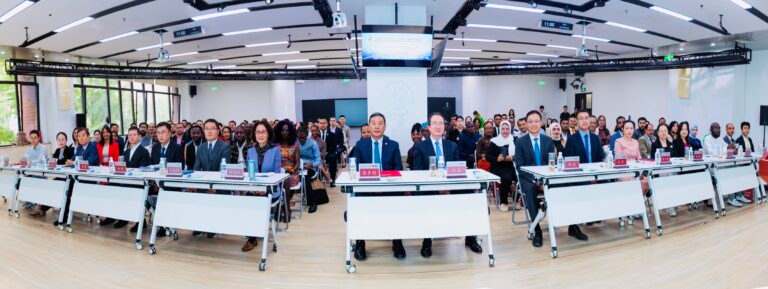
Hong explained that the CIPCC, which was founded in 2014, was a bridge for media friends from the Global South countries to get closer to, and understand, China.
He expressed the hope that through their participation in the programme, journalists would become “bosom friends” of China and help better connect the country with the world.
“I hope you will gain an intimate understanding of China’s history and dynamism, and present to the world a true, multidimensional and panoramic picture of China through objective coverage and diverse perspectives.
“I hope you will delve deep into the vivid practices of Global South countries, advance modernisation together, and bring them to a wider audience.
“This is so that the world will hear the voice of South-South cooperation, and the story of our win-win cooperation will become the prevailing narrative of our times,” he said.
Quoting a Chinese proverb, he added: “A bosom friend afar brings a distant land near.”
The minister reaffirmed China’s commitment to the development of Global South countries by standing firm with them, shouldering major responsibilities, upholding shared interests, and promoting common development.
Mr Hong Lei, China’s Assistant Minister of Foreign Affairs speaking at the event.
Hong said since the start of China’s Reform and Opening-up policy, China had made remarkable achievements, such as building the world’s largest network of highways and high-speed rails.
He listed other achievements to include lifting about 800 million people out of poverty, building a moderately prosperous society, and surpassing the UN’s 2030 SDG targets 10 years ahead of schedule.
“The life expectancy of the Chinese people has increased from 35 years in the early 1950s to 78.2 years. Basic medical insurance covers over 1.36 billion people.
“Worldwide, China is at the forefront of infrastructure, 5G, aerospace technology, AI and embodied AI.
“All these demonstrate that China has successfully forged a path of Chinese modernisation along the path of socialism with Chinese characteristics,” he said.
He said China had, through concrete actions, proved that its development was not a closed-door endeavor, but a process of sharing opportunities with developing countries, practicing true multilateralism, and improving global governance.
Ms Tong Xiaoling, CPDA Vice President, while welcoming participants, noted that the media was the bridge across national borders, connecting peoples, transcending geographical divides, and enabling societies to see one another’s true realities.
“Against this complex backdrop, candid exchanges among cross-border media practitioners are all the more essential.
“Stereotypes ought to be replaced by on-the-ground observations. Global narratives ought to be enriched by diverse perspectives, so as to inject public opinion momentum into mutual trust, enhanced understanding and deeper cooperation among nations,” she said.
Tong said China-foreign media engagement was not a one-off encounter, but a long-term partnership, adding that CPDA would continue fostering a mutually-beneficial platform for more international media and people-to-people exchanges.
She said the Centre had invited successive generations of foreign journalists, who had professionally chronicled China’s development transformations, people-centred vitality and cultural heritage, impressively.
“They have presented to the world a genuine, multi-dimensional and vibrant China beyond the single-sourced Western narrative. They laid a solid public-opinion foundation, making valuable media-sector contributions to stronger people-to-people bonds, as well as deeper friendship and cooperation between China and the world,” Tong added.
Prof Zhang Donggang, Secretary, Communist Party of China, Renmin University Committee, said since 2014, the university had hosted the programme and trained more than 700 media professionals from over 100 countries.
According to him, in doing so, the institution has created an important platform for journalists from China and around the world to deepen understanding, expand exchanges, strengthen cooperation and build mutual trust.
He urged participants to faithfully document “China as seen through the eyes of the world,” vividly tell the stories of “mutual learning among civilisations,” as well as convey and harness “the power of global development.”
“Journalists are the keen observers and chroniclers of our times. Through their cameras, they capture reality; through their words, they foster understanding.
“They turn fragmented information into verifiable facts and voices from around the world into topics for shared discussion,” Zhang said.
Mr Mark Longyen, News Agency of Nigeria (NAN) Editor and Nigeria’s representative, while speaking on behalf of other participants, said the journalists came to China to see its developmental achievements and challenges for themselves.
While placing particular emphasis on Africa-China relations, he noted that China’s economic, technological and diplomatic importance to Africa had made the relationship increasingly important.
He tasked Global South journalists on becoming the “authors” of global narrative, rather than mere consumers of it, and called for stronger cross-border reporting, fact-checking partnerships and professional exchanges.
“As journalists, our job is not to repeat what we are told, but to observe, investigate, verify, and tell stories that help our audiences make sense of a changing world.
“We cherish the type of journalism that promotes understanding without abandoning scrutiny, cooperation without abandoning independence, and friendship without abandoning truth.
“There is, therefore, need for more African journalists to be telling African stories about China, and more Chinese journalists to be telling Chinese stories about Africa,” he said. (NAN)
