


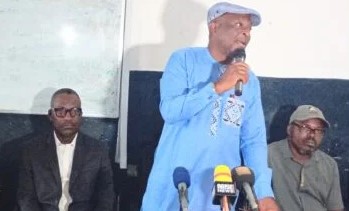
THE ASSOCIATION of Senior Civil Servants of Nigeria (ASCSN) has called on the Federal Government to create additional vacancies at the directorate level to address prolonged career stagnation in the public service while reiterating its opposition to the proposed concession of Federal Government colleges, popularly known as Unity Schools.
The National Vice-President of ASCSN, Olubunmi Fajobi, made the submissions on Wednesday at a news conference held at King’s College, Lagos.
Fajobi said the creation of more directorate-level vacancies would improve workers’ morale and enhance efficiency across Ministries, Departments and Agencies (MDAs), noting that many qualified officers had remained on the same grade level for years despite meeting all requirements for promotion.

According to him, expanding opportunities for advancement would enable deserving officers to attain career progression, improve productivity and strengthen service delivery in the public service.
He suggested that additional vacancies could be created by disarticulating senior secondary schools from their junior secondary arms, with each headed by separate directors.
He also proposed splitting large departments into smaller units headed by directors and upgrading strategic units in MDAs into full-fledged departments to create more directorate positions.
Fajobi further appealed to the Federal Government to approve palliatives for public servants to cushion the effects of the prevailing economic hardship, saying rising inflation and the increasing cost of living had placed enormous pressure on workers and their families.
On the proposed concession of the country’s 120 unity schools, the union maintained its opposition, warning that handing the institutions over to private interests would make quality secondary education inaccessible to millions of Nigerian children and threaten the jobs of thousands of workers.
Fajobi said the union would reject any attempt to cede the schools to private individuals, organisations or old students’ associations, describing the colleges as national assets established to promote unity and integration among Nigerians.
He recalled that the union had on July 1 urged the Federal Government to abandon the concession plan, insisting that individuals or organisations interested in operating secondary schools should establish their own institutions rather than take over public schools.
According to him, the union’s latest intervention followed claims by the King’s College Old Boys’ Association (KCOBA) that the college had been concessioned to it.
“If the old boys claim the school has been ceded to them, what template have they designed to cater for the students and employees of the college?” he asked.
Fajobi said a similar attempt to concession unity schools under a public-private partnership arrangement was made in 2005 during the administration of former President Olusegun Obasanjo but was resisted by the union alongside students, parents, civil society organisations, religious leaders, traditional rulers and other stakeholders through dialogue, industrial actions and litigation.
He added that normalcy returned to the unity school system in 2010 when the administration of former President Goodluck Jonathan restored the junior secondary school components that had earlier been disarticulated.
The ASCSN vice-president said the unity schools were conceived by Nigeria’s first Prime Minister, the late Sir Abubakar Tafawa Balewa, to foster national integration by bringing together children from different ethnic, religious and social backgrounds.
“The least the present generation can do is preserve these institutions as a lasting legacy of national unity instead of turning them over to private entrepreneurs,” he said.
He warned that beyond increasing school fees, privatisation could result in the conversion of school facilities and large expanses of land into commercial ventures such as hotels and shopping malls.
Fajobi urged the Federal Government to abandon the concession plan and instead provide adequate funding to improve infrastructure, teaching and learning in the schools. He appealed to political leaders, religious and traditional rulers, civil society organisations and other stakeholders to support efforts to preserve unity schools as public institutions, adding that while the union would continue to engage the government through dialogue, it would seek legal redress if necessary.
He expressed confidence that addressing career stagnation, protecting public education and providing economic relief for workers would boost morale and improve the efficiency of the public service.
Also speaking, the Chairman of ASCSN, King’s College Unit, Mr Samuel Enang, described the proposed concession of the college as “barbaric.”
Enang argued that members of KCOBA, who benefitted from free education at the institution, should not seek to take over its management for private interests.
He said the association could not point to any major infrastructure it had provided at either the college’s main campus or annex to justify such a move, noting that its interventions had largely been limited to repainting buildings, repairing leaking roofs and carrying out minor maintenance works.
According to him, such contributions did not justify concessioning the institution, adding that the union would continue to resist any policy capable of making quality education unaffordable for ordinary Nigerians.
The spokesperson for the Parents Community of King’s College Lagos, Mr Olatunji Ojulari, also opposed the proposed concession, saying parents would not support any attempt to hand the college over to private interests.
Ojulari warned that concessioning the school would increase the cost of education and place it beyond the reach of many Nigerian families. He appealed to the First Lady, Sen. Oluremi Tinubu, to intervene to ensure that King’s College remained a public institution accessible to all Nigerians.
He also urged the Federal Government to prioritise the provision of modern facilities to improve teaching and learning instead of concessioning the college.
