


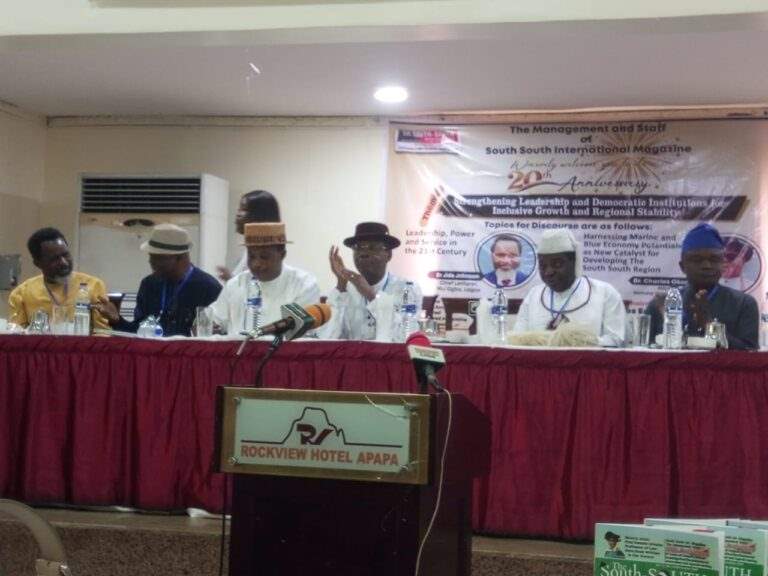
The Chief Lecturer and Director of Special Programmes at the Nigerian Institute of Journalism (NIJ), Dr Babajide Johnson, says Nigeria’s leadership challenge lies not only in who holds political power, but also in how that power is exercised and translated into public service and the common good.
Johnson said this on Wednesday during the 20th Anniversary Ceremony of The South-South International Magazine in Lagos, which held under the theme: “Strengthening Leadership and Democratic Institutions for Inclusive Growth and Regional Stability”.
Speaking on the topic, “Leadership, Power and Service in the 21st Century”, Johnson said many Nigerians pursue positions such as governor, president, senator and member of the house of representatives for personal gain rather than for the good of society.

According to him, leadership is a call to service, yet he questioned why a person who has served as governor for eight years will still seek to become a senator.
“A governor operates in an executive office where he issues directives and orders, while a senator operates in a deliberative body built on discussion and debate,” he explained, describing the transition as a misnomer.
He said that periodic elections alone did not guarantee accountability, effective service delivery, or public confidence.
Johnson said his academic research on public trust in institutions of governance had shown a decline.
Quoting leadership author, John Maxwell, the lecturer said: “Every thing rises and falls on leadership.”
He added that whenever God wants to change a society, He gives it a good leader, and prayed that Nigeria would have “an accident with history with good leaders.”
Johnson described the trinity of governance as leadership, power and service. “Leadership is articulating a vision. Power determines who gets what. Service delivery — who gets what benefit,” he said.
According to him, leadership is direction and influence, power is authority and capacity, while service is the purpose and ethical test of public office.
“Power without leadership can become arbitrary; leadership and power without service become instruments of domination and oppression, and that is what we have in Nigeria,” he said.
Dr Charles Okorefe, the Managing Director, Kamany Marine, also spoke on “Harnessing Marine and Blue Economy Potential as New Catalyst for Developing the South-South Region”.
Okorefe said the Niger Delta must harness its blue economy potential to achieve the United Nations Sustainable Development Goals (SDGs).
According to him, this includes eradication of poverty, creation of decent jobs, energy, sustainable cities, food security and disaster readiness.
He said that the UN’s 17 SDGs also cover sustainable or smart cities, food security and agriculture, water, oceans, and disaster preparedness.
He said most cities around the world were going smart, questioning whether Lagos qualified as a smart city.
He contrasted Lagos with cities that work with clockwork efficiency, citing Chongqing in China, which he had visited about 13 days earlier.
On the Niger Delta, he described the region as the prime basket of the Nigerian nation, tracing its history from the slave trade in the 1400s.
He said places like Opobo and Akassa were trade stations where captured slaves were put in vessels and taken to the New World.
He said the trade later gave way to legitimate trade after abolition, with foreign conglomerates such as the Royal Niger Company, UAC, John Holt, Unilever and G.B. Olivant operating in the area.
Mr Adewale Akodu, Chairman, Nigeria Union of Journalist (NUJ), Lagos chapter, represented by Mr Phillips Nwosu, the Vice-Chairman, commended the publisher on the theme of the programme.
Akodu congratulated the publisher on the 20th anniversary of the magazine.
In his remarks, Dr Ovie Edomi, Publisher of The South-South Magazine, urged the media under a democratically elected government to hold government officials accountable to the public.
Edomi said that during colonial era, pre- independence and post independence, the Lagos press used to be very vibrant.He called on journalists to live to their responsibility by objectively reporting the 2027 general elections. (NAN)
