


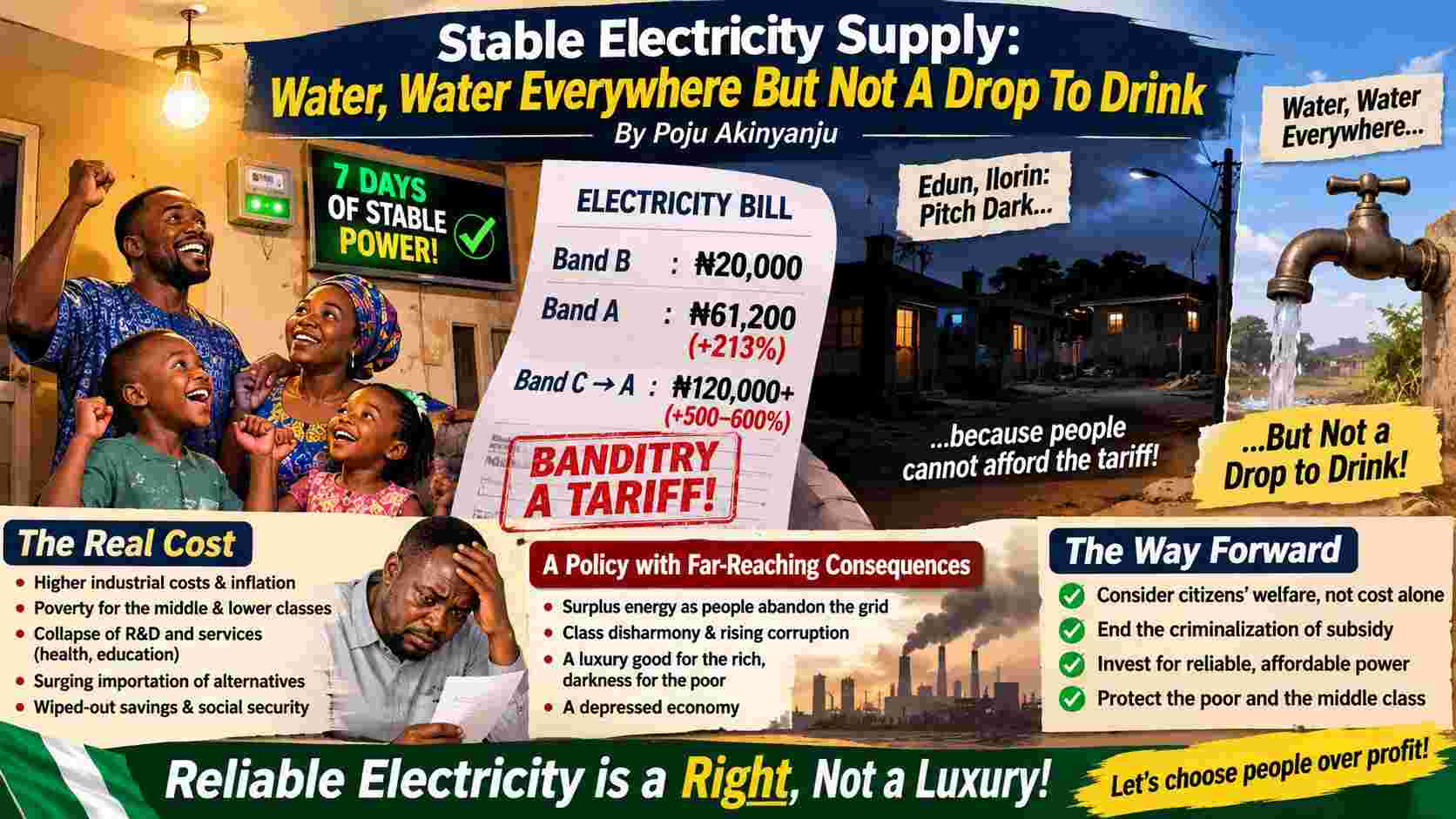
ABOUT nine weeks ago, the indicator bulbs, which tell us in my house that ‘NEPA’ (electricity from the national power grid) is on, lit up and remained lit for hours on end. Supply remained available without blinking throughout day one, two, three-six, seven! The first feeling was one of surprise, then disbelief, then embarrassment. Finally a happiness that it was possible for our nation to achieve this feat, hitherto thought impossible.
A friend who lives in the same neighbourhood came in to relate the same experience and joked that ‘NEPA’ staff are likely to be on strike but forgot to switch off power before they quit work. We progressed through week 2 of this stable supply and gave thanks that Nigeria has finally resolved its electricity supply conundrum, at least in our area.
And it is not just with electricity. The governments of Nigeria, indeed the entire ruling class, have the mindset of criminalizing subsidy. Since 1978, when the war on removal of subsidies from social services of education, healthcare, etc., was begun by the Obasanjo administration, through the formality of the policies of SAP of mid-80s by Babangida, the assault on subsidies has been persistent and gone more vicious. The submission has always been that everything must be cost reflective. The welfare of the citizens and the peculiarities of our socio-economic situation are never considered. The truth of the matter is that there is no nation on earth that does not support the welfare of its citizens, one way or the other. The array of structural and financial support that operates in the capitalist countries that we ape is unbelievable.
In the first 3 weeks of this experience, I didn’t have cause to recharge my prepaid meter, which I do monthly with a fair amount of units over my known estimated use. Then we had a community meeting and the people who had recharged started narrating their experience. The story is that they are getting a little less than one third of the units they used to get for the same amount of money. We had been migrated from Band B(N72/kWh) operative in our area to Band A (N225/kWh).

I then recharged and confirmed the migration to Band A.
ALSO READ: ‘Tinubu: From Renewed Hope To Despair’ — Matters Arising; By Omotoye Olorode
Then the reality. From personal experience my monthly bill under Band B was N20,000. If I retained the use at the level of the unstable supply that we use to have, my monthly bill skyrockets to N61,200. If I allow ad lib, even if disciplined, use, my monthly bill will be over N 120,000 per month! The summary is that if you are migrated from Band B to A, the rate of increase is 213%. If you are migrated from Band C to A, like in Edun area of Ilorin, where my electrician lives, the increase is 350%. If you factor in increased usage as a function of constant availability of electricity, the rate of increase in what you spend will range from 500 to 600%.
The argument of government for this huge increase in price is that the price of electricity must be cost reflective.
However, firstly, nobody has analyzed the cost to us. In a monopolistic production environment, the cost will certainly include the cost of inefficiency in production, transmission, etc.
Secondly, it is not clear if the cost borne by the consumers have been factored in. For example, over 95% of electricity poles and cables that supply electricity to domestic consumers are bought by the consumers. Customers, even in the Band A era still pay for, from minor repairs, fault corrections through replacement of stolen cables to replacement of hugely expensive transformers. I have personally joined to pay for replacement of stolen cables at Oyo, Owo, and Ilorin, cities in which I have lived. Even though the regulatory body, the NERC, advertises that consumers should not pay for these services, one will live in darkness for ever, if one does not finance such repairs and replacements. The distributive companies, DISCOS, do not care, which is strange for businesses that should make money from the quantity of power that they make available for sale. This situation is still operative even with the imposition of Band A price on customers.
Lastly, it is forgotten that the funds employed to build the infrastructures: dams, transmission lines, etc., were sourced from public funds that belong to the citizens. Where is the return on investments for them?
ALSO READ: Uzodimma And Okorocha: Big Politicians And Tricks Of Politics; By Owei Lakemfa
However, cost cannot be the only parameter that should be considered by government in fixing the price of such a key facility. The citizens’ ability to pay within the subsisting economic structure; and their welfare must be considered.
Edun, is an inner city suburb of Ilorin, where my electrician lives. He reports that if you visited the area at night since the imposition of Band A, the place is pitch dark though ‘NEPA’ is available because people cannot afford the increase in tariff: water, water everywhere but not a drop to drink! Electricity, a basic utility has been turned into a luxury good available for the use of the rich.
In the last 10 days or so when this article was being contemplated, my area has begun to have power outages, both short and frequent, and prolonged. Almost to the pre-Band A regime but the high tariff remains. In a most appropriate play on words, a friend has termed the imposed tariff – Banditry A tariff!
Society will be impacted negatively by this policy.
Cost of industrial production will increase leading to a higher inflation, depressed demands, industrial failures and depressed economy.
ALSO READ: When The Gulf Looks Beyond U.S.: The Limits Of American Security Primacy In A Region Searching For Its Own Answers; By Lanre Ogundipe
R and D (frontier research) in Nigeria, already, almost non-existent, will lose credibility and even disappear. Research laboratories that get electricity rationed to them cannot be trusted to produce credible findings.
The rich people will go off the grid completely as they can afford installing alternate source of energy, such as solar, to take care of all their needs.
Cost of services such as health service will spike making them more unattainable with negative consequences.
The middle class will be pushed into poverty and the lower class into the deeper dungeon of poverty. Quality of life will drop generally. My laundry man has returned to coal iron to keep his business alive!
There will be immediate increased importation of elements of the alternate source of energy, further destroying the economy.
Savings by majority of citizens will be wiped out.
The social security system rooted in family assistance will be destroyed.
Class disharmony will be further aggravated.
Corruption will increase as the need to fill the gaps that official wages cannot meet will be more urgent.
ALSO READ: Ibrahim Muazzam And The Quest For Philosophical Understanding; By Jibrin Ibrahim
Paradoxically, over time, there will be surplus energy in the national grid as more and more people abandon it for alternatives including ‘I-better-pass-my-neighbour’ solar systems. We already have stories of the DISCOs fretting over ‘loss of revenue’!
The government set up a trap for when electricity will be available. Low tariff bands, supposedly subsidized, were created when you were getting next to no electricity. High tariff trap was put in place for when supply will be available. It is callous thinking. In other countries, the energy bill assistance targets the low income group but in Nigeria, the claimed Band based subsidies subsidize lack of supply, inefficiency. When supply is improved, the poor with the same income pay the much higher unsubsidized price.
And it is not just with electricity. The governments of Nigeria, indeed the entire ruling class, have the mindset of criminalizing subsidy. Since 1978, when the war on removal of subsidies from social services of education, healthcare, etc., was begun by the Obasanjo administration, through the formality of the policies of SAP of mid-80s by Babangida, the assault on subsidies has been persistent and gone more vicious. The submission has always been that everything must be cost reflective. The welfare of the citizens and the peculiarities of our socio-economic situation are never considered. The truth of the matter is that there is no nation on earth that does not support the welfare of its citizens, one way or the other. The array of structural and financial support that operates in the capitalist countries that we ape is unbelievable.
America claims to be the flagship of capitalist ideology, practising it undiluted. But America subsidizes healthcare, education, food and nutrition, utilities, unemployment, social security, senior citizens, veterans; and relative to the topic of this piece, energy bills, both electricity and fossil fuel. This is true of all Western countries that we seek to emulate. Subsidies that promote the welfare of the citizens are made the priority even when it appears contradictory to their ideological posture.
ALSO READ: Nigeria And The Metaphor Of Fake Sleep; By Iduh Onah
The tendency is to blame the international institutions such as the World Bank and the IMF that recommend/impose these conditions. While these impositions are true, the acceptance of them is the choice of our rulers. The continuation of slavery is as much a responsibility of the slave as of the slave master, if not more. Thus, the responsibility for the hardship caused by removal of subsidies lies squarely on the Nigerian rulers who accept and implement these policies. The World Bank, for example, has no responsibility to ordinary Nigerians. The President of Nigeria does. Unfortunately, our political rulers value the praise of external agencies and are deaf to the death throes that pervade the nation.
The scope of this piece does not allow for full discussion of the lame and self incriminatory excuses the governments give for removal of subsidies; and the alternatives that are available.
Once the citizens bore the 200% (now up to 600%) increase in fuel price, as a function of subsidy removal, the government became emboldened to inflict other hardships on citizens, such as gross devaluation of the currency, the 200% increase on electricity, stamp duties on transactions, etc.
The response of Nigerians is described as resilience and tolerance. In reality, it is somnambulism of defeat. Citizen suffering will remain until the force necessary to stir the population into life comes. The trajectory from there may not be predictable but the current centre cannot hold.
In the last 10 days or so when this article was being contemplated, my area has begun to have power outages, both short and frequent, and prolonged. Almost to the pre-Band A regime but the high tariff remains. In a most appropriate play on words, a friend has termed the imposed tariff – Banditry A tariff!
As usual in Nigeria, the regulatory authorities, NERC in this instance, do not protect the consumers, they protect the government/corporate entities they are meant to regulate. The NERC has a regulation that if supply of electricity to an area is short of prescribed number of hours per day for seven consecutive days, the DISCO must revert to the appropriate lower tariff. Seven consecutive days! If the supply default lasts for 6 consecutive days but returns to specification on the 7th day, the DISCO is good to sustain the high tariff.
Emeritus Prof. Akinyanju, former president, Campaign for Democracy and Human Right (CDHR), retired from the Department of Microbiology, University of Ilorin. He writes from Ilorin. For reactions to this article, reach out via pakinyanju@yahoo.com or nationalrecordng@gmail.com
