


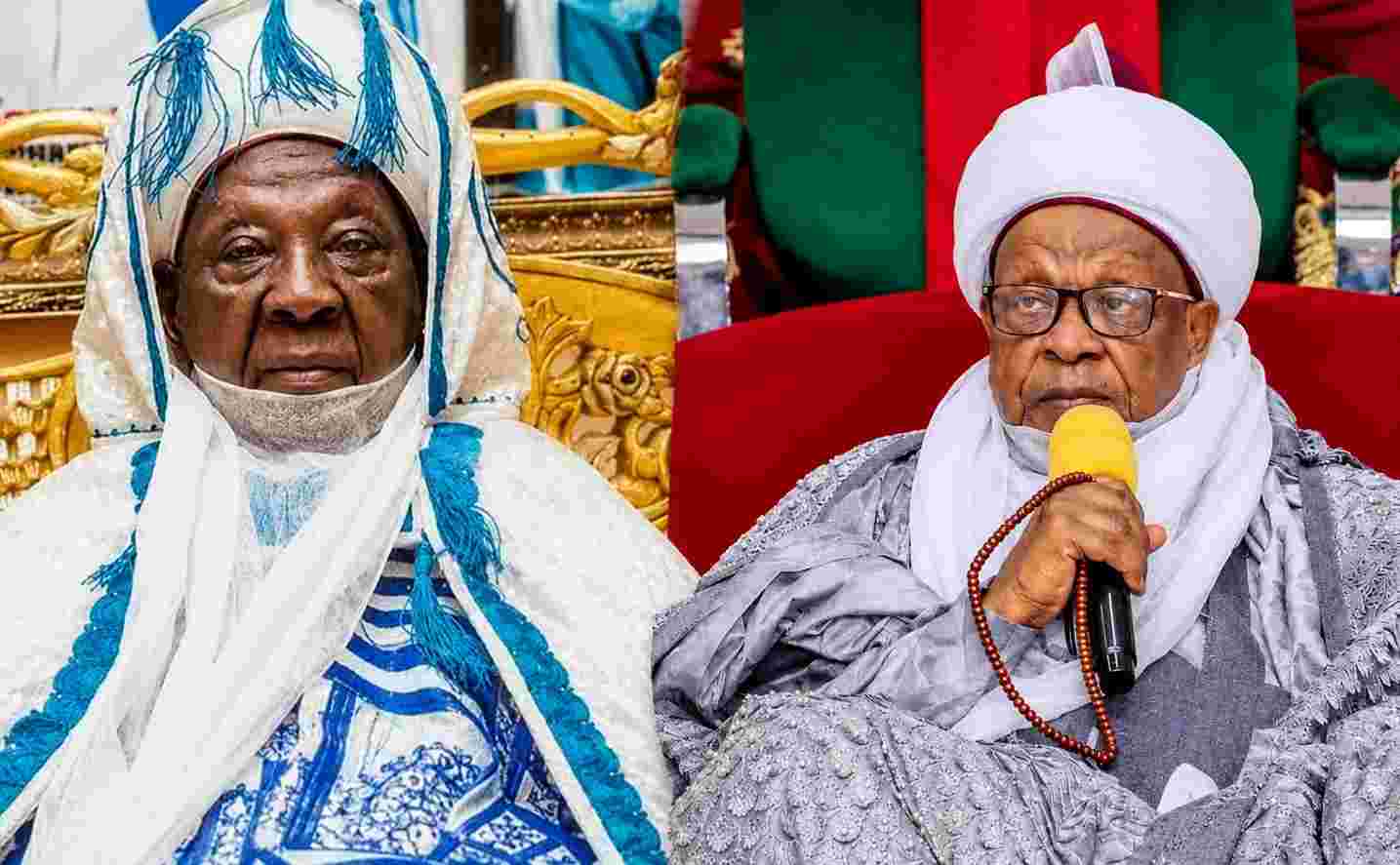
TWO emirs in Katsina State, separated by fewer than 90 kilometres, have offered Nigerians two strikingly different accounts of the same country. One spoke of hunger, banditry, collapsing livelihoods, death-trap roads, and farmers too frightened to cultivate their land. The other praised President Bola Tinubu and openly mobilised support for his re-election in 2027.
One confronted power with the uncomfortable truth of the people’s suffering. The other offered power the reassuring language of loyalty and political gratitude.
The contrast was more than a difference of opinion between two traditional rulers. It exposed an uncomfortable question about the purpose of traditional authority in contemporary Nigeria: Are our royal institutions still the conscience of the people, or are some becoming increasingly comfortable as instruments of political patronage?

ALSO READ: The 7th Kano Social Influencers Conference; By Jibrin Ibrahim
When the All Progressives Congress (APC) presidential campaign team visited the palace of the Emir of Katsina, the monarch spoke like a father watching his children suffer while those entrusted with their welfare offered excuses and political slogans.
He spoke for the talakawa—the ordinary Nigerians who bear the heaviest burden of the country’s economic and security crises. He challenged politicians to stop making promises they had no intention of keeping. He lamented hunger, banditry, deteriorating infrastructure, and the terrifying reality of farmers who could no longer reach their fields safely.
His message was unmistakable: the government cannot continue to sell hope to a population struggling to survive while treating its suffering as an inconvenient footnote to political propaganda.
Then came the contrasting intervention from the Emir of Daura. At an event associated with the commissioning of the Abuja–Kaduna–Kano road, the Daura monarch praised Tinubu’s administration and urged Northerners to support the president’s second-term ambition. He subsequently stood up and led a chant of “Tinubu, Tinubu, Tinubu in 2027.”
There was no ambiguity about his political position. He was not merely expressing a private preference; he was publicly campaigning for continuity. But continuity of what? Continuity of hardship? Continuity of insecurity? Continuity of economic policies whose consequences ordinary Nigerians continue to struggle with? Or continuity of a political arrangement whose benefits, critics might reasonably argue, are not being felt equally by those at the bottom of the economic ladder? These are questions that deserve answers, not royal chants.
Both emirs operate within the same state, amid the same national economic pressures and the same broader crisis of insecurity. Yet their interventions conveyed dramatically different priorities. One placed the suffering of the people at the centre of the conversation. The other placed his confidence in the president’s continued leadership.
ALSO READ: Beyond Faster Approvals: PenCom’s 48-Hour Reform And The Future Of Retirement Security; By Ivo Takor
The contrast was so stark that one might have thought one Emirates stood in Nigeria and the other in Dubai. And therein lies the troubling question: When the reality experienced by ordinary citizens is so painful, what explains the enthusiasm with which some influential figures celebrate the continuation of the political order?
Perhaps the answer lies in differing political convictions. Perhaps it reflects different assessments of the government’s performance. But where political praise is accompanied by little public acknowledgment of widespread hardship, Nigerians are entitled to ask whether the interests of the people are receiving the attention they deserve. A royal stool should not become a comfortable seat from which the suffering of the people can be ignored.
The Katsina Emirate is an ancient institution whose legitimacy rests on history, tradition, and service to the people. Its moral authority depends, in no small measure, on its willingness to speak uncomfortable truths to those who wield power. The credibility of such an institution does not come from the applause of politicians or invitations to government ceremonies. It comes from the confidence of the people who look to the palace for guidance, protection, and an honest voice when political leaders fail them. That is why the contrast with Daura Emirates deserves serious scrutiny.
The Emir of Daura has openly endorsed Tinubu’s re-election, arguing that the president has performed well, particularly in the North, and should be supported for a second term.
“Tinubu supported our late son, President Buhari, to become president. We in the North should support the second term of Mr President. We should all come out en masse to vote for him in 2027,” the emir declared.
He praised Tinubu for completing projects initiated by the late President Muhammadu Buhari and argued that Northerners should reciprocate the support Tinubu had given Buhari during his political journey.
The emir also thanked Tinubu for the honours accorded Buhari after his death, including the president’s attendance at the funeral, the declaration of a public holiday, and the provision of the presidential aircraft. “I am thankful to President Bola Tinubu, a good person I have been with in the last 30 years,” he said, adding that the respect shown to Buhari would not be forgotten and would be reciprocated in the 2027 presidential election.
His argument appears to rest partly on political gratitude: Tinubu supported Buhari, and the North should now support Tinubu. But since when did democratic accountability become an exercise in repaying political favours?
ALSO READ: We Are Still In Egypt, Mr President; By Iduh Onah
A presidential election is not a private transaction between political associates. It is a public decision that affects millions of people, including farmers whose livelihoods have been threatened by banditry, parents who struggle to feed their children, young people who cannot find decent employment, and families whose incomes have been battered by rising living costs.
The presidency is not an inheritance to be passed between political allies. Nor should the votes of an entire region be treated as repayment for past political support. If Tinubu supported Buhari’s political ambition, that is part of Nigeria’s political history. But the question facing voters in 2027 must be whether Tinubu’s own record in office justifies another mandate. That judgment should be based on security, economic performance, employment, infrastructure, food affordability, and the overall welfare of Nigerians—not simply on who supported whom three decades ago.
Political gratitude may explain an endorsement. It cannot, by itself, establish that a president deserves re-election. And when a traditional ruler invokes the collective identity of the North to mobilise support for a presidential candidate, the public has every right to ask whether the region’s millions of citizens have been consulted about the political bargain supposedly being made in their name. The North is not a private estate. Its people are not political debtors. Their votes are not royal gifts to be presented to any candidate.
The People Are Hungry; Politicians Are Campaigning
The intervention of the Emir of Katsina was powerful precisely because it cut through the familiar language of political self-congratulation. Addressing the campaign’s director-general, the monarch asked:
“Director-General, you are now on board. Is it right to make promises that you know you will not fulfil? Allah will question you over such actions.” It was a direct challenge to a political culture in which promises are frequently made during campaigns and forgotten once the votes have been counted.
Too often, politicians treat campaign promises as disposable instruments of electoral manipulation. They promise security, prosperity, jobs, infrastructure, and relief from hardship. Yet when citizens demand results, they are asked to be patient, make sacrifices, and wait for the dividends of a democracy that too often appears to reward political elites more generously than ordinary people.
ALSO READ: A Formula For The Determination Of The National Minimum Wage; By Izielen Agbon
The Katsina emir was right to challenge that culture. A politician who knowingly makes promises he cannot fulfil is not merely engaging in political exaggeration. He is undermining public trust. And when such promises concern security, food, livelihoods, and the survival of vulnerable communities, the consequences are far more serious than disappointment at the ballot box.
The emir also lamented the decline of industries that once provided employment and economic opportunities, citing the Defence Industries Corporation (DIC) and Peugeot Automobile in Kaduna as examples of industrial establishments that had fallen on hard times.
Then he delivered a stinging rebuke to the government’s political messaging: “You call it Renewed Hope, but our people are facing Renewed Hunger,” he said. That statement deserves to be repeated because it captures the central contradiction confronting the Tinubu administration.
What does renewed hope mean to a family that can no longer afford three meals a day? What does economic reform mean to a young graduate who has spent years searching for employment? What does a presidential road commissioning mean to a farmer who cannot safely reach his field because armed bandits control the surrounding communities?
What value do grand speeches and political ceremonies have when ordinary citizens remain trapped in the daily struggle to survive Governments are entitled to publicise their achievements. They are entitled to defend their policies and explain why difficult decisions may be necessary. But they cannot reasonably expect applause to substitute for accountability.
A road can be commissioned, a speech can be delivered, and a campaign slogan can be repeated a thousand times. None of these, on its own, proves that the government has fulfilled its responsibility to the people. The real test of governance is what citizens experience beyond the podium: whether they are safe, whether they can feed their families, whether they can earn a living, and whether they can plan for tomorrow without being consumed by fear and economic uncertainty.
For millions of Nigerians, the distance between the government’s rhetoric and their daily reality remains painfully wide. The Emir of Katsina did not need to produce a complicated economic report to make his point. He simply gave voice to the suffering that political messaging often seeks to soften or obscure. Sometimes, one honest sentence exposes more about a government’s predicament than a hundred pages of official publicity.
ALSO READ: Lagos–Calabar Coastal Highway: A Grand Illusion Or A Road To Nowhere? By Abadom Lawrence Amechi
The Emir of Katsina also warned politicians against hatred, humiliation, and the degradation of political opponents. “Politics is not madness. Whoever you are, if you humiliate another person, you may eventually face the same fate,” he cautioned.
His remarks were a timely reminder that political competition should not destroy the moral foundations of public life. Elections are contests for public trust, not licences to intimidate opponents, assassinate character, or divide communities for electoral advantage.
He also challenged the campaign leadership to confront insecurity, lamenting that farmers in Katsina and across northern Nigeria could no longer access their fields safely because of banditry.
This is not a marginal concern. It is a crisis that strikes at the heart of the North’s economic survival. When farmers abandon their fields because of armed attacks, food production suffers. When food production suffers, prices rise and households become more vulnerable. When livelihoods disappear, poverty deepens, young people become more desperate, and communities lose confidence in the institutions meant to protect them.
Insecurity is therefore not merely a campaign talking point. It is an economic emergency, a humanitarian crisis, and a direct indictment of the state’s failure to guarantee the safety of its citizens.
Any political leader seeking another mandate must be prepared to answer difficult questions about the lives lost, the communities displaced, the farms abandoned, and the livelihoods destroyed during his time in office.
That is what accountability requires.
And if traditional rulers possess the moral standing to ask those questions, they should not be discouraged from doing so simply because the questions might embarrass a visiting politician or offend the government of the day.
Indeed, if the palace cannot speak when its people are hungry, frightened, and economically battered, when exactly is it supposed to speak?
The Emir of Katsina captured this responsibility when he declared: “We are the fathers of the country, and we must tell you the truth. We have to speak up, and the truth must be told to whoever needs to hear it.” That is the essence of traditional moral authority. Not ceremonial applause. Not political choreography. Not the performance of loyalty before powerful visitors.
Truth.
Daura’s Dilemma: Political Gratitude Versus Public Responsibility
To be clear, the Emir of Daura has every right to support Tinubu’s re-election. A traditional ruler does not forfeit his personal political opinions upon ascending a throne. Nor should every expression of support for a government automatically be interpreted as evidence of patronage. A president may deserve praise for completing projects, maintaining relationships, or taking decisions that a monarch considers beneficial.
The problem, however, is not the endorsement itself. It is the question of what that endorsement communicates when placed against the lived realities of the people. When a royal father urges an entire region to support a president because of past political loyalty, what consideration is given to the millions whose immediate concerns are hunger, unemployment, insecurity, and the cost of living?
ALSO READ: Insecurity: Government Should Trust Nigerians; By Owei Lakemfa
When a monarch speaks enthusiastically about a president’s achievements, should that praise not be accompanied by an equally candid assessment of the government’s shortcomings?
And when gratitude for political favours becomes a central justification for electoral support, does the language of public service risk giving way to the logic of political transactions?
These are legitimate questions. They do not require anyone to assume that the Emir of Daura has acted in bad faith. They require only that public endorsements by influential traditional institutions be subjected to the same scrutiny as the claims of elected politicians.
The Daura Emirate also carries historical and political significance because the late President Buhari hailed from the town. During Buhari’s presidency, Daura enjoyed considerable symbolic proximity to the seat of federal power.
With a different administration now in office, public displays of political loyalty inevitably invite questions about the relationship between traditional authority and the changing centres of political influence.
It would be unfair to claim, without evidence, that the emir’s endorsement is motivated by a desire to preserve access or influence. But it would be equally naive to pretend that the relationship between political power, traditional institutions, and patronage is not a legitimate subject of public debate.
The point is not to speculate about private motives. It is to insist on a public standard.
A traditional institution must be able to demonstrate that its loyalty to the welfare of its people is stronger than its attraction to political power.
ALSO READ: The Power Without A Referee Problem; By Lanre Ogundipe
If the government performs well, praise it. If it fails, say so. If it delivers a road, acknowledge the achievement. If farmers remain unable to cultivate their land safely, demand answers.
That is not disloyalty. It is responsible leadership.
A monarch who supports a president can still challenge him. A royal father who appreciates a political relationship can still insist that the government must do more. Political endorsement and public accountability are not enemies unless one is being used to silence the other.
The danger begins when political loyalty becomes so dominant that the suffering of the people is pushed to the margins.
The North is Not a Political Debtor
I am not campaigning for any political party, neither am I apolitical. As a public affairs commentator, I have to be fair and objective when expressing my opinion in public to avoid being seen as belonging to any political camp. Perhaps the most troubling aspect of the Daura endorsement is the suggestion that Northerners should support Tinubu because Tinubu supported Buhari. This reasoning risks reducing the political choices of millions of people to a question of historical gratitude.
But the North is not a single political household whose votes can be pledged by one influential figure. It is a vast and diverse region of farmers, traders, civil servants, professionals, students, artisans, and unemployed young people whose experiences and interests cannot be reduced to a royal endorsement.
Northern Nigerians have their own grievances, priorities, and expectations. They have the right to judge a president by his record and to decide whether his administration has earned their continued confidence. Their loyalty should be to their own welfare, their communities, and the future they want for their children—not to an obligation to repay political favours exchanged among elites.
ALSO READ: Rule Of Law, Nigeria’s Only Hope Of Survival (2), By Hassan Gimba
The region has endured severe security challenges, economic deprivation, and widespread poverty. Its people deserve more than appeals to political sentiment. They deserve measurable improvements in security, education, employment, infrastructure, and living standards.
If the Tinubu administration has delivered results that justify another term, its supporters should make that case with evidence. They should explain how the government has improved lives, strengthened security, expanded economic opportunity, and addressed the needs of vulnerable communities.
But telling Northerners that they should vote for Tinubu because he once supported Buhari is not an adequate substitute for that argument. Democracy is not a system of inherited political debts. It is a system of public accountability. The president must earn the people’s votes. No monarch, political godfather, or former alliance can earn those votes on their behalf.
Whose Side is the Palace On?
Ultimately, the contrast between the two emirs forces a question that reaches beyond Katsina State: Whose interests should a traditional institution represent when the government and the people appear to be living in different realities? The royal stool is not an elected office, but it commands influence rooted in history, identity, and community trust. That influence carries responsibility.
Traditional rulers cannot replace elected governments, and they should not pretend to possess the mandate of the ballot box. But they can insist that those who hold executive power fulfil their obligations. They can speak for communities whose suffering might otherwise be ignored. They can challenge the normalisation of insecurity and the political tendency to treat hunger as an acceptable price of economic reform.
Their greatest contribution may be their ability to speak truths that party officials, political appointees, and campaign loyalists are unwilling to articulate. That is why the intervention of the Emir of Katsina matters. By challenging unfulfilled promises, highlighting insecurity, and exposing the gap between political slogans and the suffering of ordinary Nigerians, he demonstrated what traditional moral authority can contribute to public life.
The contrasting endorsement from Daura demonstrates the other side of the debate: the risk that a royal platform may become dominated by electoral mobilisation and political gratitude at a time when the public is demanding answers about its welfare.
The distinction is not that one emir must oppose Tinubu while the other supports him. It is that no political preference should excuse either monarch from confronting the conditions under which their people live.
If a ruler can find the courage to lead a chant for a president’s re-election, he should also find the courage to speak just as loudly about the insecurity, hunger, and economic distress confronting the people whose votes that president seeks.
If he can publicly praise the president for completing projects, he should also be willing to ask why so many citizens continue to struggle to meet their most basic needs.
And if he invokes the North to demand political support, he should be equally prepared to invoke the North’s suffering when demanding better governance.
Anything less risks turning traditional authority into a ceremonial accessory to political power.
History Will Judge the Emirates
As Nigeria approaches the 2027 presidential election, the country needs more than royal endorsements, political chants, and ceremonies designed to reinforce the legitimacy of those already in power.
It needs institutions capable of distinguishing between loyalty to a government and loyalty to the people. A president is not entitled to a second term because he supported another politician in the past. He must earn it through his performance in office. A region is not obligated to support a candidate because political elites have established relationships. Its people must be free to judge the evidence and make their own choices.
And a traditional ruler does not fulfil his responsibility merely by maintaining cordial relations with the government. His legacy will depend, in part, on whether he used his influence to defend his community when doing so was difficult.
The worth of a royal institution cannot be measured by the number of presidential visits it receives, the honours its members enjoy, or the access they possess to the corridors of power.
It must be measured by the courage to speak when the people are suffering, the willingness to challenge authority when it fails, and the determination to place public welfare above political convenience.
The Emir of Katsina reminded Nigerians that a royal father has a duty to tell the truth, regardless of who needs to hear it. That principle should not depend on which party is campaigning, which president occupies the Villa, or which political alliance promises the greatest influence.
The people need traditional rulers who can look a president in the eye and say, without fear or favour, that hunger is unacceptable, insecurity is intolerable, and unfulfilled promises are a betrayal of public trust. They do not need palaces that confuse political access with public service or mistake the applause of powerful visitors for the approval of suffering communities.
History will eventually judge which palace stood firmly with the people of Katsina State, northern Nigeria, and the country as a whole—and which allowed political loyalty to overshadow the responsibility to speak for them.
For when a nation is hungry and afraid, a royal father must decide whether he will amplify the cries of his people or add his voice to the applause of power. One choice preserves the honour of the throne. The other risks reducing it to a political instrument.One told truth to power. The other chose to campaign for power. And when history asks which of them better served the people, neither royal titles nor political friendships will be enough to answer the question.
Dukawa writes from Abuja and can be reached at abbahydukawa@gmail.com
