



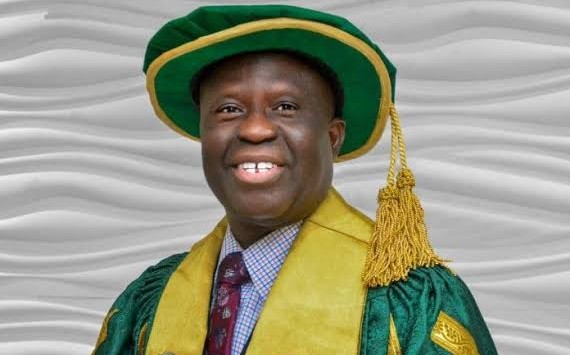
THE SENATE on Thursday confirmed the nomination of former Vice-Chancellor of the Federal University, Oye-Ekiti (FUOYE), Prof. Abayomi Fasina, as a non-career ambassador, despite a debate dominated by allegations of sexual harassment that some lawmakers argued warranted further investigation before his confirmation.
While opponents urged caution over the allegations and claimed related matters were still before the courts, the Senate relied on reports from the university’s Governing Council, the Nigeria Police Force and other security agencies, which found no evidence to substantiate the claims.
The confirmation followed the presentation and adoption of the report of the Senate Committee on Foreign Affairs, chaired by Senator Sani Bello.
Presenting the report, Senator Simon Lalong (APC, Plateau South) said the committee screened Fasina and found him qualified for the diplomatic appointment after he satisfactorily responded to questions on his experience, credentials and suitability for the role.
Lalong said the committee established that the nomination complied with Section 171(4) of the 1999 Constitution (as amended), which requires Senate confirmation before presidential appointments of ambassadors can take effect.
According to him, the committee also considered several petitions submitted both in support of and against Fasina’s nomination. He said each petition was carefully reviewed alongside available evidence and official reports before the committee arrived at its recommendation.
Addressing the allegations of sexual harassment that trailed Fasina’s tenure as FUOYE vice-chancellor, Lalong said investigations conducted by the university’s Governing Council and the Nigeria Police Force did not substantiate the claims against the nominee.
He further stated that background checks by the Department of State Services (DSS) and the Nigeria Police cleared Fasina, while committee members were satisfied with his performance during the screening exercise.
The committee subsequently recommended his confirmation, stating that all constitutional requirements had been met and that there were no official findings disqualifying him from serving as Nigeria’s non-career ambassador.
However, the recommendation was not without opposition on the Senate floor.
Senator Adams Oshiomhole (APC, Edo North) urged the Senate to delay Fasina’s confirmation, arguing that allegations reportedly involving two women and matters he said were pending before competent courts should first be resolved.
Although he acknowledged the constitutional presumption of innocence, Oshiomhole maintained that confirming the nominee before judicial determination could send the wrong signal to women who raise concerns about alleged sexual misconduct and accountability.
Responding to the concerns, Lalong insisted that the committee was not presented with any court documents or evidence showing that legal proceedings involving the nominee were pending.
He argued that allegations alone could not justify denying confirmation and stressed that the Senate must uphold the constitutional principle that every accused person is presumed innocent until proven guilty by a court of competent jurisdiction.
Senator Cyril Fasuyi (APC, Ekiti North) also opposed the nomination, noting that FUOYE is located in his constituency and that the allegations had generated widespread public discussion in Ekiti State.
He told the Senate that the complainant had personally narrated her experience to him and appealed for further investigation before a final decision was taken on the nomination.
Speaking in support of the committee’s recommendation, Senator Abdul Ningi (PDP, Bauchi Central) said all issues raised against the nominee had been exhaustively considered.
He noted that the committee reviewed petitions opposing the nomination as well as counter-petitions supporting it and concluded that competent authorities, including the university’s Governing Council and the Nigeria Police Force, had investigated the allegations and found them to be unsubstantiated.
Ningi consequently urged the Senate to confirm Fasina’s appointment as a non-career ambassador.
In his remarks, Senate President, Godswill Akpabio, read what he described as a relevant portion of the FUOYE Governing Council’s report.
According to Akpabio, the report stated that there was no case of sexual harassment, affirming the earlier findings of the Nigeria Police Force. He quoted the report as saying that during the investigation, the complainant stated she was not sexually harassed.
He added that documents reviewed by the committee included the police report, audio recordings, transcripts, correspondence involving both the former vice-chancellor and the complainant, as well as minutes of management meetings.
Akpabio stressed that the Senate could only rely on documentary evidence formally presented before it.
“I cannot rely on hearsay or telephone conversations,” he said, adding that the committee’s report cleared the nominee and affirmed his competence, integrity and suitability for the ambassadorial position.
The Senate President also reminded lawmakers that, as members of the upper chamber of the National Assembly, they had a responsibility to base their decisions on verifiable evidence rather than unsubstantiated claims.
Following the debate, the Senate approved the committee’s recommendation and confirmed Fasina as Nigeria’s non-career ambassador.
Prof. Abayomi Fasina, born on July 17, 1961, is a soil scientist and university administrator with more than four decades of experience in teaching, research and public service.
