


…Demands End To Demolitions
By Victor Itodo Abuh
THE RESOURCE Centre for Human Rights and Civic Education (CHRICED) has called on the United Nations to urgently intervene in what it described as the worsening human rights situation of the Indigenous Peoples of Nigeria’s Federal Capital Territory (FCT), Abuja, warning that forced demolitions, land dispossession and political exclusion continue to threaten their existence.

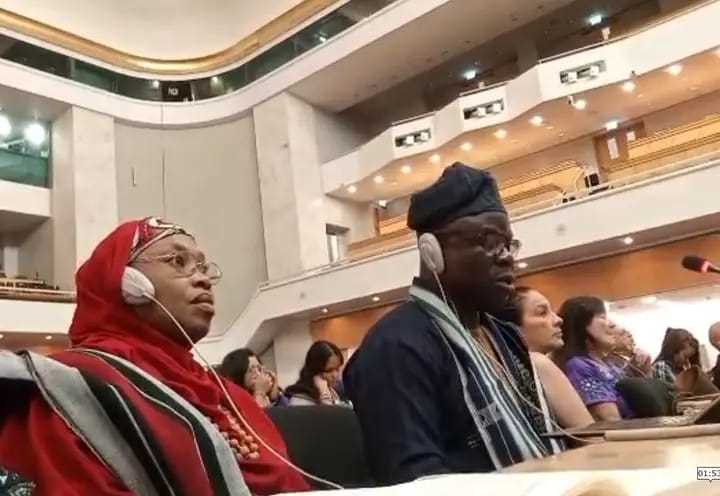
Presenting CHRICED’s position at the 19th Session of the Expert Mechanism on the Rights of Indigenous Peoples (EMRIP) in Geneva on Monday, the organisation’s Executive Director, Dr. Ibrahim M. Zikirullahi, said the condition of Abuja’s Original Inhabitants (OIs) had deteriorated significantly since the previous session.
Speaking before the UN mechanism, Zikirullahi said he was accompanied by three Indigenous delegates with the support of the John D. and Catherine T. MacArthur Foundation to draw global attention to the plight of the Original Inhabitants of the FCT.
“At the 18th Session last year, we reported that ‘over two million Indigenous people of the FCT face systematic exclusion, land dispossession, political disenfranchisement, and cultural erasure.’ Today, it is with deep concern that I must inform this Mechanism that their plight has deteriorated significantly over the past year,” he said.
The CHRICED Executive Director argued that although Abuja is generally regarded as a peaceful administrative capital, its Indigenous communities continue to endure what he described as “persistent structural conflict” driven by forced displacement, land appropriation and political exclusion.
According to him, several Indigenous communities have experienced state-led demolitions over the past year, leading to homelessness, destruction of ancestral compounds, disruption of traditional livelihoods, and increased psychological trauma.
“These demolitions constitute conflict conditions, even in the absence of armed confrontation. They mirror global patterns in which Indigenous Peoples experience violence through administrative, legal, and urban-development mechanisms rather than overt military force,” he stated.
Zikirullahi also maintained that Abuja’s Indigenous communities have never experienced genuine post-conflict justice because there has been no restitution for lands acquired under Military Decree No. 6 of 1976, no meaningful compensation or resettlement despite Supreme Court judgments, and no political representation.
“As we stated last year, ‘successive governments have failed to provide compensation, resettlement, or legal recognition.’ This unresolved injustice perpetuates a permanent post-conflict crisis,” he said.
Addressing the growing role of artificial intelligence (AI), CHRICED warned that emerging technologies could deepen the marginalisation of Indigenous communities if their data are collected without consent or used to reinforce discriminatory narratives.
The organisation cautioned that AI systems dependent on large datasets could exclude Abuja’s Original Inhabitants if government agencies or private actors extract community data without free, prior and informed consent or deploy automated systems without Indigenous participation.
“Data is not just a technical tool—it is a vehicle for justice, visibility, and empowerment. This truth is even more urgent in the age of AI,” Zikirullahi said.
He, however, noted that AI also presents opportunities if developed within the framework of Indigenous Data Sovereignty, including community ownership of data, ethical AI systems, Indigenous-led digital archives and technology-driven documentation of human rights violations.
CHRICED further expressed concern over the declining state of Indigenous languages in the FCT, including Gbagyi, Bassa, Gwandara, Koro and Ganagana, attributing the threat to displacement, urbanisation, shrinking cultural spaces and inadequate government support.
According to the organisation, recent demolitions have destroyed not only homes but also the cultural environments where Indigenous languages are preserved and passed from one generation to another.
To support the objectives of the International Decade of Indigenous Languages, CHRICED urged the Nigerian government to recognise Abuja’s Indigenous languages as national heritage, support community-led language revitalisation programmes, integrate Indigenous languages into local education, fund AI-based language preservation initiatives and protect cultural sites.
The organisation also called on EMRIP, member states and other stakeholders to pressure the Nigerian government to halt forced evictions, legally recognise Abuja’s Original Inhabitants as Indigenous Peoples, ensure conflict-sensitive development policies, guarantee democratic participation, preserve Indigenous languages and cultures, uphold Indigenous data sovereignty, and establish disaggregated national data systems reflecting the socio-economic realities of Indigenous communities.
Concluding his presentation, Zikirullahi described the situation facing Abuja’s Original Inhabitants as a “silent conflict” that requires urgent international attention.
“Abuja’s Original Inhabitants are living through a silent conflict—marked by demolitions, displacement, erasure, and denial of rights. Their situation is not improving; it is worsening.
“Development must never be weaponized against Indigenous Peoples. AI must never become a new frontier of dispossession. Language must never be allowed to die because a people were pushed off their land.
“We therefore call on this Mechanism to act with urgency and resolve. Justice delayed is dignity denied,” he said.
