


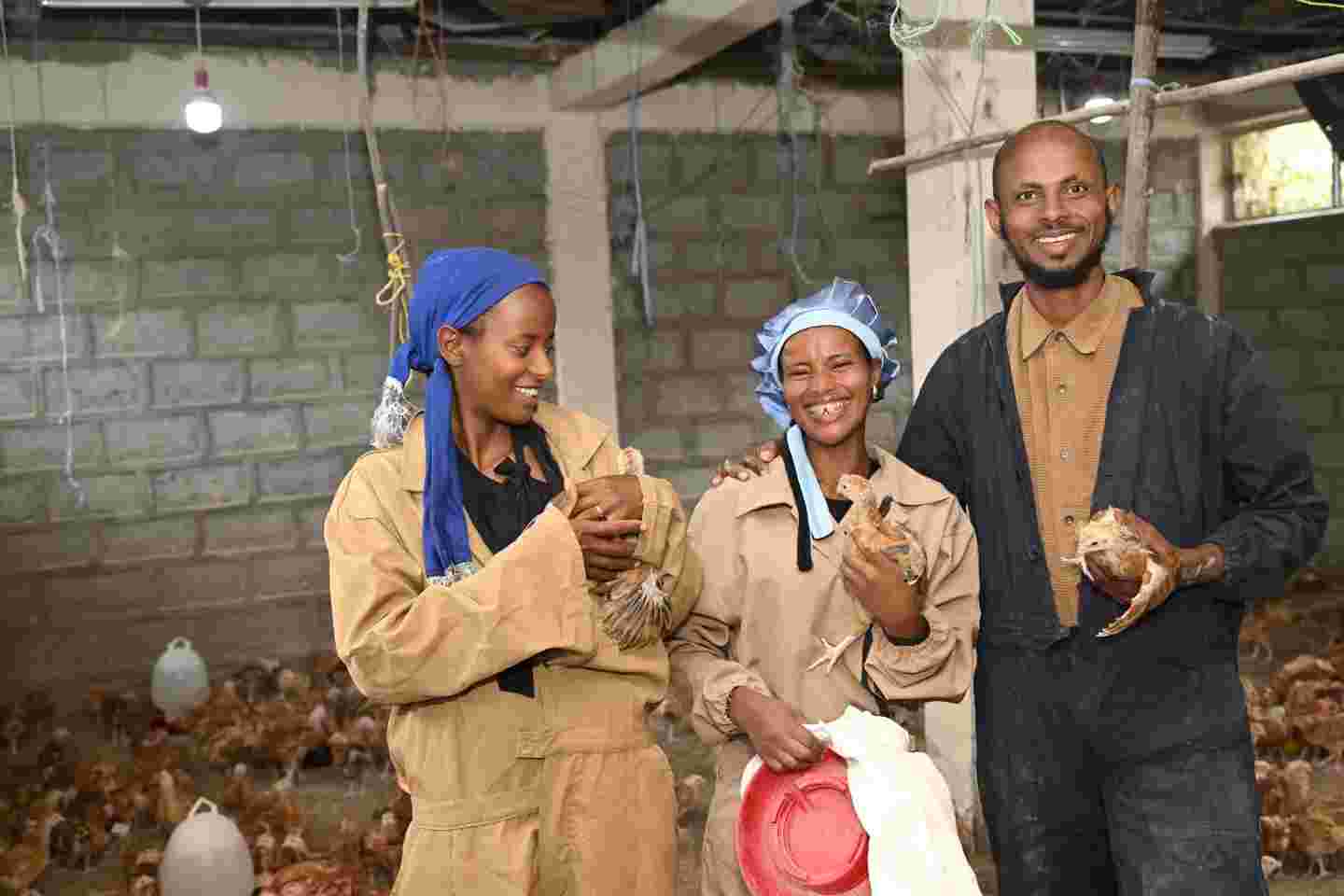
IT ALL began almost ten years ago in Lemi Kura Sub-City near Ethiopia’s capital, Addis Ababa, when Tolera Alemu and nine other young entrepreneurs came together around a shared ambition: to create their own employment opportunities and build a business that could grow with them jointly and through cooperation.
Like many youth-led initiatives, they faced the challenge of accessing working capital. Each entrepreneur contributed ETB 50,000, approximately US $320, for a total of ETB 500,000, or US $3200, to launch a poultry cooperative. Organizing collectively, they were able to mobilize resources and that’s how “Tolera, Yakob and Friends Poultry Farm Cooperative” was born.
Their cooperative then connected with International Labour Organization (ILO)-supported Live for Generation, an organization promoting youth participation, leadership, and decision-making in social, economic, and civic life. Live for Generation gave them additional capital, which they used to buy feed for their animals and vaccines to protect them from disease.
“Access to additional finance came at the right time for our growth,” said Tolera, the 32-year-old leader of the cooperative and father of one. “The support moved us forward.”
With improved cash flow, the “Tolera, Yakob and Friends Poultry Farm Cooperative” adopted a business model focused on purchasing newly born chicks, rearing them for a month and then reselling them. In its first production cycle, the cooperative purchased 1,200 chicks and earned a net profit of ETB 50,000 (approximately US$300), which the group reinvested by purchasing an additional 100 chicks.
The cooperative also expanded into egg production.
“We have a vision to grow together and supply quality products to our customers,” explained Tolera.
Building capacity, confidence and collective action
Alongside financing, members say follow-up and mentorship from the ILO-led initiative helped them stabilize operations and plan for growth.
Cooperative members work in shifts. They rotate responsibilities for feeding, watering, sanitation and temperature control, and they make key business decisions collectively and democratically, sharing risks, responsibilities and returns.
For 24-year-old Biftu Debia, an accounting student who was unemployed before joining, the initiative has brought economic and personal transformation.
“The support came at the time when we needed it most,” Biftu said. “They motivated us to believe in our capacity and to think about expanding this business to reach more customers.”
The experience also changed Biftu’s view of cooperative work. “In the past, I had heard it is hard to work as a group. I did not have a positive idea about cooperative formation,” she said. “But that attitude has changed now that I see it working practically. I understand that it is possible to work together peacefully and grow together.”
In the long term, the “Tolera, Yakob and Friends Poultry Farm Cooperative” plans to expand production, increase its income and diversify its activities. Members also hope that as the business grows, it will contribute to the local economy by creating more employment opportunities for young people in the community.
Rebuilding livelihoods through cooperation
Live for Generation is among youth-led organizations selected to mentor refugee and host community entrepreneurs. The initiative, the ‘ILO-Youth to Youth Fund’, is implemented with Edukans Ethiopia under PROSPECTS, a partnership between the ILO, the International Finance Corporation (IFC), UNHCR, UNICEF and the World Bank and supported by the Government of the Netherlands, which aims to improve the lives of host communities and refugees.
Since 1919, the ILO has promoted cooperatives as democratic, member-owned enterprises that advance decent work, social justice and inclusive development. In Ethiopia, the ILO is working with its Ethiopian partners to support cooperative development through policy advice, capacity building, and practical training.
