


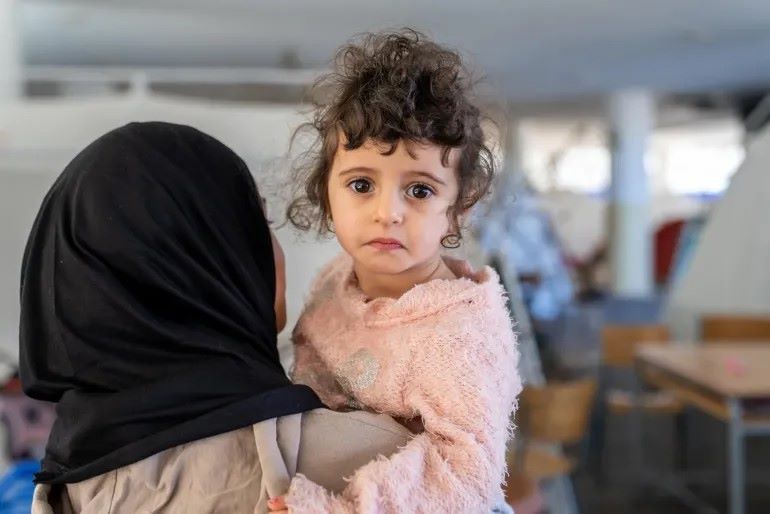
A MONTH into the military escalation in the Middle East, the conflict is exacting an increasingly devastating toll on children, with mounting casualties, mass displacement, and a growing risk of global supply disruptions that threaten vulnerable populations far beyond the region, UNICEF warned on Tuesday.
According to the latest figures from the United Nations children’s agency, more than 340 children have been killed and thousands more injured since hostilities began.
The reported casualties include 216 children killed and 1,767 injured in Iran, 124 killed and 413 injured in Lebanon, and four killed and 862 injured in Israel.

Additional child casualties have been recorded in Kuwait, Bahrain, and Jordan. The single deadliest incident involved a missile strike on the Shajareh Tayyebeh school in Iran on the first day of the war, which killed 168 children.
In the State of Palestine, including Gaza and the West Bank, ongoing violence over the same period has claimed the lives of 16 Palestinian children and injured more than 50.
“Children in the region are being exposed to horrific violence, while the very systems and services meant to keep them safe are coming under attack,” said UNICEF Executive Director, Catherine Russell. “Urgent action is needed by all parties to conflict to protect the lives of civilians and uphold the rights of children.”
Relentless attacks across multiple countries have damaged or destroyed critical infrastructure that children depend on, including hospitals, schools, and water and sanitation systems. More than 1.2 million children are now displaced across the region, with entire communities emptied by bombardment and evacuation orders.
Prolonged exposure to such violence and instability, UNICEF noted, can have lasting impacts on brain development, emotional regulation, and long-term mental health.
In Lebanon, the situation has deteriorated with alarming speed. In just three weeks, more than 370,000 children – an average of 19,000 per day – have been forced from their homes, representing roughly 20 per cent of the country’s population displaced in less than a month. Many families are now uprooted for the second, third, or fourth time.
“The speed and scale are staggering,” said Marcoluigi Corsi, UNICEF Representative in Lebanon. “This is a sudden, chaotic mass displacement, tearing families apart and hollowing out entire communities, with consequences that will reverberate long after the violence subsides.”
More than 135,000 internally displaced persons are sheltering in over 660 collective shelters across Lebanon, many in overcrowded and unsafe conditions.
The displacement has severely disrupted essential services: 435 public schools now function as shelters, abruptly halting the education of over 115,000 students.
In areas such as Bekaa and Baalbek, attacks on water infrastructure have cut off tens of thousands of people from safe water.
At least 121 children have been killed in Lebanon to date, with 395 injured, according to UNICEF.
Global Supply Chains Under Strain
The conflict’s impact is extending far beyond the Middle East. UNICEF estimates that disruptions across procurement, production, and transport caused by the hostilities could delay critical supplies to countries worldwide by up to six months. Projected increases of up to 20 per cent in global oil prices threaten to raise manufacturing costs for essential items such as vaccines and nutrition products, while port congestion and extended shipping routes are adding up to four weeks to transit times.
In response, UNICEF is activating alternative air, land, and sea routes, diversifying sources of life-saving supplies, frontloading procurement, and negotiating with transporters to cap excessive surcharges and prioritize humanitarian goods.
Emergency Response on the Ground
In Iran, at the request of the Ministry of Health, UNICEF is deploying pre-positioned health supplies, including mobile health units, primary health care tents, and emergency health kits, to restore essential services for approximately 226,000 people in affected areas. The support includes vaccines, primary health care supplies, and mental health and psychosocial support for children and adolescents.
In Lebanon, UNICEF has scaled up its emergency response to reach displaced families in collective shelters, host communities, and hard-to-reach areas.
Together with partners, the agency has expanded health services to include vaccination, neonatal, and paediatric intensive care in over 290 shelters, reaching more than 480,000 people in host communities.
UNICEF has also repaired 20 water and sanitation systems across the country, restoring reliable services for over 1.2 million people.
The agency’s Rapid Response Mechanism has reached over 167,000 displaced people with essential non-food items and winterization kits, while more than 140 tons of medical supplies have been delivered to hospitals.
UNICEF reiterated its call for an immediate cessation of hostilities and genuine de-escalation, urging all parties to exercise maximum restraint and to uphold international humanitarian law, which requires the protection of civilians and civilian infrastructure.
