


By Amos Aar
THE WORLD could save over $400 billion every year by prioritizing preventive eye care, according to Sightsavers, an international non-governmental organization dedicated to ending avoidable blindness and promoting disability inclusion globally.
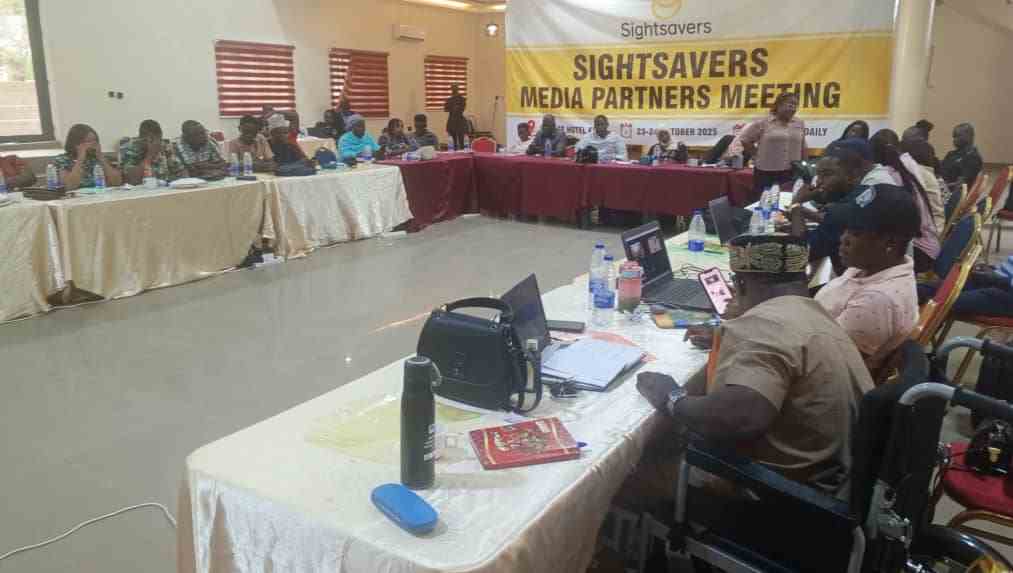
This revelation came during a two-day Media Partners’ Meeting organized by Sightsavers in Keffi, Nasarawa State, where journalists, programme officers, and inclusion advocates gathered to strengthen collaboration and develop new strategies for improving eye health and disability reporting in Nigeria.
Speaking on the economic cost of visual impairment, Barbara Mark, Programme Officer (Eye Health), painted a worrying picture of Nigeria’s eye health landscape. She revealed that only 4.4 percent of Nigerians currently have access to eye care services, compared to 38 percent in most middle-income countries.
“Globally, the world loses over $400 billion to visual impairment because when people lose sight, productivity drops. In Nigeria alone, we could inject up to $2 billion into our economy by 2030 if we address visual impairment,” she stated.
Mark explained that most causes of blindness, including cataracts, glaucoma, and uncorrected refractive errors, are preventable with early diagnosis and affordable care. She urged Nigerians to undergo eye checks at least once a year, even when they experience no visible problems, and called on the media to raise awareness on preventive eye health.
In a welcome address, Anita Gwom, Programme Director and Regional Liaison Manager (RLM), said the meeting aimed to deepen collaboration with the media to amplify Sightsavers’ work in eye health, disability inclusion, and the fight against neglected tropical diseases (NTDs).
She recalled that Sightsavers’ founder, Sir John Wilson, who was himself blind, established the organization in 1950 with the conviction that no one should live with preventable visual impairment.
“That vision has guided our work across Africa and Asia for over 70 years,” she said, adding that Sightsavers’ impact in Nigeria spans nine states in partnership with governments, NGOs, and local communities.
Since its founding, Sightsavers has grown into one of the world’s leading organizations in eye health and inclusion, operating in over 30 countries across Africa and South Asia. The organization also works to eliminate five major neglected tropical diseases: lymphatic filariasis (elephantiasis), river blindness (onchocerciasis), intestinal worms, schistosomiasis (bilharzia), and trachoma.
In Nigeria, Sightsavers’ operations date back to the 1950s with rehabilitation and river blindness research projects in Kaduna State. Through partnerships with the Federal Ministry of Health, the World Health Organization (WHO), and local governments, the organization has provided over 653 million NTD treatments nationwide.
As of 2024, Sightsavers has helped 84 local government areas achieve trachoma elimination thresholds and contributed 80 percent of national progress in the fight against the disease. Similarly, over 29 million Nigerians no longer require treatment for river blindness — a condition that once threatened millions of rural livelihoods.
Also addressing participants, Julius Omokhunu, Senior Media Officer (Inclusion), emphasized the media’s crucial role in advancing Nigeria’s inclusion agenda.
He urged journalists to adopt rights-based language when covering disability issues, moving away from charity-oriented narratives to stories that emphasize resilience, equality, and human rights.
“The media must tell the stories of people with disabilities from a position of strength, dignity, and agency,” Omokhunu said.
He further advised that terms such as “the disabled,” “handicapped,” or “victim” are outdated and demeaning. Instead, journalists should use person-first language like “people with disabilities” or “wheelchair users.” He added that Sightsavers’ media partnership is rooted in the principle of “nothing about us without us” — ensuring that people with disabilities are central voices in stories that concern them.
Other speakers, including Folake Aliu, Senior Manager for Monitoring, Evaluation and Learning, and Esther Bature, Country Advocacy Coordinator, highlighted Sightsavers’ contributions to public health, inclusive education, and economic empowerment through programmes such as Inclusive Futures — a UK Aid-funded initiative implemented across seven countries, including Nigeria.
They explained that Inclusive Futures seeks to ensure equal access to education, healthcare, and employment for people with disabilities, in line with the United Nations Convention on the Rights of Persons with Disabilities (UNCRPD).
Participants at the Keffi meeting agreed during their group presentations that eliminating avoidable blindness and promoting inclusion in Nigeria require stronger advocacy, data-driven programming, and consistent media collaboration. They noted that while Sightsavers has already achieved remarkable milestones, sustaining progress would depend on community ownership of programmes and continued media engagement.
The meeting ended with an optimism that with ongoing collaboration between Sightsavers, the government, and the media, Nigeria can look forward to a future where no one is left behind because of disability or visual impairment.
