


By Our Reporter, With Reports from Reuters and The Guardian
BRAZIL has handed Luiz Inácio Lula da Silva a historic fourth presidential term, but the victory was immediately overshadowed by the refusal of his right-wing opponent, Senator Flávio Bolsonaro, to concede defeat — reviving fears of another confrontation over the country’s electoral system.
Lula, 80, won Sunday’s runoff with 64.26 million votes, or 51.79% of valid ballots, against 59.83 million, or 48.21%, for Flávio Bolsonaro, the eldest son of former President Jair Bolsonaro. The result, certified by Brazil’s Superior Electoral Court (TSE), gives Lula a fourth non-consecutive term and makes him the first person elected president of Brazil four times through democratic elections.

The result was particularly striking because Flávio Bolsonaro had led the first round of voting earlier this month, taking 47.03% of valid votes to Lula’s 45.16%. Lula therefore became the first candidate in Brazil’s post-dictatorship democratic era to finish second in the first round and then win the presidency in the runoff.
Yet within hours of the TSE confirming Lula’s victory, Bolsonaro rejected the result.
The senator said it was “impossible to recognize” the election outcome and announced that his legal team would seek to have the vote annulled.
His principal objection concerns a late decision by Supreme Court Justice Cristiano Zanin to extend voting hours by two hours in areas affected by transportation problems and other disruptions.
Bolsonaro argued that extending voting after polling was supposed to have closed amounted to changing the rules during the election.
But the challenge faces significant obstacles. Bolsonaro’s own campaign had also sought an extension of voting hours because of heavy rains in parts of southern Brazil, while the TSE has maintained that measures taken to facilitate voting did not compromise the result.
The scale of Bolsonaro’s defeat also makes an annulment attempt difficult to sustain. Lula finished more than 4.4 million votes ahead, a margin large enough to make a successful legal challenge dependent on demonstrating serious irregularities capable of affecting the overall result.
The episode nevertheless carries considerable political weight because it echoes the conduct of Bolsonaro’s father, Jair Bolsonaro, after his defeat by Lula in the 2022 election. Jair Bolsonaro did not formally acknowledge the result and his supporters later mounted a violent attack on Brazil’s democratic institutions in Brasília. He was subsequently convicted in connection with a coup plot and is serving a 27-year sentence.
An Extraordinary Comeback
Lula’s victory represents one of the most remarkable reversals of his long political career.
The former metalworker and trade-union leader first won the presidency in 2002 after three unsuccessful campaigns. He served two consecutive terms before leaving office in 2010, then returned to the presidency after defeating Jair Bolsonaro in 2022.
His latest victory appeared uncertain only weeks ago. Flávio Bolsonaro emerged from the first round as the leading candidate, while Lula faced concerns over the cost of living, crime and dissatisfaction with his government. Bolsonaro’s first-round lead suggested that Brazil might join a broader regional movement toward conservative and right-wing governments.
Instead, Lula rebuilt his campaign for the runoff and succeeded in mobilizing enough voters to overturn the first-round result. Turnout also improved: abstention fell from 21.08% in the first round to roughly 19.2% in the runoff. More than 128 million voters participated in the second round.
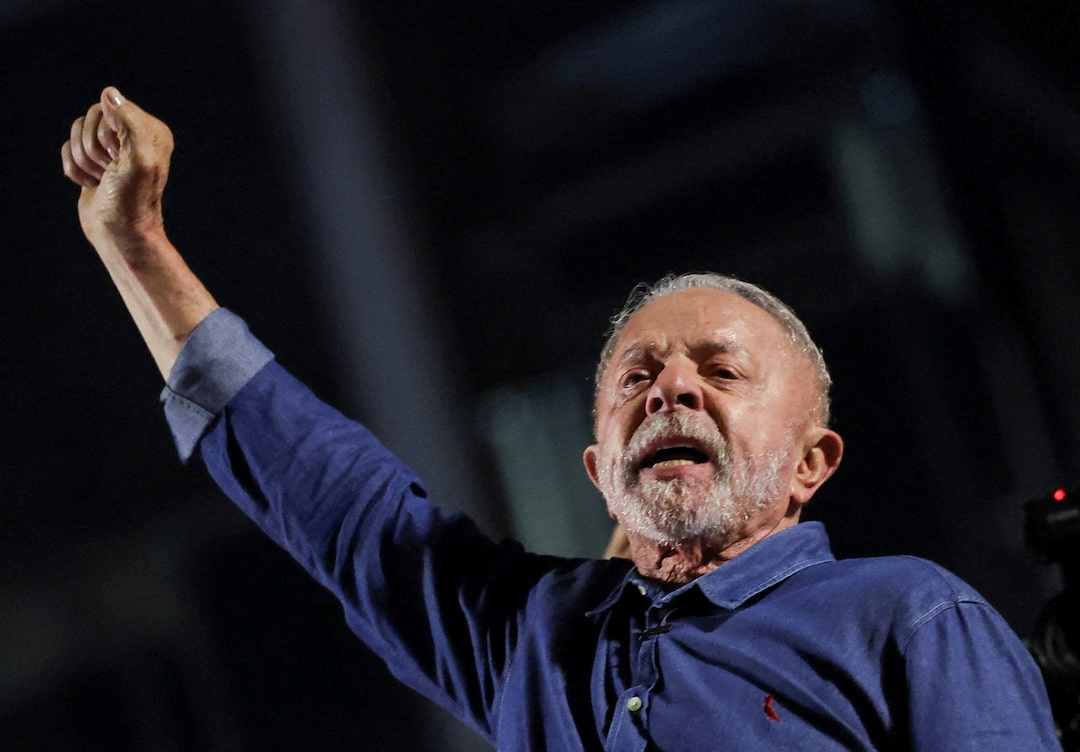
Lula presented the result as a rejection of political extremism and what he called denialism. In his victory speech, he promised to change the way Brazil is governed while stressing that his mandate would extend to people who did not vote for him.
His victory celebrations reflected the sharp political divisions exposed by the campaign. Supporters gathered in São Paulo and other cities, while Bolsonaro supporters expressed anger at the result and questioned the legitimacy of the electoral process.
A Divided Brazil
The election has demonstrated that Lula remains Brazil’s most formidable political figure, but it has also shown the strength of the political movement created by Jair Bolsonaro.
Flávio Bolsonaro’s 48.21% share represents tens of millions of Brazilians who continue to support the conservative political project associated with his family. His first-round victory and strong second-round performance also demonstrate that the Brazilian right remains a powerful force even without Jair Bolsonaro himself on the ballot. That reality will complicate Lula’s fourth term.
Brazil’s Congress has shifted substantially to the right, leaving Lula dependent on negotiation with political forces that are often hostile to his Workers’ Party. His administration will therefore have to balance an ambitious social and economic agenda against a legislature capable of blocking or diluting major initiatives.
The challenges are likely to include fiscal management, public security, the cost of living and the broader question of how Brazil can reduce political polarization after years of confrontation between supporters of Lula and Bolsonaro.
Economic policy may prove particularly important. Investors will be watching whether Lula’s government can combine increased social spending and development policies with credible fiscal management. Reuters reported that markets reacted negatively to the election result as investors reassessed their expectations for economic policy and the country’s fiscal outlook.
International Significance
Lula’s victory also carries implications well beyond Brazil.
The result interrupts, at least temporarily, a broader wave of electoral successes for right-wing and conservative forces across Latin America. It also preserves Lula’s role as one of the most prominent leaders of the global left and gives Brazil continuity in its emphasis on multilateral diplomacy, the BRICS grouping and environmental policy.
Foreign governments were quick to recognize the result. The international response contrasted with Bolsonaro’s refusal to accept it, underscoring the extent to which Lula’s victory has already been treated abroad as the legitimate outcome of Brazil’s electoral process.
The election also carries particular significance for relations with the United States. Flávio Bolsonaro’s campaign was closely associated with the political legacy of his father and the broader conservative movement that has maintained ties with President Donald Trump. Lula’s victory therefore represents a setback for that political alignment and could reinforce Brazil’s determination to pursue a more autonomous foreign policy.
For Brazil’s relations with Europe, China, Russia and other emerging powers, Lula’s return also means continuity in his preference for multilateral engagement and a foreign policy that seeks to increase Brazil’s influence among developing countries.
The Next Test
For Lula, however, the hardest part begins after the celebration.
He will take office for another four years with a country that remains deeply polarized and with an opposition that has demonstrated its ability to mobilize millions of voters. His government will have to translate an electoral victory of less than four percentage points into a workable governing coalition.
The refusal by Flávio Bolsonaro to concede adds another layer of uncertainty. While his legal challenge appears unlikely to overturn a result certified by Brazil’s electoral authorities, continued attacks on the legitimacy of the vote could deepen mistrust in institutions and potentially fuel protests.
Brazil has been through that cycle before. The 2022 election showed how quickly political disputes over electoral legitimacy could escalate into a broader democratic crisis.
Lula therefore enters his fourth term with both an extraordinary mandate and a formidable constraint: he has defeated the Bolsonaro camp at the ballot box, but he has not defeated the political movement it represents.
His victory is historic. Whether it becomes a durable political turning point will depend on what happens next — in Congress, in the economy, in Brazil’s streets and, above all, in the country’s ability to accept an election result without another confrontation over the rules of democracy.
“The challenges are countless,” said Carlos Melo, a political science professor at Insper in São Paulo.
