


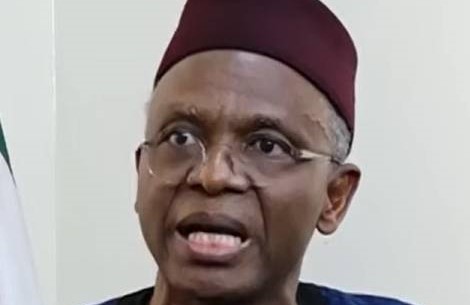
THE FEDERAL High Court in Abuja on Thursday allowed the Independent Corrupt Practices and Other Related Offences Commission (ICPC) to play portions of its Closed-Circuit Television (CCTV) footage in the N10 billion suit filed by former Kaduna State Governor Nasir El-Rufai.
Justice Chigozie Onah, ruling on separate applications filed by the ICPC and El-Rufai, declined the former governor’s request for the complete footage, which runs for more than six hours, to be played in open court.
The judge granted both parties 20 minutes each to play relevant portions of the footage in open court, saying the court could not be turned into a viewing centre.

Onah said the court did not have the luxury of time to watch the entire recording and agreed with the ICPC’s argument that some portions contained sensitive information that could expose its facility to security risks if shown publicly.
He said if the complete footage had to be viewed, it could be played in his chambers.
The judge also rejected El-Rufai’s request for two ICPC officials who deposed to affidavits in the commission’s processes to be produced for cross-examination.
He said fundamental rights enforcement proceedings are sui generis and are ordinarily determined on affidavit evidence, adding that the relief could therefore not be granted.
Onah also declined the other reliefs sought by the former governor.
“Both parties only have 20 minutes each to play part of the footage at 1pm in open court,” the judge said, noting that most lawyers and litigants would have left the court by then.
He adjourned the matter until Nov. 3 at 1 p.m. for definite hearing of the substantive applications.
El-Rufai instituted the suit, marked FHC/ABJ/CS/1852/2026, against the ICPC, its Chairman, Musa Aliyu, SAN, and the Attorney-General of the Federation as first to third respondents.
The former governor, through his counsel, Ubong Akpan, filed the suit on Aug. 13, seeking N10 billion in damages over the alleged denial of access to his wife, Mrs Aichatou Asabe, and son, Abba El-Rufai, while he was in the commission’s custody.
He is also seeking a declaration that his fundamental rights guaranteed under Part IV of the 1999 Constitution, as amended, remain in force notwithstanding his detention and must be respected.
In a joint counter-affidavit filed by the ICPC and its chairman, John Uche, a Chief Anti-Corruption Assistant in the commission’s Internal Security Support Unit, said several claims in El-Rufai’s affidavit were false.
Uche said El-Rufai was in the lawful custody of the commission pursuant to an order of the Federal High Court, Kaduna Judicial Division, in charge number FHC/KD/73C/2025.
He said that on July 7, in compliance with a Kaduna Federal High Court order permitting access to El-Rufai’s personal physician, the commission facilitated a medical visit accompanied by its officers and Asabe.
According to him, the commission later received reports that the medical visit had been turned into a political meeting, allegedly in breach of its security protocol.
He said the development prompted the commission to temporarily restrict non-essential access to El-Rufai while it reviewed its security arrangements.
Uche also alleged that El-Rufai’s son, Abba, arrived at the commission’s office on July 7 seeking access to his father but was prevented from entering the premises.
He said the incident was captured by CCTV cameras installed at strategic locations within and around the commission’s premises.
The officer further alleged that Asabe was smuggled into the commission’s premises on July 4, at about 7:35 p.m., after official visiting hours, with the connivance of some officers who were subsequently subjected to disciplinary proceedings.
He said the commission consequently suspended her visiting access pending the completion of its security review and implementation of appropriate measures.
In its application, the ICPC asked the court for permission to demonstrate portions of CCTV footage contained in a USB device attached to its counter-affidavit as Exhibit ICPC B.
The commission identified three portions of the footage as “The Scuffle,” “The Son Being Taken Away” and “Unauthorized Entry.”
It argued that the selected portions were relevant to the determination of disputed facts because they showed the events as they occurred and would enable the court to assess the sequence of events, the persons present and their conduct.
El-Rufai, however, asked the court to order the production of the complete, unedited CCTV recordings covering specified periods on June 7, July 4 and July 7.
He also sought the production of visitor registers, entry and exit records and other contemporaneous records of visits by Asabe and other members of his family.
The former governor further sought leave for Sadiq Baba, who certified Exhibit ICPC B, and Uche, who swore to the commission’s counter-affidavit, to attend court for questioning.
El-Rufai argued that the three clips produced by the ICPC did not establish that they represented all the recordings made during the relevant periods.
He also alleged that omitted portions of the July 7 footage showed events that contradicted the account contained in the ICPC’s counter-affidavit.
He argued that the June 7 recording would show that the ICPC invited Asabe onto its premises, while the July 4 footage would provide independent evidence to test the commission’s allegation that she had been “smuggled” into the facility.
El-Rufai also relied on provisions of the Constitution, the Evidence Act and the Fundamental Rights (Enforcement Procedure) Rules, 2009, in urging the court to order production and public playback of the recordings.
The ICPC opposed the application, arguing that playing the entire footage in open court could expose sensitive information about its facility and create security risks.
The commission maintained that, if the court considered it necessary to view the complete recording, it could be played in the judge’s chambers.
