


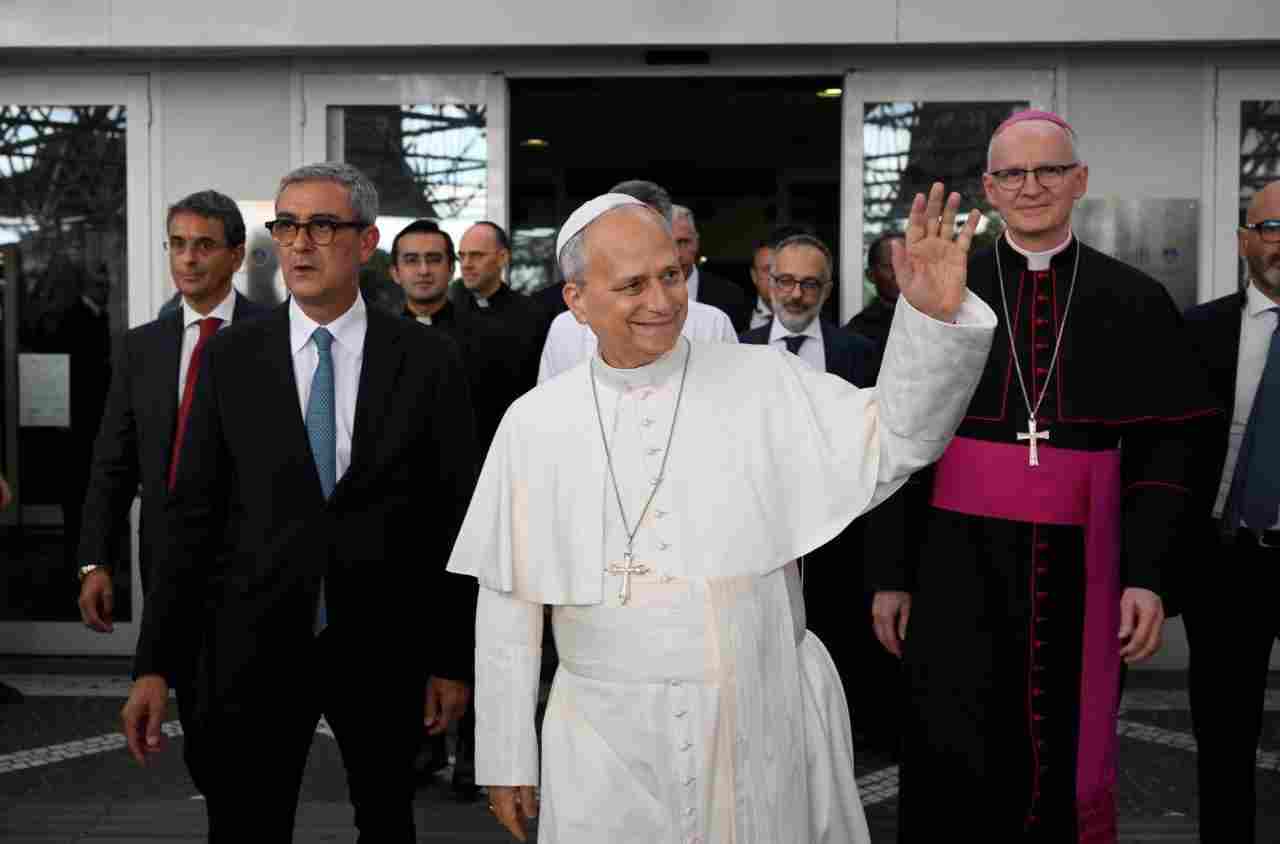
POPE Leo XIV returned to the Vatican on Saturday after being discharged from Rome’s Agostino Gemelli University Hospital, where he underwent surgery on his right lung earlier in the week.
The Pope was discharged Saturday afternoon after doctors determined that his clinical condition was satisfactory and that he was fit to leave hospital.
Before departing, he thanked Professor Stefano Margaritora, the surgeon who performed the operation, as well as the medical, nursing and other healthcare staff who cared for him during his stay.

The Holy See Press Office said the Pope also greeted healthcare staff, Professor Elena Beccalli, Rector of the Catholic University of the Sacred Heart, and the leadership of the Agostino Gemelli University Hospital.
The Press Office said Pope Leo is scheduled to recite the Angelus at noon on Sunday from the Apostolic Palace.
Earlier on Saturday, the Pope’s doctors, Dr. Luigi Carbone and Professor Margaritora, said blood tests and a chest X-ray carried out that morning confirmed that his condition allowed him to leave the hospital.
Before returning to the Vatican, Pope Leo celebrated Mass in the room designated for that purpose on the 10th floor of Gemelli Hospital.
Doctors Say Recovery is Progressing Normally
In an interview with Vatican News, Margaritora said Pope Leo was in an “entirely satisfactory clinical condition” when he was discharged. His blood tests were normal, his heart function was fine, and the re-expansion of his lung following surgery was progressing according to the usual timetable.
Margaritora, Professor of Thoracic Surgery at the Catholic University of the Sacred Heart and Director of the Thoracic Surgery Unit at the Agostino Gemelli University Hospital Foundation, said the operation had been performed without complications.
The surgeon described the procedure as routine from a medical standpoint. Because the tumor was located in the lower lobe of the Pope’s right lung, the entire affected lobe had to be removed.
“It would be dishonest of me to say it was very complicated in order to make it sound heroic,” Margaritora said, explaining that removing the lobe containing a lung tumor of that size was the standard procedure in similar cases.
He said he was very satisfied with the outcome of the operation and with the Pope’s postoperative recovery.
According to Margaritora, Pope Leo was highly motivated during his recovery, followed instructions concerning diet and physiotherapy, and repeatedly pushed himself to do more than was required of him.
The surgeon said the Pope would need about another 10 days to achieve a full physical recovery, based on the typical recovery period of roughly two weeks following such an operation.
No Medical Obstacle to Latin America Trip
Margaritora also said there was no clinical reason at present why Pope Leo should not undertake his planned visit to Latin America from November 6 to 17.
The trip is scheduled to take place about three weeks after the surgery and will involve long-distance air travel.
“Treating him as I would any other patient,” Margaritora said, he expected the Pope to be fully recovered in about another 10 days. Regarding the planned journey, he added: “I would say there are no clinical reasons why it should not take place.”
The assessment does not itself constitute an announcement that the trip will go ahead, but indicates that, from the surgeon’s medical perspective, the recovery is progressing in a way that would permit the demanding journey.
Lung Cancer Was Discovered Accidentally
The Pope’s malignant lung tumor was discovered by chance during examinations carried out for another medical reason, Margaritora said.
A small spot was detected at the base of the lung during routine abdominal examinations. The surgeon explained that the lower portions of the lungs can appear during radiological examinations of the abdomen because of the position and shape of the diaphragm.
Had the spot been located higher in the lung, he said, it would not necessarily have been visible during those examinations.
The discovery highlighted the importance of prevention and screening, particularly for people considered at risk, Margaritora said.
He noted that lung cancer can cause no symptoms in its early stages. In Pope Leo’s case, the cancer was found even though he had no respiratory symptoms and felt well.
Margaritora said the experience demonstrated why preventive checkups can be important, alongside established screening programs for other cancers.
Pope an “Ideal Patient”
The surgeon praised Pope Leo for his approach to recovery, describing him as an “ideal patient” who remained serene and smiling and rarely complained despite the pain associated with the operation.
The Pope followed the medical team’s instructions on diet and physiotherapy, Margaritora said, and was able to get back on his feet quickly.
The surgeon recalled that on the second day after the operation, members of the medical team found Pope Leo arranging chairs in the chapel himself.
When they offered to do it for him, the Pope replied that he could do it himself and therefore would do it.
Margaritora said the Pope’s determination contributed to his rapid progress.
He also thanked the wider team at Gemelli Hospital, including nurses, operating-room staff, laboratory and radiology technicians, physiotherapists and other healthcare professionals involved in the Pope’s care.
Surgery Carried Unusual Human and Personal Weight
Although Margaritora described the operation as medically routine, he said performing surgery on the Pope carried an extraordinary emotional weight.
He said he experienced what he described as “a deep feeling I cannot describe” because of the significance of the patient and the worldwide attention surrounding the operation.
Margaritora said the medical team had to approach the procedure as they would any other operation while also recognizing that they were operating on the Pope and on a malignant tumor.
He said Pope Leo was, in his view, the first Pope in modern history known to have undergone surgery for a malignant tumor.
The surgeon recalled that when Pope Leo entered the operating room before anesthesia, he was smiling and appeared down-to-earth.
Margaritora told him, “Holy Father, this is our dream team.”
The Pope smiled as the medical team began administering the anesthesia.Margaritora said the experience left him conscious of the distinction between the routine nature of the surgery medically and its extraordinary significance on a human level.
