



By Max Amuchie
EVERY serious intellectual undertaking eventually reaches a threshold where it can no longer rely entirely on inherited language. It must create its own vocabulary.
The three-month sprint that produced The Insecurity Triad, the Trinity of State Decay (TSD), and the Decoupling Sovereignty Index (DSI) crossed that threshold repeatedly. New realities demanded new concepts, and new concepts demanded new names.
Some of those names describe the architecture of collapse. Others describe the mechanisms that sustain it. Still others describe what recovery requires. Together, they form a vocabulary of sovereignty — its decay, its distortion, and its possible reconstruction.
Land is lost because institutions have weakened. Institutions weaken because citizens no longer trust them. Citizens withdraw their trust because the state can no longer protect the land. Each failure licenses the next. Each decay deepens the others. The trinity does not merely describe deterioration — it drives it.
The Grammar Beneath the Vocabulary
Before naming the concepts, it is worth naming the architecture that organises them.
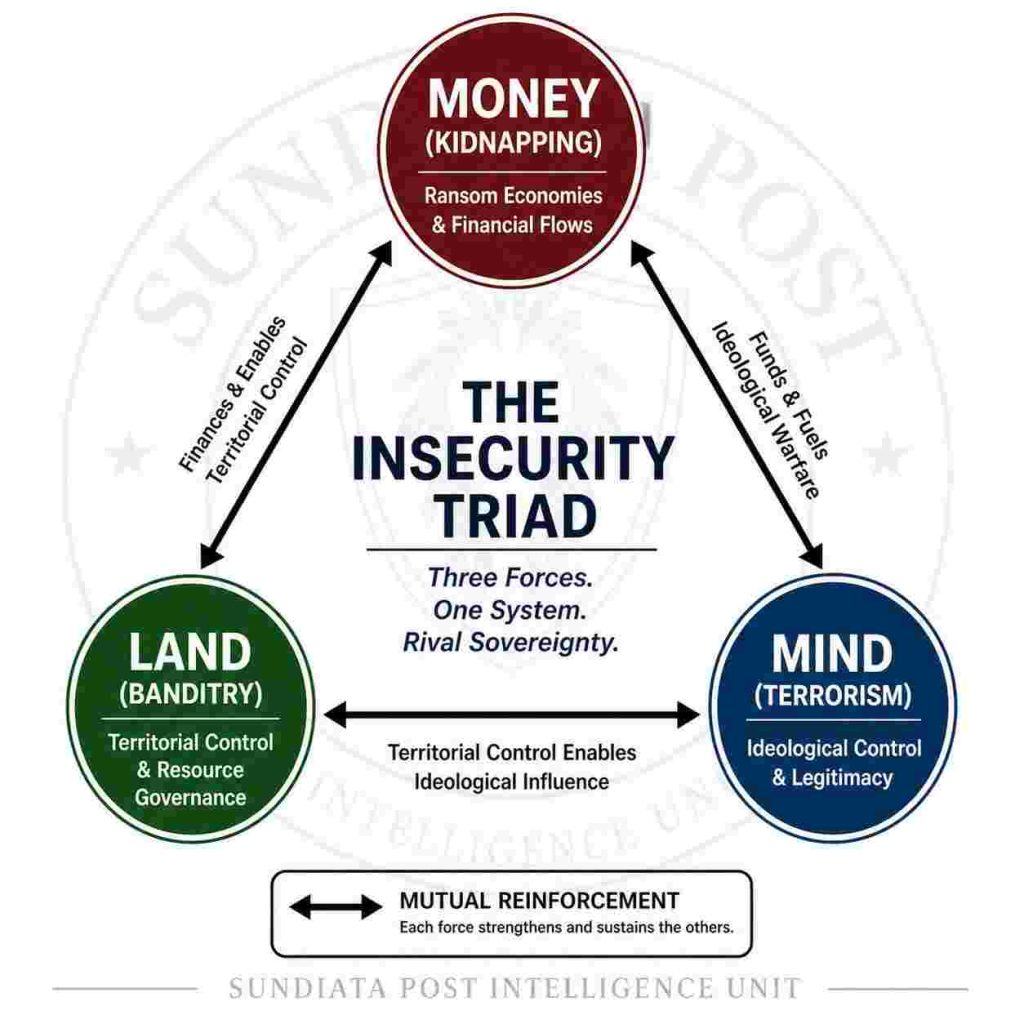
The Insecurity Triad identified three vectors through which rival sovereignty is produced: Money, Land, and Mind. Kidnapping finances violence through ransom economies — that is Money. Banditry governs territory and controls the means of production — that is Land. Terrorism reshapes the ideological order, rewriting who commands loyalty and who commands fear — that is Mind.
ALSO READ: Now, Nowhere Is Safe (2); By Hassan Gimba
These three vectors do not operate in isolation. They converge. And their convergence is what makes The Insecurity Triad a system rather than a catalogue of threats.
What the Trinity of State Decay reveals is what happens to a state when that convergence is sustained. Money drains the state’s fiscal and security capacity. Land slips from its territorial grip. Mind withdraws — citizens, communities, and eventually institutions themselves stop believing that the state is the relevant authority. The Trinity maps the structural consequences of what the Triad set in motion.
The Decoupling Sovereignty Index then asks the measurement question: how far has each vector decoupled? M1 tracks the Money dimension — the degree to which ransom economies and rival revenue systems have displaced the state. L tracks the Land dimension — the erosion of territorial authority and enforceability. M2 tracks the Mind dimension — the collapse of psychological allegiance and institutional legitimacy.
Every concept that follows in this column lives inside that architecture. The Institutional Mirage is what the Mind dimension produces at the level of governance. The Shadow Order is what Land and Money produce when they combine to constitute rival authority. The Ransom Economy is Money in its most organised form. Constitutional Erasure is Land rewritten at gunpoint. The Psychology of the Table is Mind in its most exclusionary expression.
ALSO READ: Our Sister, Ruth First; By Owei Lakemfa
Money. Land. Mind. That is the grammar. What follows is the vocabulary it generates.
The Architecture of Collapse
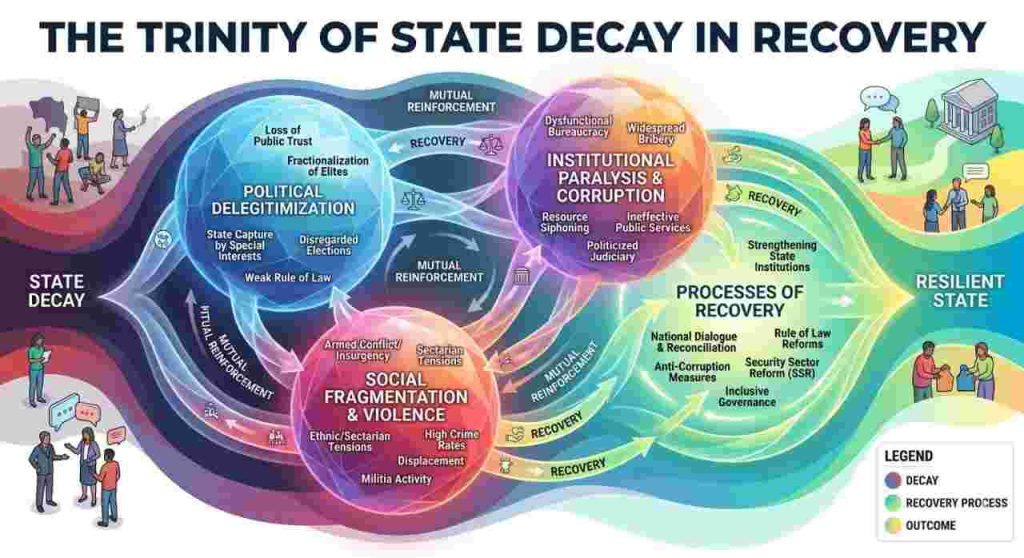
Among the formulations that emerged was the Trinity of State Decay.
Consider what happens when a state begins to lose its grip.
It does not lose one thing. It loses three — simultaneously, and in ways that accelerate each other.
Territory slips first, or perhaps institutions do, or perhaps the people withdraw their faith before either of the others move. The sequence varies. What does not vary is the convergence.
The first dimension is territorial: the state’s control of physical space becomes contested, fragmented, then absent in places it once claimed without effort.
The second is institutional: governance structures remain formally intact — ministries open, officials report, procedures are observed — but effectiveness drains away, and with it, public confidence.
The third is psychological: citizens stop believing. Not all at once. Not loudly. But progressively, they withdraw their emotional allegiance from the state and redirect their trust toward other identities, other authorities, other protections.
And then the loop closes.
ALSO READ: No Sheriff In Town So Bandits/Terrorists Kill As They Please; By Jibrin Ibrahim
Land is lost because institutions have weakened. Institutions weaken because citizens no longer trust them. Citizens withdraw their trust because the state can no longer protect the land.
Each failure licenses the next. Each decay deepens the others. The trinity does not merely describe deterioration — it drives it.
That is what makes it a trinity rather than a list.
But what fills the space that the decaying state vacates? Two concepts answer that question, and they must be understood together.
The first is the Institutional Mirage. When a state loses empirical authority — the actual capacity to protect, compel and deliver — its formal structures do not always disappear. They persist. Ministers are appointed. Budgets are passed. Ceremonies are conducted. The architecture of governance remains visible, sometimes impressively so. But it no longer functions as architecture. It functions as scenery.
The Institutional Mirage is the state performing sovereignty it no longer possesses.
The second concept is the Shadow Order. Into the spaces the Mirage cannot reach, alternative authority structures move. They may be armed groups, criminal networks, ethnic militias, or insurgent organisations. They collect their own revenues, enforce their own rules, and provide their own version of protection — however brutal or extractive. They do not merely fill a vacuum. They constitute a rival sovereignty.
The Institutional Mirage and the Shadow Order are not opposites. They are a system. One performs authority without possessing it. The other possesses authority without performing it in the language of the state. Together, they represent the decoupling at the heart of the Trinity of State Decay: the separation of juridical sovereignty from empirical sovereignty, of the state that exists on paper from the state that exists on the ground.
ALSO READ: Democracy, Power, And The Future Of Opposition Politics In Nigeria; By Lawan Musa Danlami
The Mechanisms of Sustenance
Collapse of this kind does not sustain itself through inertia alone. It requires mechanisms — arrangements, transactions and distortions that keep the system operational even as it deteriorates.
Three concepts describe these mechanisms.
States do not live merely through constitutions and coercive instruments. They also live through perceptions. They survive because people believe institutions matter, believe they belong at the table, and believe collective political life remains worth investing in.
The first is the Ransom Economy. In zones where the Shadow Order operates and the Institutional Mirage cannot reach, kidnapping ceases to be merely criminal. It becomes economic. Ransom payments circulate as a form of revenue — funding armed groups, sustaining supply chains of complicity, and generating employment in the logistics of abduction and negotiation. The Ransom Economy is not a disorder within the economy. In the territories where it operates, it is the economy.
ALSO READ: How Nigeria’s Political Elites Turned Politics Into Struggle For Power, Public Wealth; By Ivo Takor
The second mechanism is Pacification Bargaining. Faced with armed groups it cannot defeat militarily, the state — or the communities caught between the state and the Shadow Order — enters into informal negotiations. Cattle corridors are quietly conceded. Seasonal movements are permitted. Attacks pause in exchange for unspoken accommodations. The bargaining is never acknowledged publicly, because acknowledging it would require admitting the limits of state authority. But it happens. And each round of bargaining, however tactically rational, extends the life of the arrangement it was meant to manage.
The third is Constitutional Erasure. This is not a legal phenomenon. It does not occur in courtrooms or parliamentary chambers. It occurs on the ground, at gunpoint. This is, in the most precise sense, a Violent Amendment of the Constitution — not through any legitimate process of revision, but through the barrel of a gun. The armed group does not petition the state to redraw its map. It redraws it unilaterally, inscribing its own authority where the constitution once held.
Constitutional Erasure is the illegal process by which armed non-state actors unmake the official state map and replace it with their own sovereign order. Where the state’s constitution says one thing about who governs a territory, the gun says another — and the gun wins. The armed group does not merely occupy the space. It renames it. It redraws it. It inscribes its own authority onto territory that the constitution still claims but can no longer hold.
This is counter-constitutional inscription: a rival cartography written in violence.
The constitution remains on paper. But on the ground, a different document governs — unwritten, unratified, enforced by the threat of death. What is erased is not the text of the state’s founding law but the physical reality it was meant to describe.
The Psychology of Recognition
Beneath the structural and economic dimensions of decay lies something harder to measure but no less consequential: the question of who belongs.
Political power is frequently imagined through offices, armies and constitutions. Yet societies often possess another, less visible metric of authority.
Who sits at the table?
Who is invited?
Who is absent?
The Architecture of Resurrection
Perhaps the most hopeful formulation to emerge from the sprint was the idea of the Architecture of Resurrection.
ALSO READ: The Wait’s Over, Arsenal Has Finally Delivered: In Memory Of Oga Duro
Most analyses of state fragility devote considerable attention to decline and collapse. Far less attention is given to recovery. Yet history repeatedly demonstrates that societies possess remarkable capacities for renewal.
The Architecture of Resurrection refers to the institutional, psychological and political design necessary for rebuilding state effectiveness and legitimacy after periods of profound disruption.
Resurrection is not restoration.
A building that has partially collapsed cannot simply be painted and declared repaired. It requires redesign. Its foundations must be reassessed. Structural weaknesses must be corrected. New load-bearing systems must be introduced.
The Trinity of State Decay reveals the multidimensional nature of collapse. The Institutional Mirage and the Shadow Order name the twin faces of decoupled sovereignty. The Ransom Economy, Pacification Bargaining and Constitutional Erasure describe the mechanisms that sustain it. The Architecture of Resurrection directs attention toward the design principles of renewal.
The same principle applies to states.
The Architecture of Resurrection therefore concerns the deliberate reconstruction of authority, trust and institutional capability. It asks difficult questions:
How is territorial control re-established?
How is confidence in institutions rebuilt?
How are psychologically alienated populations reintegrated into a common political project?
ALSO READ: Trump Asked Questions Of Iran When He Did Not Know The Answers; By Lindsay Newman
How does sovereignty become recoupled — the Institutional Mirage dissolved into functional authority, the Shadow Order displaced, the Ransom Economy dismantled, Pacification Bargaining replaced by genuine security provision, Constitutional Erasure reversed by the renewed enforceability of rights?
How are communities that have been excluded from the table brought back — not as afterthoughts but as constitutive members of the political project?
The metaphor is intentionally architectural because durable recovery requires design, sequencing and structural coherence. Political resurrection cannot be improvised.
These concepts did not emerge in isolation. They emerged in conversation with one another— each one clarifying, qualifying or extending the others.
States do not live merely through constitutions and coercive instruments. They also live through perceptions. They survive because people believe institutions matter, believe they belong at the table, and believe collective political life remains worth investing in.
Conversely, states decay when these sustaining beliefs weaken—when the Institutional Mirage replaces genuine authority; when the Shadow Order occupies the spaces the state has abandoned; when the Ransom Economy becomes normalised; when Pacification Bargaining substitutes for security provision; when Constitutional Erasure progressively empties the law of its force; and when the Psychology of the Table degenerates into a psychology of permanent exclusion.
That is why vocabulary matters. These are not merely descriptive terms; they are diagnostic concepts that identify the mechanisms through which sovereignty decouples from authority and states slide along the continuum of decay.
The Trinity of State Decay reveals the multidimensional nature of collapse. The Institutional Mirage and the Shadow Order name the twin faces of decoupled sovereignty. The Ransom Economy, Pacification Bargaining and Constitutional Erasure describe the mechanisms that sustain it. The Architecture of Resurrection directs attention toward the design principles of renewal.
Together, they demonstrate that scholarship is not simply the accumulation of information. It is also the invention of language capable of capturing realities that old vocabularies struggle to describe.
For sometimes the first step toward understanding a crisis is learning to name it.
And sometimes the first step toward renewal is discovering the words that make recovery imaginable.
Trust is sacred. Stay seasoned.
Dr. Amuchie is an Independent Scholar-Journalist, Media CEO, and Lead Researcher at the Sundiata Post Intelligence Unit (SPIU). He writes The Sunday Stew, a weekly syndicated column on faith, character, and the structural forces that shape society, with a focus on Nigeria, Africa, and the Global South in a changing world. X (formerly Twitter): @MaxAmuchie | Email: max.a@sundiatapost.com | Tel: +234(0)8053069436
