


- Apologises For Slavery, Condemns Algorithmic Warfare, Demands Civilisation Of Love
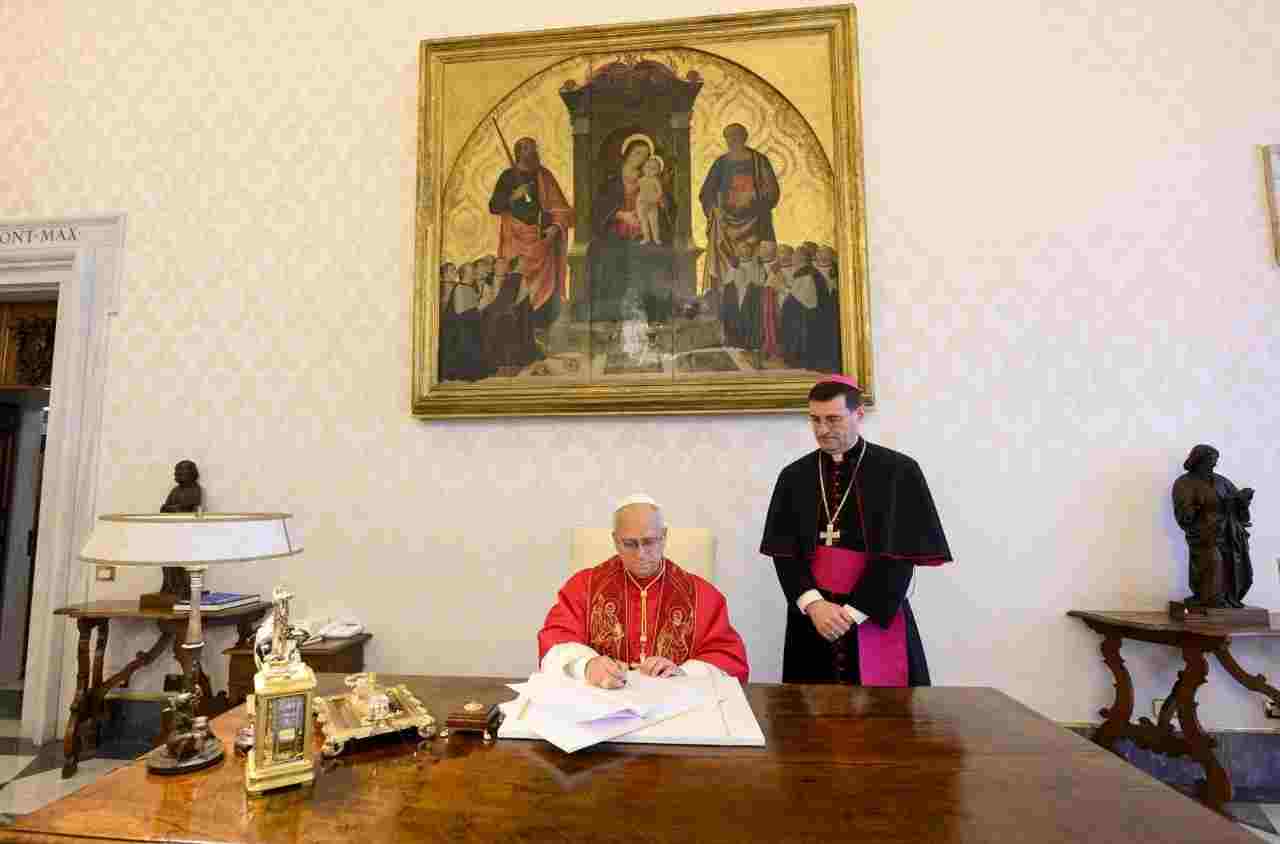
IN HIS first encyclical released Monday, Pope Leo XIV has called on world leaders to regulate artificial intelligence with urgency and moral clarity, warning that autonomous weapons systems have already advanced “practically beyond any human reach to govern them” and that without immediate action, humanity risks constructing a new Tower of Babel rather than a civilisation of love.
The 43,000-word document, titled: “Magnifica humanitas: On Safeguarding the Human Person in the Time of Artificial Intelligence” and subtitled: “Magnificent Humanity,” was signed by the pontiff on May 15, the 135th anniversary of Pope Leo XIII’s landmark social encyclical Rerum novarum.
Released to the public on Monday, it represents the first U.S. pope’s most significant teaching document since his election just over a year ago.
“Humanity, created by God in all its grandeur, is today facing a pivotal choice: either to construct a new Tower of Babel or to build the city in which God and humanity dwell together,” Leo writes in the encyclical’s opening words, invoking the biblical story of a prideful civilisation that angered God by attempting to reach heaven without divine blessing.
Pope Leo calls for a renewal of labour organisations and insists that technology must not lead to unemployment in the name of reducing costs and increasing profit.
The document, divided into five chapters, rejects both technological determinism and Luddite fear. “Technology is not a force antagonistic to humanity,” the pope writes, “nor is it inherently evil.” But he adds a crucial caveat: “Technology is never neutral, because it takes on the characteristics of those who devise, finance, regulate, and use it.”
‘What is needed is a more active political involvement’
Speaking at a Vatican event launching the encyclical, attended by Chris Olah, co-founder of the leading AI company Anthropic, Leo adopted a noticeably forceful tone that has in recent months drawn the ire of U.S. President Donald Trump following the pope’s criticism of the Iran war.
“What is needed is a more active political involvement that is capable of slowing things down when everything is accelerating,” the pope said, calling for “robust legal frameworks, independent oversight, informed users and a political system that does not abdicate its responsibility.”
Olah thanked the pontiff for addressing the disruptive technology’s challenges, acknowledging that “every frontier AI lab, including Anthropic, operates inside a set of incentives and constraints that can sometimes conflict with doing the right thing.”
Disarming AI and rejecting the ‘technocratic paradigm’
The encyclical’s third chapter, “Technology and Dominance,” warns forcefully against what Pope Francis previously called the “technocratic paradigm” – the assumption that efficiency and profit should dictate every choice. AI can imitate and simulate the human person, Leo writes, but it possesses no moral conscience, empathy, or spiritual capability.
“A more moral AI is not enough if that morality is determined by a few,” the pope insists, calling for an ethical code subject to shared standards of social justice.
Perhaps most strikingly, Leo demands that artificial intelligence be “disarmed” – not in the sense of physical destruction, but by “discrediting the assumption that technical power automatically confers the right to govern.”
He warns against transhumanism and posthumanism, ideologies that interpret progress as the overcoming of human limits. “Humanity flourishes not despite limitations, but often through them,” he writes.
Repudiating the ‘just war’ doctrine
In what may be the encyclical’s most controversial passage for some Catholic traditionalists and Trump administration officials – including Vice President JD Vance, a Catholic who has invoked just war theory to defend the Iran war – Leo explicitly declares that the centuries-old doctrine is “now outdated.”
“The ‘just war’ theory which has all too often been used to justify any kind of war is now outdated,” the pope writes. “There is no algorithm that can make war morally acceptable. AI does not remove the intrinsic inhumanity of conflict; indeed, it can only bring about conflict more quickly and render it more impersonal, lowering the threshold for resorting to violence, transforming defense into threat prediction and thus reducing victims to data.”
The pope warns that leaders might cynically start wars to distract from domestic problems, stating bluntly: “We cannot rule out the possibility that some leaders may consider armed conflict as an effective way of diverting attention from domestic problems and a cynical tool for managing difficulties.”
An apology for slavery and new forms of exploitation
In a striking passage of institutional repentance, Leo acknowledges the Catholic Church’s historical failure to condemn transatlantic slavery until the 19th century. “This constitutes a wound in Christian memory,” he writes. “For this, in the name of the Church, I sincerely ask for pardon.”
The apology comes within a broader condemnation of what Leo calls “new forms of slavery” linked directly to the digital economy.
The Pope calls for “profound reforms” of the United Nations to overcome the current crisis of values and hopes for renewed interreligious dialogue, insisting that “those who use the name of God to legitimize terrorism, violence or war betray his true nature.”
He describes the extraction of rare earth elements – essential for computers, smartphones, and AI infrastructure – as leaving bodies “scarred, injured and worn down so that computational flow may continue uninterruptedly.” In some regions, he adds, “children and adolescents work in dangerous conditions, crushing the materials from which rare earth elements are extracted.”
The pope also identifies a “new face of colonialism” in which personal data – on health, demographics, and behaviour – is harvested from vulnerable populations to guide economic strategies, turning the digital environment into “a space of exploitation.”
Migrants as ‘litmus test’ and the dignity of work
Across five chapters, the encyclical applies traditional Catholic social teaching – the dignity of the person, the universal destination of goods, solidarity, subsidiarity, and social justice – to the digital age. Leo identifies migrants, refugees, and displaced persons as a “litmus test” for social justice: “The way society treats migrants reveals whether its sense of justice is driven by fear or by the spirit of fraternity.”
On labour, the pope warns that “the ‘new ways’ of working are not necessarily better,” observing that “AI promises to boost productivity by taking over mundane tasks, yet it frequently forces workers to adapt to the speed and demands of machines, rather than machines being designed to support those who work.”
Pope Leo calls for a renewal of labour organisations and insists that technology must not lead to unemployment in the name of reducing costs and increasing profit.
The family, which Leo describes as “founded on the stable union between a man and a woman,” is upheld as a “primary social good” and “the fundamental and irreplaceable cell of every community organization.”
An ‘ecology of communication’ and the crisis of multilateralism
The fourth chapter calls for an “ecology of communication” based on truth, urging transparency in content selection, protection of personal data, serious journalism, and renewed attention to schools as places where young people “learn to seek and love the truth.”
The pope criticises the “architecture of visibility” on digital platforms, which amplifies only what is visible and shapes opinions, warning that profiling and algorithmic prediction constitute “a new form of power” that risks discriminating against the weakest.
In the final chapter, Leo laments the crisis of multilateralism and the emergence of “a disorderly and conflict-ridden multipolarism” where the rule of law has been replaced by the law of the strongest.
The Pope calls for “profound reforms” of the United Nations to overcome the current crisis of values and hopes for renewed interreligious dialogue, insisting that “those who use the name of God to legitimize terrorism, violence or war betray his true nature.”
‘No one is without responsibility’
The encyclical concludes with an exhortation to hope rather than resignation. “A subtle temptation may emerge, namely the thought that the problems are too big and we are too small, and that our choices, therefore, cannot make a difference,” Leo writes. “Certainly, not everyone has the same power to make a difference. Yet, no one is without responsibility. We all have our own areas for action.”
Even in the age of AI, the pope concludes, “we may bear witness to the grandeur of humanity, in which God has made His dwelling.”
