


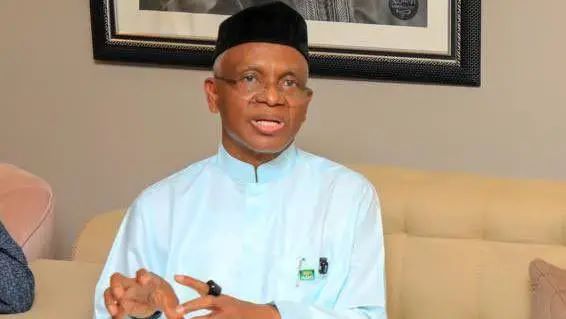
FORMER Vice President Atiku Abubakar has expressed grave concern over the detention of former Kaduna State Governor, Nasir el-Rufai, demanding transparency from the Federal Government regarding his whereabouts, health condition, and the agency holding him in custody.
In a statement posted on his verified Facebook page on Tuesday, Atiku described reports that el-Rufai suffered a nosebleed in detention while family members were allegedly denied access to him as “deeply troubling and unacceptable in a democracy.”
“The health and welfare of Nasir El-Rufai is a matter of grave concern to his family, friends, and associates,” Atiku wrote, calling on the Federal Government to provide immediate clarification.

He insisted that the government must state clearly which agency is holding the former governor – whether the Economic and Financial Crimes Commission (EFCC), the Independent Corrupt Practices Commission (ICPC), the State Security Service (SSS), or any other arm of the security establishment.
“Secrecy in matters of detention only fuels suspicion. Nigerians deserve transparency,” Atiku asserted.
The former Vice President emphasised that whichever agency is responsible has a constitutional obligation to guarantee el-Rufai’s safety, dignity, access to medical care, and access to his family and legal representatives.
“If the authorities cannot guarantee his health and fundamental rights, the lawful and humane course of action is to grant him bail without delay,” Atiku stated, warning: “If anything happens to El-Rufai, this government will be held accountable”.
Atiku’s reaction follows allegations by Muyiwa Adekeye, media aide to el-Rufai, that the former governor suffered a nosebleed while in EFCC custody.
Adekeye had earlier disclosed that el-Rufai was interrogated and granted administrative bail, but remained in detention as his legal team sought a variation of the bail conditions. He alleged that on February 17, “one of his wives was not allowed to deliver his meal directly to him, but was asked to pass it to him through one of the commission’s personnel.”
The media aide further claimed that el-Rufai’s lawyers reported that he “suffered an overnight episode of bleeding from his nose” while in custody. On February 18, El-Rufai was transferred without prior notice from EFCC custody to the ICPC.
El-Rufai has been in detention since February 9, when he was first taken into custody by the EFCC over alleged corruption during his tenure as Kaduna State governor from 2015 to 2023.
An EFCC source quoted by The Sun newspaper reported said that investigations involving the former governor are still ongoing, adding that he has not been charged in court because “investigations are not yet concluded”.
After being granted administrative bail by the EFCC on February 18, el-Rufai was immediately taken into custody by the ICPC.
ICPC spokesperson, John Odey, confirmed the development, stating simply: “Malam Nasiru El-Rufai is in the custody of the commission in connection with ongoing investigations”.
The Department of State Services (DSS) has filed a three-count criminal charge against el-Rufai over alleged cybercrime and breach of national security. The DSS accuses him of unlawfully intercepting telephone communications of the National Security Adviser, Nuhu Ribadu, an offence allegedly admitted during a television interview on February 13.
The DSS is scheduled to arraign el-Rufai on Wednesday, February 25 before the Federal High Court in Abuja.
Beyond the immediate health and welfare concerns, Atiku warned against what he described as a “growing perception of selective prosecution” in the government’s anti-corruption drive.
“More troubling, however, is the growing perception of selective prosecution, in which opposition figures are aggressively pursued while others are conspicuously shielded from investigation or interrogation. Anti-corruption must not become a political weapon,” he said.
Atiku added that the continued detention of El-Rufai “under unclear circumstances raises serious questions about motive,” stressing that anti-corruption efforts must not appear “partisan, coercive, or strategically timed”.
“Justice must be transparent. Accountability must be even-handed. And the rule of law must apply to all; without fear, without favour, and without political bias,” the former Vice President concluded.
