


- NLC Highlights ‘Financial Insecurity’ Of Workers in Talks With President
BY Our Reporter, with Agency Reports
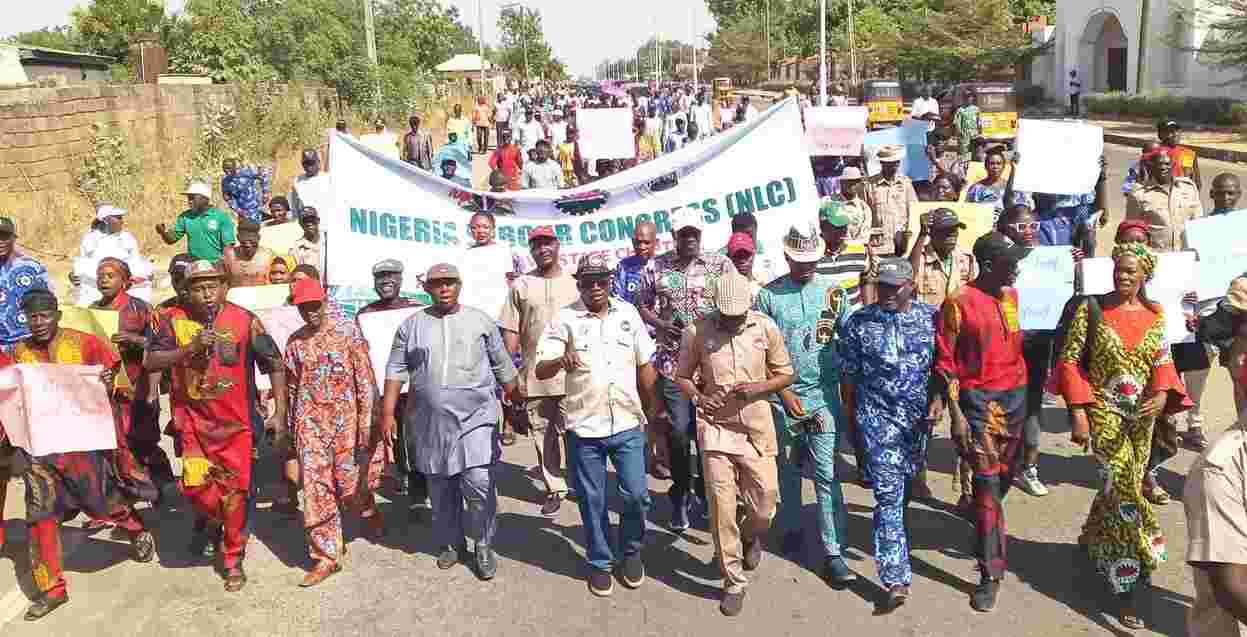
THE NIGERIA Labour Congress (NLC) carried out its planned peaceful protests across several states on Wednesday, December 17, 2025 even as its leadership held a series of high-level meetings with President Bola Tinubu and state governors aimed at addressing the nation’s security crisis and workers’ welfare.
The protests, declared earlier in the month over what the foremost labour centre in Nigeria termed the country’s “degenerating security situation,” proceeded in states including Kano and Adamawa.

However, the nationwide action unfolded alongside a flurry of negotiations at the instance of the Nigerian Presidency in Abuja, where NLC President, Comrade Joe Ajaero, led a team of labour leaders to meet with President Bola Ahmed Tinubu on Tuesday night and with the Chairman of the Progressive Governors’ Forum (PGF), Hope Uzodimma, on Wednesday.
Following the closed-door meeting at the State House, Comrade Ajaero disclosed highlights of the discussions, which he said centred on national security and the “financial insecurity” of Nigerian workers.
“A worker that is not well fed and not well paid will have even more problems than the ones that are well fed and well paid,” Ajaero stated, adding that President Tinubu was “emphatic that the issue of insecurity will be a thing of the past very soon”.
He also noted that the president had committed to further discussions in January on economic prosperity.
While the NLC leadership engaged with the Federal Government, NLC state councils proceeded with coordinated rallies.
In Kano, NLC officials submitted a formal letter on security to the State Government, represented by Chief of Staff to the governor, Dr Suleiman Wali.
The state government praised the protest as evidence of constructive engagement and harmony with labour.
Similarly, in Adamawa, NLC members held a peaceful march in Yola, urging the Federal Government to intensify efforts to end kidnapping and the abduction of students.
The state chairman emphasised that security is a collective responsibility and called for improved conditions for both citizens and security personnel.
Despite the protests proceeding, Governor Uzodimma, who facilitated Wednesday’s follow-up meeting, indicated a significant de-escalation in the spate of insecurity.
He announced that a channel for regular engagement had been opened and that “all parties are on the same page,” with previous issues “cleared.” He expressed gratitude for the maturity exhibited by the NLC.
Uzodimma said: “President Bola Tinubu met last night with the leadership of NLC. They discussed issues of the Nigerian economy, issues of welfare of workers and the various reforms going on; and also issues of national security and other developments in the country, and all of them agreed.
“National unity is very critical and our national interest is also very important. And the march towards economic prosperity by the president is a welcome idea. At the end of the meeting, we also discovered that there is a need for regular engagements with the Nigeria Labour Congress.
“For now, both the government and labour are on the same page to ensure that Nigeria is better protected and more investments in the areas of security should be encouraged. And the president’s programmes to secure Nigeria and the entire space should also be supported.”
Comrade Ajaero, however, stopped short of declaring the protests suspended, noting that the action for Wednesday had already commenced. He stated that the union’s National Executive Council would review the outcomes of the government engagements.
“We are going back to our members now, and then we will get back to them. But today (Wednesday) is gone and our action is not an indefinite one. It’s a protest. The issue of suspension is not there because the action has taken off this morning,” Ajaero said, deferring a final decision on the protest action to the statutory organs of the NLC.
The developments suggest a dual-track approach by the NLC: maintaining pressure through symbolic peaceful demonstrations while pursuing high-level dialogue on systemic issues of security and workers’ economic welfare.
