


By Amos Aar
THE BENUE State Primary Health Care Board (SPHCB) has said that it is set to vaccinate over one million children across the state against measles and rubella as part of a nationwide campaign aimed at curbing the rising spread of the disease.
The statewide campaign, which is scheduled to hold from October 18 to 27, 2025, targets children aged nine months to fourteen years and is being implemented with technical support from the United Nations Children’s Fund (UNICEF), the World Health Organization (WHO), the National Primary Health Care Development Agency (NPHCDA), and other partners.
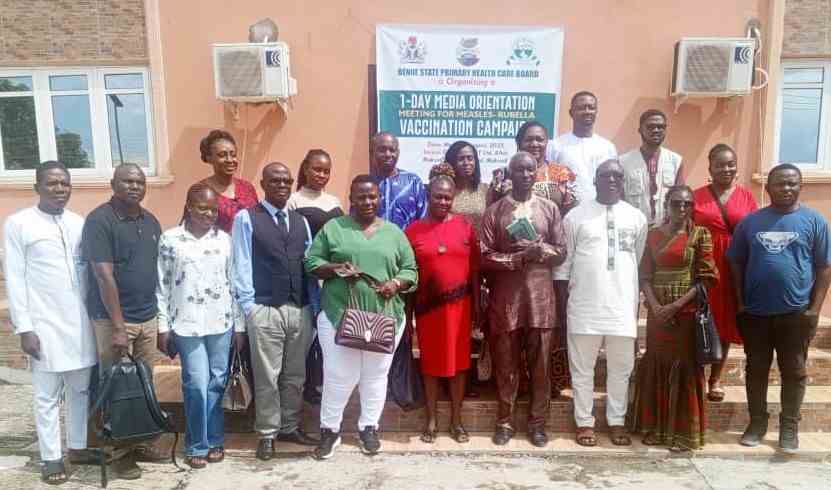
During a one-day media orientation held in Makurdi, the Assistant State Health Educator at the SPHCB, Mrs. Nancy Mkende, disclosed that “the targeted population in the exercise is 1,221,107 and the number of teams to embark on the exercise is 712 made up of a team of six.” She added that the total number of measles vaccines collected by the state stands at 1,282,340.
While some reports indicate a broader target of up to three million children in the age bracket, the campaign in Benue is aligned with a national strategy to address outbreaks recorded in at least 386 local government areas across 37 states as of epidemiological week 15 of 2025.
Also speaking during the orientation, the State Immunisation Officer, Mr. Innocent Adega, said Benue is fully prepared to begin the exercise. According to him, “already we have commenced advocacy visits and we have met the officials of the Ministry of Education for advocacy to schools. Letters would soon be sent to the schools for visits to commence.”
On her part, the Technical Officer for WHO in charge of Measles, Yellow Fever, and Meningitis A Campaigns in Enugu, Dr. Ndubuisi Ebita, assured of the potency and safety of the vaccines to be deployed. He said, the vaccines will be carried in ice packs and after six hours of opening any of the vaccines it is discarded whether used or not. Also, the period will witness an integrated exercise. “This means that aside measles vaccines, the vaccinators will also carry along other vaccines so that where it is discovered that children in any community are not vaccinated against other diseases, they will get vaccinated.”
Dr. Aaron Kwarbai, another WHO Technical Officer, disclosed that Benue is among the first batch of states to benefit from the new rollout of the Measles-Rubella vaccine being introduced for the first time in Nigeria. He emphasized the need for protecting children from the virus, saying Measles-Rubella, also known as German measles, can cause severe disorders in afflicted children.
Stressing the need for publicity in the campaign against the disease, UNICEF’s Social and Behaviour Change Specialist from the Enugu Field Office, Dr. Hilary Ozoh, said the media is central to the success of the campaign. “We know the role the media plays in agenda setting and opinion moulding, that is why the media is key to the campaign to have our children vaccinated”, he said.
Echoing that call, UNICEF State Consultant for Social and Behaviour Change, Victor Olaniyi, said the success of the upcoming measles Rubella vaccination largely depends on the media “as it reaches millions of people, shapes public perception and trust in the vaccine as well as counters misinformation and the mismanagement of information.”
He urged journalists to actively enlighten the public, create awareness, engage in myth busting, mobilization, and provide feedback from the field, stressing that the role of the media is “key in achieving the objective of the campaign.”
The Executive Secretary of the SPHCB, Mrs. Grace Ashi Wende, represented at the event by Mr. Adega, appealed for robust media collaboration. “The media is an important tool for positive behavioural change, so we urge you to help mobilise the people to embrace the exercise,” she said.
Similarly, the State Technical Assistant from the International Vaccine Access Center, Victoria Oladejo, and the State Health Educator, Mr. Emmanuel Beeka, called on the media to give their best to ensure widespread coverage. Mr. Beeka said, “the only way the message can get to the people is through the media,” describing it as “a powerful tool in behavioural change,” and appealing to media practitioners “to always ensure that the right message is passed during the exercise.”
In separate goodwill messages, representatives of JSI, the NPHCDA, HVAC, and other partners also reiterated the importance of timely and accurate media engagement to ensure the success of the mass vaccination effort.
With ongoing measles outbreaks across the country and new cases reported in over 30 LGAs as of mid-April 2025, health officials say urgent mass immunization remains the most effective means to protect children and prevent further spread.
